
Moussaka-style Eggplant
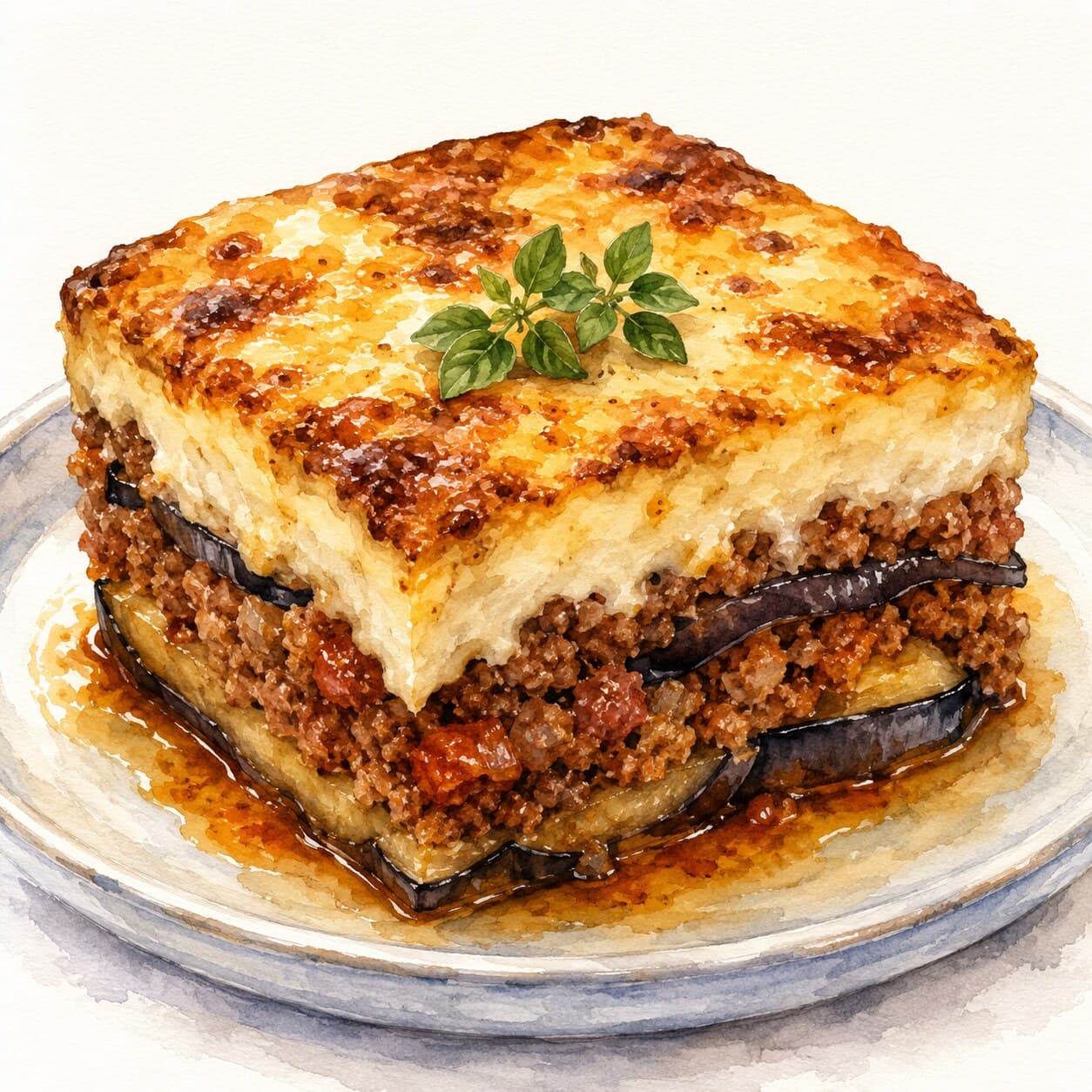
Delight in layers of tender eggplant, spiced ground lamb, and creamy béchamel in this classic Moussaka-style Eggplant dish.
Contents (5 sections)▾
Ingredients
- 2 medium eggplants, sliced into 1 cm rounds
- 500 g ground lamb or beef
- 1 onion, finely chopped
- 2 cloves garlic, minced
- 400 g canned chopped tomatoes
- 1 tsp ground cinnamon
- 1 tsp dried oregano
- Salt, to taste
- Pepper, to taste
- 50 ml olive oil
- 50 g butter
- 50 g all-purpose flour
- 500 ml milk
- 1 large egg
- 100 g grated Parmesan cheese
Steps
Preheat your oven to 180°C (350°F). This ensures even cooking for all layers of the moussaka.
Salt the eggplant slices and let them sit for 30 minutes to draw out moisture. This prevents a soggy dish.
Rinse the eggplant slices and pat dry. Heat 25 ml of olive oil in a skillet over medium heat and fry the eggplant until golden on both sides, about 3-4 minutes per side.
In the same skillet, add the remaining olive oil and sauté the onion and garlic until soft. Add the ground meat and cook until browned, then stir in the tomatoes, cinnamon, oregano, salt, and pepper. Simmer for 15 minutes.
For the béchamel, melt the butter in a saucepan over medium heat. Stir in the flour and cook for 2 minutes. Gradually whisk in the milk and cook until thickened, about 5 minutes. Remove from heat, stir in the egg and half the Parmesan.
In a baking dish, layer half the eggplant, followed by the meat sauce, the remaining eggplant, and top with béchamel. Sprinkle with the remaining Parmesan.
Bake in the preheated oven for 30-35 minutes or until the top is golden and set. Let it rest for 10 minutes before serving.
Why this works
Moussaka-style Eggplant showcases the technique of layering ingredients, which allows flavors to meld beautifully. The eggplant, when salted, releases excess moisture, keeping the dish from becoming overly watery. If the béchamel seems too thick while whisking, add a splash of milk to achieve a smooth consistency. The creaminess of the béchamel contrasts with the spiced meat sauce, creating a rich mouthfeel. Baking the layers allows the flavors to infuse while the béchamel sets on top, forming a delightful crust. If the top browns too quickly, cover it with foil halfway through baking to prevent burning while the inside cooks through. This layered approach ensures a satisfying texture and depth of flavor in each bite.
Common mistakes
Skipping or rushing the eggplant's salting step.
Target: Salt the slices and let them sit the full 30 minutes, then rinse and pat thoroughly dry before frying.
Why it matters: Eggplant holds a lot of water; salting draws it out through osmosis (moisture pulled out by salt), which both concentrates flavor and keeps the baked dish from turning watery. Skipping this, or not drying the slices well afterward, also means the oil will spit when the wet surface hits the hot pan, and the slices will steam instead of browning.
What to do: Give the full 30 minutes, then press the slices between towels until they feel dry to the touch before they go into the hot oil.
Leaving the ground meat in coarse clumps instead of breaking it up fully.
Target: Break the meat into small, even crumbles while browning, so no dense clump remains pink at the center once the sauce has simmered.
Why it matters: A dense clump of ground meat can look browned on the outside while its center stays under the safe 71°C/160°F mark, even after 15 minutes of simmering and a later bake — ground meat should show no pink and reach that temperature throughout, since grinding mixes surface bacteria into the interior.
What to do: Use a spoon or spatula to break the meat into small pieces as it browns, and check a piece from the center of the pan, not just the surface, before moving on to the tomatoes.
Adding the egg to béchamel while it's still too hot.
Target: Let the béchamel (a butter, flour, and milk sauce) cool for a minute or two off the heat before whisking in the egg.
Why it matters: Egg proteins begin to set around 63-70°C; stirring egg directly into a sauce that just came off the heat can cook it into visible flecks instead of blending into a smooth, custard-like topping.
What to do: Whisk the egg in a small bowl first, spoon in a little of the warm (not scalding) béchamel to temper it, then stir that mixture back into the pan off the heat.
Slicing the eggplant unevenly.
Target: Cut the rounds to a consistent thickness, close to the thickness suggested.
Why it matters: Thin slices fry quickly and can scorch or turn mushy while thicker slices in the same batch are still undercooked, leaving some layers of the finished dish soft and custardy and others firm.
What to do: Slice with a steady hand or a mandoline (an adjustable slicing tool) for even rounds, and fry slices of similar thickness together in the same batch.
What to look for
- Eggplant slices that come out of the salting step visibly beaded with moisture, then dry to the touch after patting. That moisture is what would have made the dish watery if left in.
- Ground meat with no pink remaining anywhere, including in the thickest crumbles. Cut into a larger piece from the center of the pan to check, not just the surface.
- A béchamel that thickens into a smooth, pourable custard with no visible egg flecks. Streaks or small curds mean the egg was added while the sauce was too hot.
- A top layer that is golden and set, with the dish holding its layers when sliced after resting. If it slumps into a puddle, it needed the full resting time for the béchamel to firm up.
A note on history
Moussaka's history stretches back well before the dish most people picture today. The name traces to the Arabic musaqqa'a, meaning roughly "moistened" or "pounded," and Ottoman Turkish carried a version of the word — and the dish — across the empire's territories from the 14th century onward, seeding related layered eggplant-and-meat dishes throughout the Balkans, the Levant, and North Africa, which is part of why Egypt, Greece, and various Middle Eastern countries each have a claim to the dish's roots. The version most familiar in Greek restaurants today, with its custardy béchamel top layer, is a much more recent invention: the French-trained Greek chef Nikolaos Tselementes introduced it in the 1920s as part of a broader effort to bring French technique into Greek home cooking. Before Tselementes, versions of the dish existed without béchamel at all; his layered, custard-topped structure is the one that spread and became the standard (Moussaka, Wikipedia).
Get the essays in your inbox — free
Weekly notes on flavor, fermentation, and food history — the writing behind the Atlas of Flavor. No spam; unsubscribe anytime.