
Momo (Himalayan Dumplings)
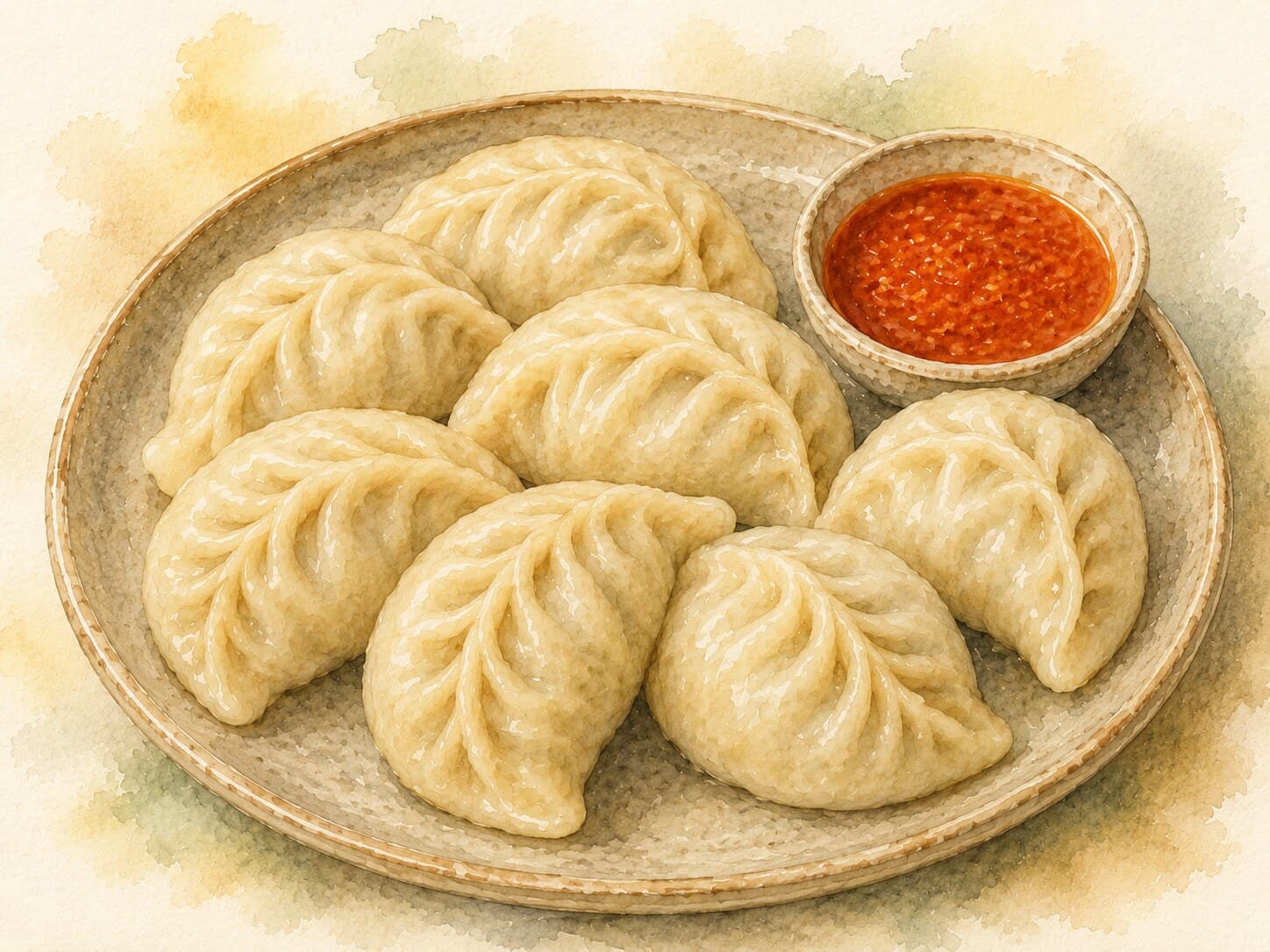
Momo are delightful Himalayan dumplings filled with spiced meat or vegetables, served with a rich sesame-tomato chutney.
Contents (5 sections)▾
Ingredients
- 250 g minced meat (chicken, pork, or beef) or vegetables
- 1 medium onion, finely chopped
- 2 cloves garlic, minced
- 1 inch ginger, minced
- 2 tbsp soy sauce
- 1 tsp ground cumin
- 1 tsp ground coriander
- 1/2 tsp turmeric powder
- 1/2 tsp red chili powder
- Salt to taste
- 300 g all-purpose flour
- 150 ml water
- 1 tbsp vegetable oil
- 2 medium tomatoes, chopped
- 2 tbsp sesame seeds, toasted
- 1-2 green chilies, chopped
- Cilantro sprigs for garnish
Steps
In a bowl, combine minced meat or vegetables, onion, garlic, ginger, soy sauce, cumin, coriander, turmeric, red chili powder, and salt. Mix thoroughly and let it marinate for 10 minutes.
In another bowl, mix the flour with water and oil to form a smooth dough. Knead for about 5 minutes, then cover and let it rest for 10 minutes.
Divide the dough into small balls, roll each into a thin circle about 10 cm in diameter. Place a spoonful of the filling in the center.
Pleat the edges of the dough around the filling, pinching them together to seal. Ensure they are tightly closed to prevent leakage during steaming.
Arrange the dumplings in a steamer basket lined with parchment paper. Steam over hard-boiling water for about 15 minutes. For meat momo the filling goes in raw, so cook it fully: cut one dumpling open to check the interior is no longer pink and reaches 74 °C / 165 °F on an instant-read thermometer before serving the rest — the wrapper turning translucent is a dough cue, not a meat cue.
While steaming, prepare the chutney by blending tomatoes, toasted sesame seeds, and green chilies until smooth. Adjust seasoning to taste.
Serve the steamed momo hot with the fiery sesame-tomato chutney and garnish with cilantro sprigs.
Tools you'll want
Why this works
The success of momo lies in the balance of flavors and the technique of pleating (the folded crimping that seals the dumpling shut while leaving a decorative top). This method ensures that the filling is enclosed securely, allowing the dumplings to retain their moisture while steaming (cooking with hot vapor over boiling water, which keeps the dough soft and the filling juicy). The marinated filling, with its mix of spices and aromatics, infuses the dumplings with rich flavor. If the dumpling wrappers are too thick, they may not cook evenly and can become chewy. To rescue this, ensure the dough is rolled out to a thin consistency. The steaming process is crucial as it preserves the juiciness of the filling while cooking the dough gently. A hint of chili in the chutney (a fresh, blended condiment served alongside the dumplings) creates a perfect contrast to the savory dumplings.
Common mistakes
Under-steaming the dumplings. Target: steam over actively boiling water for a full 15 minutes for chicken/pork/beef momo, until the interior reaches at least 74°C / 165°F and the meat shows no pink. Cut one dumpling open before serving the rest to verify. Why it matters: Momo are wrapped raw — the seasoned ground meat goes into the dough uncooked, then cooks entirely during the steam. The wrapper turning translucent is a wrapper signal, not a meat signal: the dough can look done while the center of a thick filling is still well below safe temperature. Under-steamed momo are the single most common reason home momo make people sick. What to do: Bring the steamer water to a hard rolling boil before the basket goes on. Don't open the lid for the first 12 minutes — every peek drops the temperature noticeably. After 15 minutes, lift one momo to a plate, slice it open, and confirm the meat is fully cooked through (no pink, juices clear). If in doubt, return the basket to the steamer for another 3 minutes. Cook in single layers if possible; if stacking, add 2–3 minutes per layer.
Rolling the wrappers thick or unevenly. Target: dough discs about 10 cm across, thin at the edges and slightly thicker (about 1–2 mm) at the center where the filling will sit. Why it matters: A thick edge means a chewy, gummy seam where the pleats overlap — those folds stack on themselves and the doubled or tripled layer never cooks tender. A center that is too thin tears under the filling and leaks juice into the steamer. Aim for an uneven thickness on purpose: thin at the perimeter so the pleated seal cooks through, slightly thicker in the middle to hold the filling without bursting. What to do: Roll each piece of dough starting from the center outward, rotating the disc a quarter turn between strokes. Press harder at the edges and lift the pin as you reach the center. If you cannot keep up, rest the dough under a damp cloth so it does not dry out while you work.
Sealing the pleats with dry hands. Target: keep a small bowl of water near the work surface; brush the rim of each disc lightly before folding. Why it matters: Dry dough does not stick to dry dough — and momo are pleated, not crimped, so the seam relies on a hydrated edge fusing to itself. A dry seal pops open during steaming, the filling juice runs into the steamer water, and you lose both flavor and structural integrity. The pleats also do double duty: they relieve pressure as the filling expands so the dumpling does not burst from the bottom. What to do: Dip a fingertip in water and run it around the rim of the dough disc before pleating. Pinch each pleat firmly between thumb and index finger so the seam is welded shut. If a momo unseals while pleating, set it aside and use it for testing doneness rather than serving.
Crowding the basket so dumplings touch. Target: dumplings spaced at least 1 cm apart, arranged in a single layer (or with parchment-paper rounds with steam holes between stacked layers). Why it matters: Wet dough on wet dough means the dumplings fuse to each other and tear when you try to separate them. Worse, steam flow gets blocked in the gaps between dumplings and parts of the basket end up cooler than the rest — you finish with some momo perfectly cooked and others still cold in the center. What to do: Brush the basket or the parchment with a thin film of neutral oil, lay the dumplings out with finger-width gaps, and steam in batches if you cannot fit them in a single layer. Plate steamed momo immediately so they do not sit on the wet steamer surface.
What to look for
- A wrapper that turns translucent but still holds its pleats sharply. Properly steamed momo are glossy and slightly see-through — you can faintly make out the filling color through the dough — and the pleats stand up cleanly rather than melting into the body. Limp, slumped pleats with an opaque white wrapper mean either the dough was too thick or the steam was not hot enough.
- A test cut showing fully cooked, juicy filling. Slice one open and the meat should look uniformly cooked: gray-brown throughout for beef and pork, opaque white for chicken, with hot juice that runs clear. Any pink, any cloudy juice, return the basket to the steamer.
- A momo that holds its shape when picked up with chopsticks but yields easily to a bite. The cooked wrapper should be tender, not stiff, but not so soft it tears under its own weight. A wrapper that splits open the moment you grab it was over-thinned at the seam; one that resists biting is under-steamed.
- A chutney that pools but does not slip off. Properly blended sesame-tomato achar is just thick enough to cling to the dumpling's pleats when dipped, with a glossy red-orange color and a coarse-but-spoonable texture. Watery, separated chutney has been under-blended; thick paste has been over-reduced.
A note on history
Momo trace back to the Tibetan Plateau and travelled into Nepal — the most often-cited route is the 7th-century marriage of the Nepalese Princess Bhrikuti to the Tibetan king Songtsen Gampo, with later trade between Tibet and the Lhasa Newar merchants of the Kathmandu Valley reinforcing the exchange. In Nepal the dumpling adapted to local preferences (buffalo and potato fillings, spicier seasoning, and the inseparable companion of a chili-tomato-sesame chutney known as achar), and the form is now a defining dish of Nepali cuisine alongside its Tibetan ancestor (Smithsonian, Taste Tibet).
Get the essays in your inbox — free
Weekly notes on flavor, fermentation, and food history — the writing behind the Atlas of Flavor. No spam; unsubscribe anytime.