
Mì Quảng
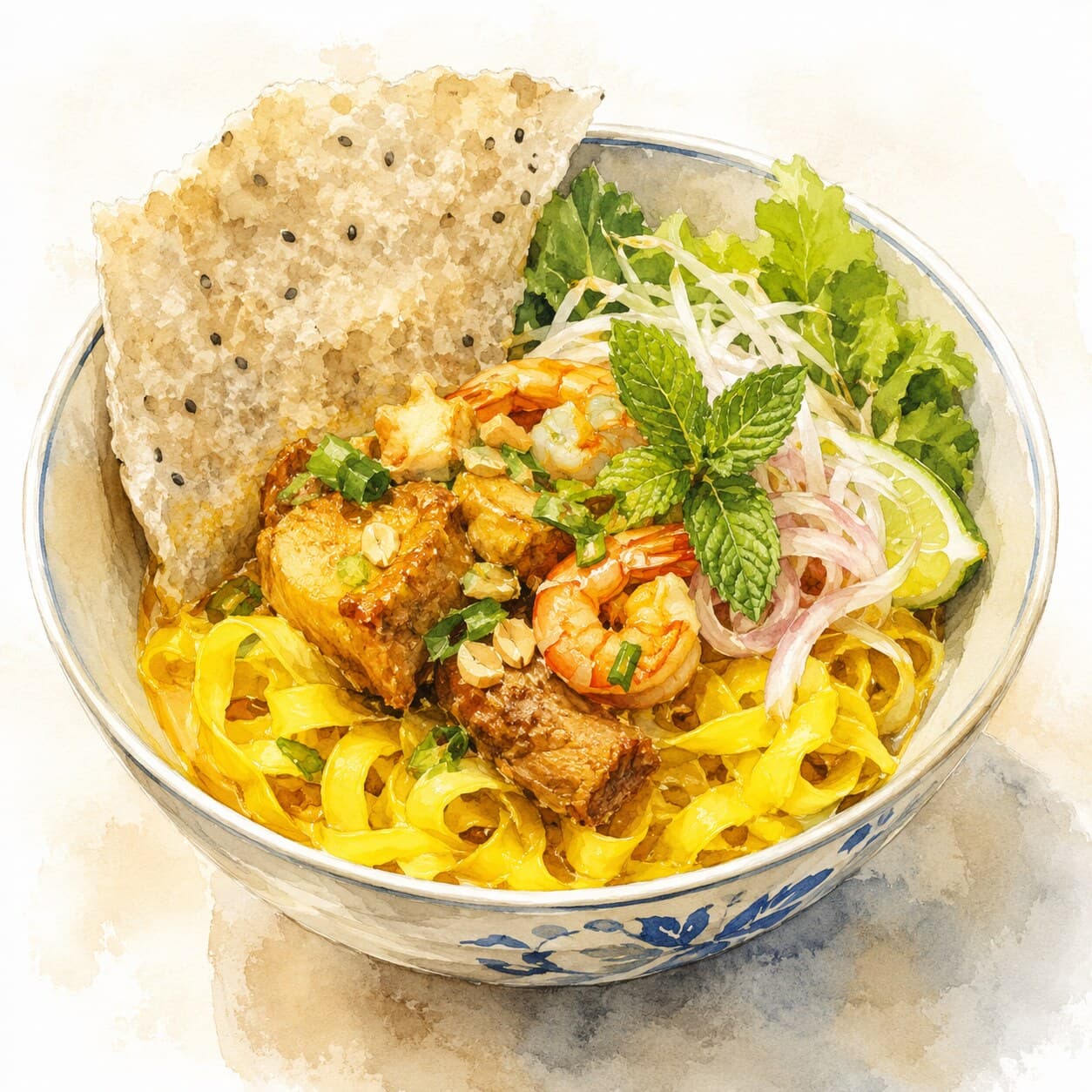
Mì Quảng is a vibrant Vietnamese noodle dish featuring turmeric-infused rice noodles, pork, shrimp, and fresh herbs.
Contents (5 sections)▾
Ingredients
- 200 g wide turmeric rice noodles
- 100 g pork belly, sliced
- 100 g shrimp, peeled and deveined
- 500 ml water
- 1 tsp turmeric powder
- 2 tbsp fish sauce
- 1 tbsp vegetable oil
- 1 clove garlic, minced
- 50 g roasted peanuts, crushed
- Fresh herbs (coriander, mint) to taste
- 2 sesame rice crackers (bánh tráng)
- Salt and pepper to taste
Steps
In a pot, heat 1 tbsp of vegetable oil over medium heat. Sauté the minced garlic until fragrant, about 1 minute.
Add the sliced pork belly to the pot and cook until browned, about 5 minutes.
Pour in 500 ml of water, then stir in the turmeric powder and fish sauce. Simmer for 10 minutes to develop the broth's flavor.
While the broth simmers, cook the turmeric rice noodles in a separate pot according to package instructions, usually about 5 minutes. Drain and set aside.
Add the shrimp to the broth and cook until they turn pink, about 3 minutes. Season with salt and pepper to taste.
To serve, place a portion of the cooked noodles in a bowl, ladle a small amount of the broth over the noodles, and top with shrimp, pork, crushed peanuts, and fresh herbs.
Finish with a sesame rice cracker on top for texture and serve immediately.
Why this works
Mì Quảng's success hinges on balancing the intense flavors of its components. The turmeric broth, while minimal, is crucial; it should not overwhelm the dish but rather enhance the noodles and toppings. The wide rice noodles are best when cooked just right—if they seem too soft, they can become mushy and lose their characteristic chewiness. Ensure the broth is bubbling but not boiling violently when you add the shrimp, allowing them to cook gently and retain their sweetness. The dish's freshness comes from the herbs, which should be added just before serving to preserve their vibrant taste. Using a sesame rice cracker adds crunch and a nutty flavor that complements the crushed peanuts. If you find the broth too strong, you can dilute it slightly with more water, but be careful not to lose the essence of the turmeric flavor.
Common mistakes
Ladling in broth as if this were a noodle soup.
Target: Use just enough turmeric broth to moisten and season the noodles — a few spoonfuls, not a full bowl.
Why it matters: Mì Quảng is defined by its dry-ish, lightly dressed noodles, unlike brothy soups such as phở; drowning the bowl mutes the herbs and peanuts and turns the noodles soft and slippery instead of pleasantly chewy.
What to do: Ladle a small amount over the noodles just before serving, enough to glisten and season them without pooling at the bottom of the bowl.
Slicing the pork belly too thick to cook through in the time given.
Target: Slice the pork belly thin (a few millimeters) so it browns and finishes cooking within the browning-and-simmer time; the meat should show no pink and the juices should run clear.
Why it matters: Thick-cut pork can look browned on the outside while the center stays underdone, since the total active cooking time here is short. Thin slices cook through evenly and pick up more of the turmeric and fish sauce.
What to do: Slice against the grain (across the meat's fibers, which keeps it tender) into thin pieces before browning, and cut into a piece to check that it is opaque throughout, with no pink, before adding the noodles and shrimp.
Pulling the shrimp before they're fully opaque, or leaving them in too long.
Target: Cook the shrimp just until they turn from translucent grey to opaque pink throughout and curl into a loose "C" shape.
Why it matters: Color change alone can mislead; a shrimp can look pink on the surface while the center is still translucent and undercooked, while a shrimp cooked past done curls into a tight "O" and turns rubbery.
What to do: Watch the shape as much as the color — pull the shrimp the moment they curl gently and turn fully opaque, usually within the 3 minutes the recipe suggests.
Assembling the bowl too far ahead of eating.
Target: Add the herbs and rice cracker (bánh tráng, a thin sesame cracker) right before serving.
Why it matters: The dish's appeal rests on contrast — warm noodles against crisp cracker, fresh herbs against savory toppings. Left to sit, the cracker softens in the residual steam and the herbs wilt.
What to do: Keep the cracker and herbs off to the side until the last moment, then top the bowl and serve immediately.
What to look for
- Noodles that glisten rather than swim. A thin coating of broth clinging to each strand, with no pool collecting at the bottom of the bowl, signals the right ratio.
- Pork that is opaque all the way through when cut, with no pink center. This confirms it has cooked fully despite the short cooking time.
- Shrimp that are fully pink and opaque, curled into a loose "C." A tightly curled "O" shape means they went past done and will taste rubbery.
- A rice cracker that still snaps audibly when broken. If it has gone soft and bendy, it sat too long before serving.
A note on history
Mì Quảng takes its name from Quảng Nam, the province in central Vietnam around Đà Nẵng and the old trading port of Hội An where the dish is most closely associated. Exactly how old it is remains murky: some food writers point to Hội An's centuries as a trading hub, where Chinese merchants who settled near the port are said to have brought wheat-noodle traditions later remade with local rice flour; others simply describe it as a home-grown specialty of the region without a precise founding story. The name itself is a small puzzle — "mì" typically implies wheat noodles elsewhere in Vietnam, yet the noodles here are made from rice flour, a substitution that apparently took hold long after the name had already stuck. In August 2024, Vietnam's Ministry of Culture, Sports, and Tourism recognized mì Quảng as part of the national intangible cultural heritage list, cementing its status as a signature regional dish served everywhere from everyday meals to death anniversaries and Tết (Lunar New Year) gatherings (Mì Quảng, Wikipedia).
Get the essays in your inbox — free
Weekly notes on flavor, fermentation, and food history — the writing behind the Atlas of Flavor. No spam; unsubscribe anytime.