
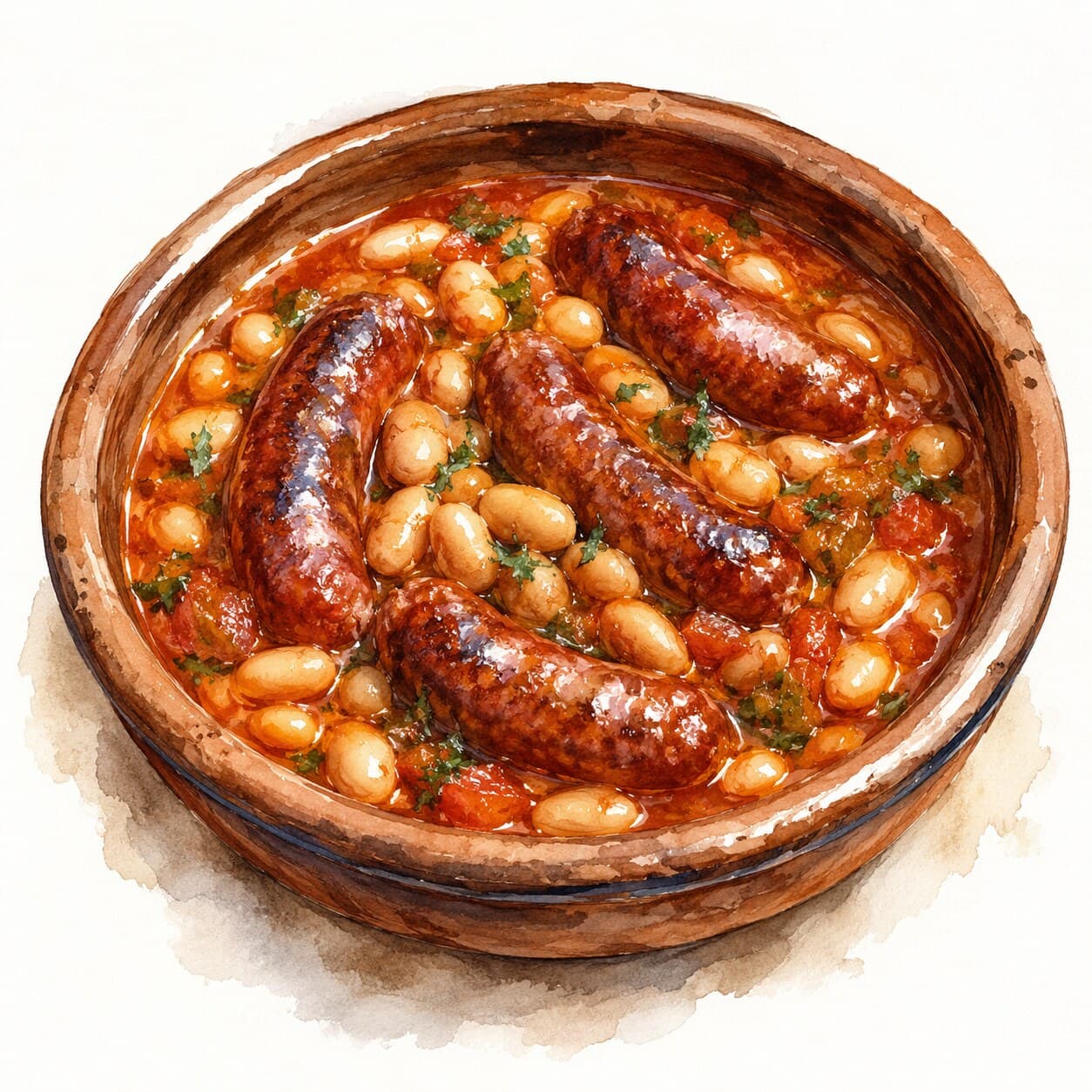
Merguez and White Bean Stew
A quick and flavorful merguez and white bean stew, perfect for a weeknight dinner.
Contents (5 sections)▾
Ingredients
- 400 g merguez sausage
- 400 g canned cannellini or navy beans, drained and rinsed
- 400 g diced tomatoes, canned
- 2 clove(s) garlic, minced
- 1 tsp smoked paprika
- 2 tbsp harissa
- 2 tbsp olive oil
- Salt to taste
- Fresh parsley for garnish
Steps
In a large pot, heat the olive oil over medium-high heat. Add the merguez sausage and brown for about 5-7 minutes, turning occasionally to ensure even cooking.
Once browned, remove the sausage and slice it into bite-sized pieces. Set aside.
In the same pot, add the garlic and sauté for 1 minute until fragrant. Then stir in the diced tomatoes, smoked paprika, and harissa, cooking for another 2-3 minutes.
Return the sliced merguez to the pot along with the beans. Stir to combine and season with salt to taste. Cover and simmer for 10 minutes, allowing the flavors to meld.
Serve hot, garnished with fresh parsley.
Why this works
This merguez and white bean stew showcases the rich, spicy flavors of North African cuisine, particularly through the use of merguez sausage, which is seasoned with spices like cumin and coriander. Browned merguez adds depth and a savory richness to the dish, while the beans contribute a creamy texture that balances the spice. The harissa adds a layer of heat and complexity. If the stew seems too thick after simmering, simply add a splash of water or broth to achieve the desired consistency. Cooking the garlic until fragrant ensures its flavor infuses throughout the stew without becoming bitter. This dish is versatile; feel free to adjust the spice levels according to your taste.
Common mistakes
Browning the outside of the merguez without checking that the center is cooked through.
Target: Cook the merguez completely, with no pink or raw color at the center — for sausage like this, that means reaching an internal temperature of about 71°C/160°F.
Why it matters: Merguez is typically sold raw rather than cured or pre-cooked, so unlike some charcuterie (preserved meats that are often sold ready to eat) it must be fully cooked before eating; searing the outside for color doesn't guarantee the center is done.
What to do: Brown it over medium-high heat as described, then cut into a piece (or check with a thermometer) to confirm there's no raw or pink color left before slicing it and returning it to the pot.
Adding the canned beans straight from the can without draining and rinsing.
Target: Drain and rinse the beans well, as the recipe specifies, before adding them to the pot.
Why it matters: The canning liquid is starchy and often heavily salted; adding it along with the beans can leave the stew tasting oversalted or flat, with a cloudy, gluey texture instead of a clean one.
What to do: Tip the beans into a sieve or colander and rinse under cool water until it runs clear, then shake off the excess before adding them.
Adding all the harissa at once without tasting as you go.
Target: Start with less harissa (a North African chili paste whose heat can vary a great deal by brand) than the recipe calls for if you're unsure of its strength, then add more gradually.
Why it matters: Harissa ranges from mild to very hot depending on the brand or batch; stirring in a fixed amount blindly can make the stew far spicier — or blander — than intended.
What to do: Stir in about half the harissa first, let it simmer in, taste, then add more until the heat matches your preference.
Simmering too hard or too briefly.
Target: Keep the stew at a gentle simmer — small, lazy bubbles — for the time given, not a hard boil.
Why it matters: Since canned beans are already cooked, the simmer is mainly about marrying the flavors of the sausage, tomatoes, and harissa into the beans; a hard boil can break the beans down into a grainy mush, while too short a simmer leaves the components tasting separate rather than unified.
What to do: Keep the heat low enough for a gentle simmer, and give the stew its full cooking time so the flavors come together without turning the beans to paste.
What to look for
- No pink or raw color when a piece of merguez is cut open. This is the clearest doneness check for a raw sausage — the center should look fully cooked and opaque throughout, matching the browned exterior.
- Beans that are creamy and tender but still hold their shape, not broken down into mush. A short, gentle simmer is enough since canned beans are already cooked.
- A stew that's thickened slightly and clings to the beans, rather than sitting thin and watery. The tomatoes and a little rendered (melted out of the sausage during cooking) sausage fat should bind everything into a cohesive stew; if it looks thin, a few more minutes of uncovered simmering helps it come together.
A note on history
Merguez is a spicy sausage, traditionally made from lamb or a lamb-and-beef mix, from the Maghreb — the North African region spanning Morocco, Algeria, Tunisia, and Libya. Its characteristic red color and heat come from a spice mix that typically includes chili and paprika alongside cumin, fennel, or garlic, with the exact blend varying by region and butcher.
Merguez is now just as strongly associated with France, where it became a fixture of home grilling and butcher-shop counters as North African communities settled there over the twentieth century, bringing their food traditions with them. That dual identity — a North African sausage thoroughly woven into French home cooking — is reflected in this stew's pairing of merguez and harissa with white beans, a staple of French and wider European cooking, bridging both traditions in a single pot.
Get the essays in your inbox — free
Weekly notes on flavor, fermentation, and food history — the writing behind the Atlas of Flavor. No spam; unsubscribe anytime.