
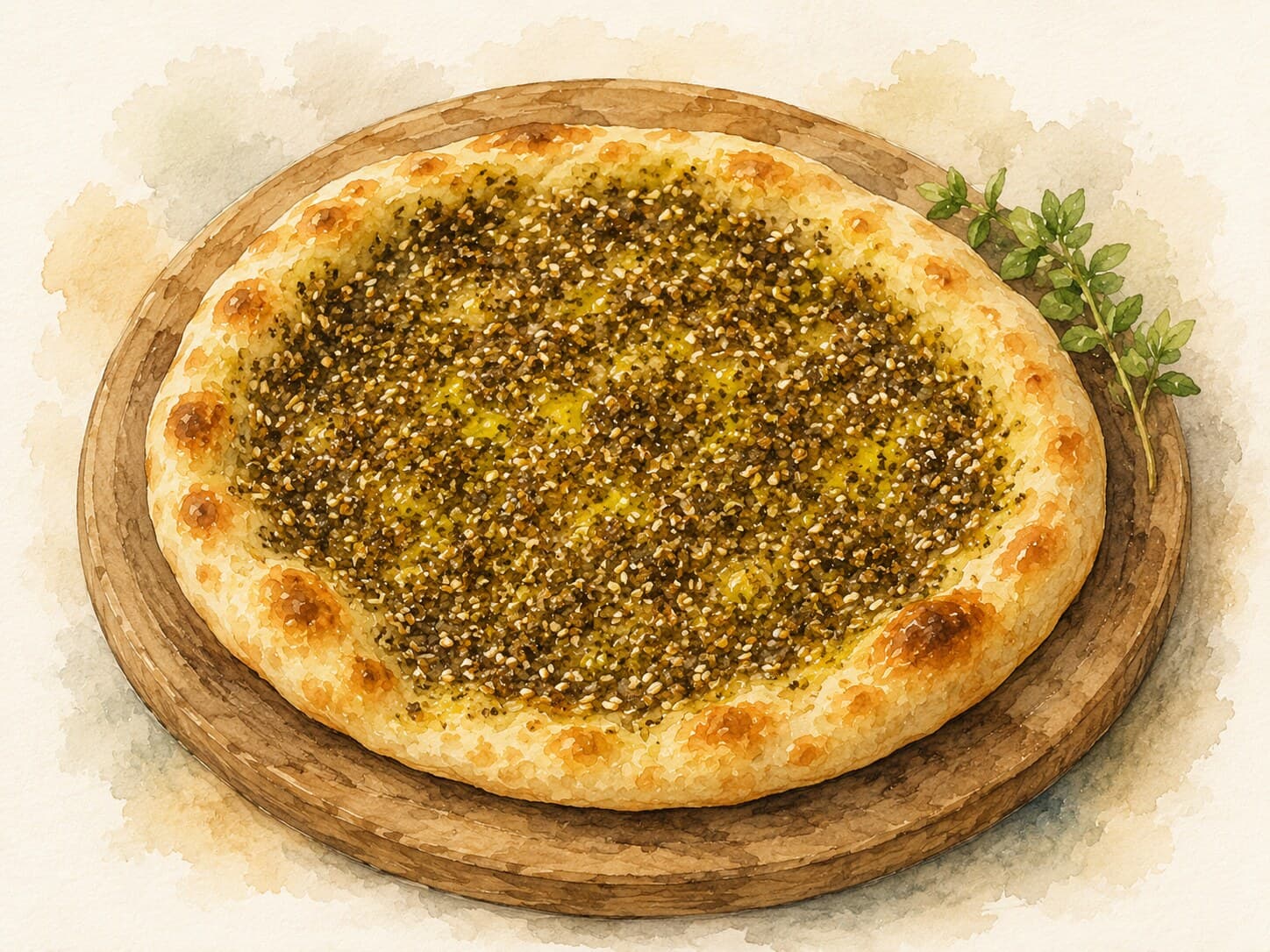
Manakish Zaatar (Levantine Za'atar Flatbread)
Enjoy the aromatic flavors of the Levant with this easy Manakish Zaatar recipe, perfect for breakfast or a light meal.
Contents (5 sections)▾
Ingredients
- 500 g all-purpose flour
- 10 g salt
- 10 g instant yeast
- 300 ml warm water
- 30 ml olive oil
- 100 g za'atar
- 60 ml additional olive oil for topping
Steps
In a large bowl, mix the flour, salt, and instant yeast. Add the warm water and 30 ml of olive oil, and knead until you have a soft dough, about 10 minutes.
Cover the dough with a damp cloth and let it rise in a warm place for about 1 hour, or until it doubles in size. This allows the yeast to activate, creating a light texture.
Preheat your oven to 220°C (428°F). Punch down the dough to release air, then divide it into 4 equal portions. Roll each portion into a circle about 0.5 cm thick.
In a small bowl, mix the za'atar with the remaining 60 ml of olive oil to create a paste. Spread this mixture evenly over each rolled-out dough circle.
Transfer the topped dough onto a baking sheet and bake in the preheated oven for 10-15 minutes, or until the edges are golden brown and the bread puffs up.
Remove from the oven, let cool slightly, and enjoy warm, perhaps with fresh vegetables or yogurt.
Why this works
The combination of yeast and warm water creates a dough that rises beautifully, yielding a light and airy flatbread. The za'atar, a blend of herbs, adds aromatic depth, while the olive oil enhances flavor and creates a crisp texture. It’s essential to spread the za'atar paste generously, as it flavors the bread and helps create that toasty crust as it bakes. If your dough seems too sticky, add a small amount of flour while kneading; if it feels too dry, you can introduce a teaspoon of warm water at a time until the desired consistency is achieved. Baking at a high temperature ensures the bread puffs up quickly, creating a pleasing texture and aroma. Serve it warm for the best experience, as the flavors are most vibrant right out of the oven!
Common mistakes
Dough rolled too thin, edges too thick. Manakish is a flatbread, not a pizza. The dough should be rolled to a consistent thickness — about 4–5 mm — without thick edges. Otherwise the za'atar pools in a soggy centre while the edges are hard and dry. Target: rolled disc of uniform 4–5 mm thickness. No raised "crust" border like pizza. Why it matters: thinner spots cook through faster and risk burning while thicker spots remain doughy. The za'atar oil also pools in any thin depression, deepening the unevenness. A flat consistent disc means the heat reaches all areas at once. What to do: use a light dusting of flour and a rolling pin (not your hands — they make uneven thickness). Slide a hand under the disc occasionally to feel for soft spots. If you press a finger in, it should leave a clear mark but spring back slowly.
Bread pulled when only the edges look golden — the centre is raw. Like any flatbread baked at high heat, the rim catches first. If you trust the rim and pull early, the dough underneath the za'atar is still raw. Target: baked through — the underside should be lightly browned and dry, not pale and tacky, when you lift a corner. Bread should sound hollow when tapped on the base. Why it matters: za'atar oil on top insulates the surface from the oven's radiant heat — so the topping looks "done" before the dough underneath is set. Underbaked dough means raw flour in the centre, which is unsafe and unpleasant. What to do: at the 8-minute mark, slide a peel or spatula under one manakish and lift. If the underside is still pale, give it 2–3 more minutes. Edges should be golden, centre underside should be dry. Trust the bottom, not the top.
Za'atar mixed with cold oil so it sits like dry powder. Za'atar (a Levantine blend of wild thyme, sumac, sesame, and salt) needs to be loosened with olive oil into a slack paste — otherwise it doesn't spread, it doesn't carry flavour deep, and the powder burns dry on the surface. Target: za'atar mixed with olive oil into a spoonable paste — about 1 part za'atar to 1.5 parts oil by volume. It should pour slowly, not crumble. Why it matters: za'atar's flavours (thymol from thyme, vitamin-C-like tartness from sumac, nuttiness from sesame) are fat-soluble. Oil dissolves them and carries them across the dough. Dry powder just sits, scorches, and tastes harsh. What to do: stir the za'atar into the oil first and let it sit 5 minutes. The mixture will thicken slightly. Spoon it generously onto the rolled dough and spread to the edges — including a thin coat right to the rim so the rim also tastes seasoned.
Hot oven, hot tray, hot stones — and no respect. Manakish bakes at 220°C+, often on a pre-heated stone or steel. A burn at this temperature is serious; so is opening the oven without keeping your face clear of the steam blast. Target: baked at 220°C (428°F) in a fully preheated oven, on a tray or pizza stone that has come up to temperature. Oven mitts on, face turned away when opening. Why it matters: flatbreads need radiant heat from below to set the dough quickly. A pre-heated stone or steel gives that "oven floor" feel of a clay oven. But hot metal and 220°C steam can cause real burns — skin reacts in less than a second. What to do: preheat the oven and the tray together for at least 30 minutes before baking. Use a peel or oven-safe spatula to load and unload — never your hand. When opening the door, step back, turn your face away, then look in. Let the bread cool slightly before tearing or cutting.
What to look for
- A flat, even disc that holds its shape without contracting back. Properly rested dough rolls out and stays put. If it keeps shrinking, the gluten is too tight — let the disc rest a few more minutes before topping.
- Za'atar paste that spreads in a continuous coat with no powdery dry patches. Wherever you see dry powder on the dough, that spot is going to burn while the rest looks fine. Add another drizzle of oil and re-spread.
- Underside that is golden brown and sounds hollow when tapped. This is the single most reliable doneness signal. Edges and tops can deceive; the underside is honest.
- A fragrant, slightly toasted smell — not a burnt smell — when the oven opens. Toasted sesame and thymol from the za'atar should be the front note. If you smell acrid burning, the oven was too hot or the paste too dry.
A note on history
Manakish has been bread-and-breakfast in the Levant — Lebanon, Syria, Palestine, Jordan, and surrounding territories (Wikipedia, Al'Deewan Bakery). The earliest written reference to a flatbread topped with thyme and olive oil appears in a 10th-century Arabic cookbook, and by the Ottoman era the form had become daily: women would mix the dough at home, top it with za'atar from hills they themselves had foraged, and carry it to the village's communal furn (oven) to bake (Eats History). The herb blend za'atar itself — wild thyme, sumac, sesame, salt — has been part of Arab cooking since medieval times and is the subject of a folk belief that it sharpens the mind, a reason it's still served to schoolchildren before exams (Mamajoun).
Get the essays in your inbox — free
Weekly notes on flavor, fermentation, and food history — the writing behind the Atlas of Flavor. No spam; unsubscribe anytime.