
Baked Kibbeh
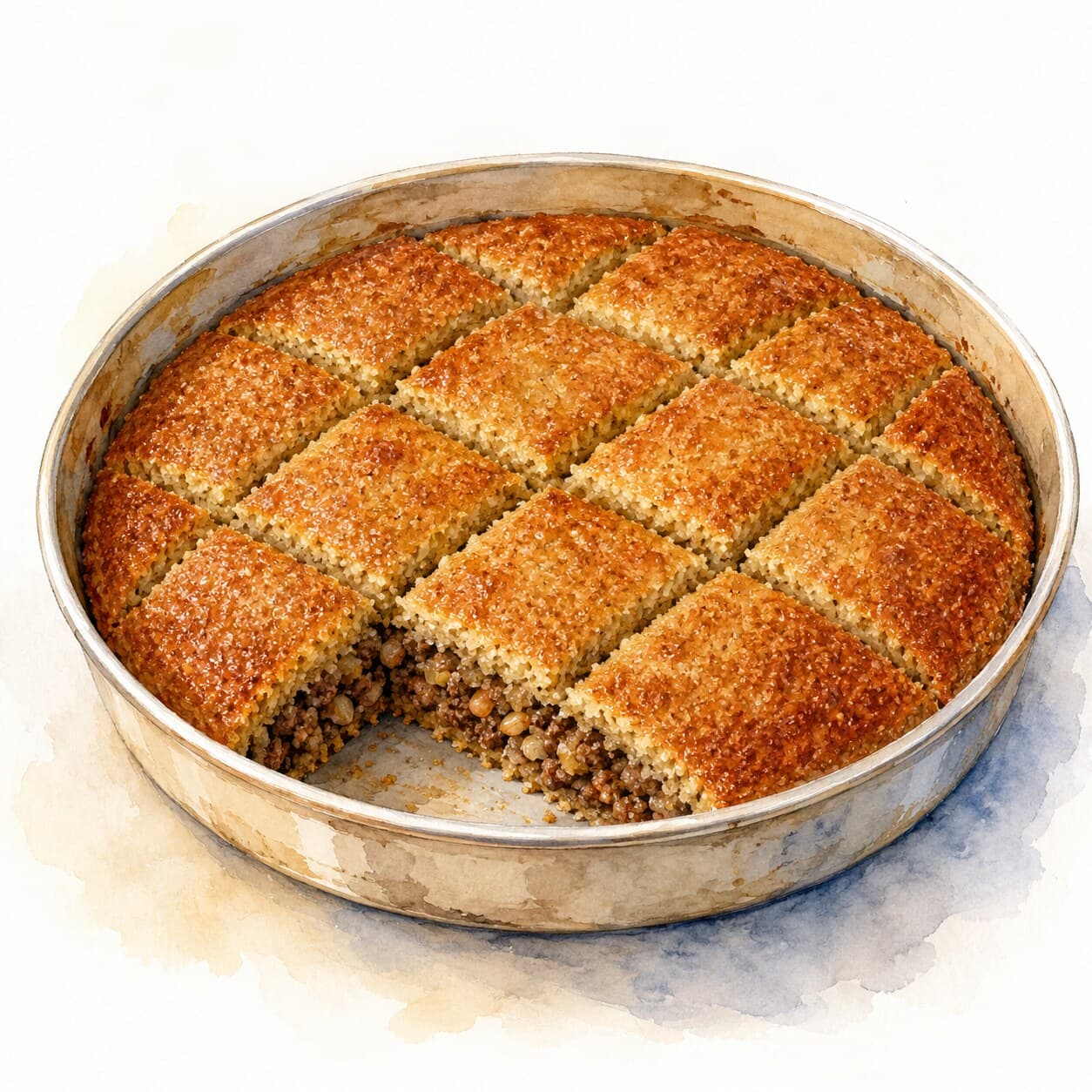
Enjoy a delicious baked kibbeh made with a spiced bulgur-meat shell and a savory pine-nut-and-meat filling.
Contents (5 sections)▾
Ingredients
- 250 g bulgur
- 300 g ground lamb or beef
- 1 medium onion, finely chopped
- 100 g pine nuts
- 1 tsp ground cinnamon
- 1 tsp ground allspice
- 1 tsp salt
- 1/2 tsp black pepper
- 3 tbsp olive oil
- 500 ml water
Steps
Preheat your oven to 180°C (350°F). This temperature ensures even cooking and a nicely browned top.
In a bowl, soak the bulgur in 500 ml of water for 20 minutes until it absorbs moisture and expands.
In a skillet, heat 2 tbsp of olive oil over medium heat and sauté the chopped onion until translucent, about 5 minutes.
Add the ground lamb or beef to the skillet, cooking until browned. Mix in the pine nuts, cinnamon, allspice, salt, and black pepper, cooking for an additional 5 minutes.
Drain any excess water from the bulgur and mix it with the meat mixture, combining well.
In a greased baking pan, spread half of the bulgur-meat mixture evenly to form the base layer.
Layer the remaining bulgur-meat mixture on top, pressing down gently. Score the top into diamond shapes with a knife for easy serving.
Drizzle the remaining olive oil over the surface and bake in the preheated oven for 30 minutes or until golden brown.
Remove from the oven and let it rest for 10 minutes before cutting along the scored lines to serve.
Why this works
The technique of creating a bulgur-meat shell gives baked kibbeh its signature texture and flavor. Soaking the bulgur softens it, allowing it to blend well with the meat, creating a cohesive dish. The use of ground lamb or beef adds richness, while the pine nuts introduce a delightful crunch and nutty flavor. Spices like cinnamon and allspice enhance the dish with warm undertones, typical of Levantine cuisine. If the kibbeh seems too dry after baking, you can drizzle a little broth or olive oil on top before serving to add moisture. Additionally, ensuring even pressing of the layers prevents cracks, leading to an intact presentation when cut into diamond shapes.
Common mistakes
Not breaking the ground meat into fine enough pieces while browning, so pink pockets survive.
Target: Break the meat into small, even crumbles as it browns in the skillet, until no pink remains and it reaches a safe internal doneness, about 71°C (160°F) for ground meat.
Why it matters: Ground meat mixes surface bacteria throughout the whole batch, not just on the outside, so every pocket needs to reach a safe temperature. A large, unbroken clump can stay pink and undercooked at its center even after the surface looks browned, and the baking step afterward may not be enough on its own to fix an undercooked core.
What to do: Use a spatula or wooden spoon to break the meat into small pieces as it cooks, stir frequently, and cut into a thicker piece to check that no pink remains before mixing it with the bulgur (parboiled cracked wheat that needs rehydrating before it's baked).
Skipping the bulgur soak, or draining it while it's still hard.
Target: Let the bulgur sit in water the full 20 minutes until it's tender and has visibly absorbed the liquid, then drain it well.
Why it matters: The soak is what rehydrates the bulgur; if it's still hard and dry when mixed with the meat, the baked kibbeh comes out with a gritty, undercooked shell, and leftover unabsorbed water can also make the mixture soggy.
What to do: Taste a few grains after soaking — they should be soft, not chalky — and squeeze or drain off any excess water before combining with the meat.
Pressing the layers unevenly, leaving thin patches or cracks.
Target: Press both the base and top layers to an even thickness across the whole pan, patching any thin spots before baking.
Why it matters: Thin patches cook, dry out, or scorch faster than the rest of the pan, while thicker patches lag behind, so an uneven kibbeh can end up over-baked at the edges and under-baked at the center at the same time.
What to do: Use damp hands or the back of a spoon to press and smooth the mixture evenly before scoring it into diamonds.
Judging doneness by the color of the top crust alone.
Target: Look for an evenly golden-brown top, and also confirm there's no pink when a piece near the center is cut open.
Why it matters: The surface can brown nicely in 30 minutes while a thick, densely packed center lags behind, especially in a deep pan; color on top is a useful cue but not a substitute for checking the center, particularly with a dish built on ground meat.
What to do: After the 30 minutes, lift out one scored piece from the middle of the pan and check that it's cooked through with no pink before letting the whole pan rest and serving.
What to look for
- Bulgur after soaking that looks plump and tender, with no hard or chalky grains left. That's the right texture for the shell before it meets the meat.
- Browning meat that shows no pink and breaks apart into small, even crumbles. Large unbroken clumps are a sign to keep chopping as it cooks.
- A baked top that's evenly golden-brown from edge to edge, not just at the corners. Patchy coloring usually points to uneven pressing underneath.
- A cut center that's fully cooked through with no pink, and layers that hold together rather than crumbling apart. Crumbling usually means the bulgur was too dry or too wet going in.
A note on history
Kibbeh's documented history stretches back further than most home-cooked dishes: an 18th-century Arabic dictionary, Taj al-'Arus, already describes a version made of ground meat and bulgur as a specialty "of the people of al-Sham" — the Levant, the region spanning today's Lebanon, Syria, Jordan, and Palestine. Nineteenth-century travelers documented it further: American missionary William McClure Thomson called it "the national dish of the Arabs" after visiting Lebanon in 1847, and Swedish orientalist Jacob Berggren catalogued eight varieties in an 1844 dictionary of the region (Wikipedia: Kibbeh).
Kibbeh is claimed today as a national dish by both Lebanon and Syria, and it takes a wide range of regional forms — a single 20th-century encyclopedia of Aleppo alone described dozens of local variations. This baked version, pressed flat into a pan and cut into diamonds before serving, is one of the most common home-cooking preparations, alongside fried, torpedo-shaped versions built from the same bulgur-meat shell (Wikipedia: Kibbeh).
Get the essays in your inbox — free
Weekly notes on flavor, fermentation, and food history — the writing behind the Atlas of Flavor. No spam; unsubscribe anytime.