
Kanelbulle (Swedish Cinnamon Roll)
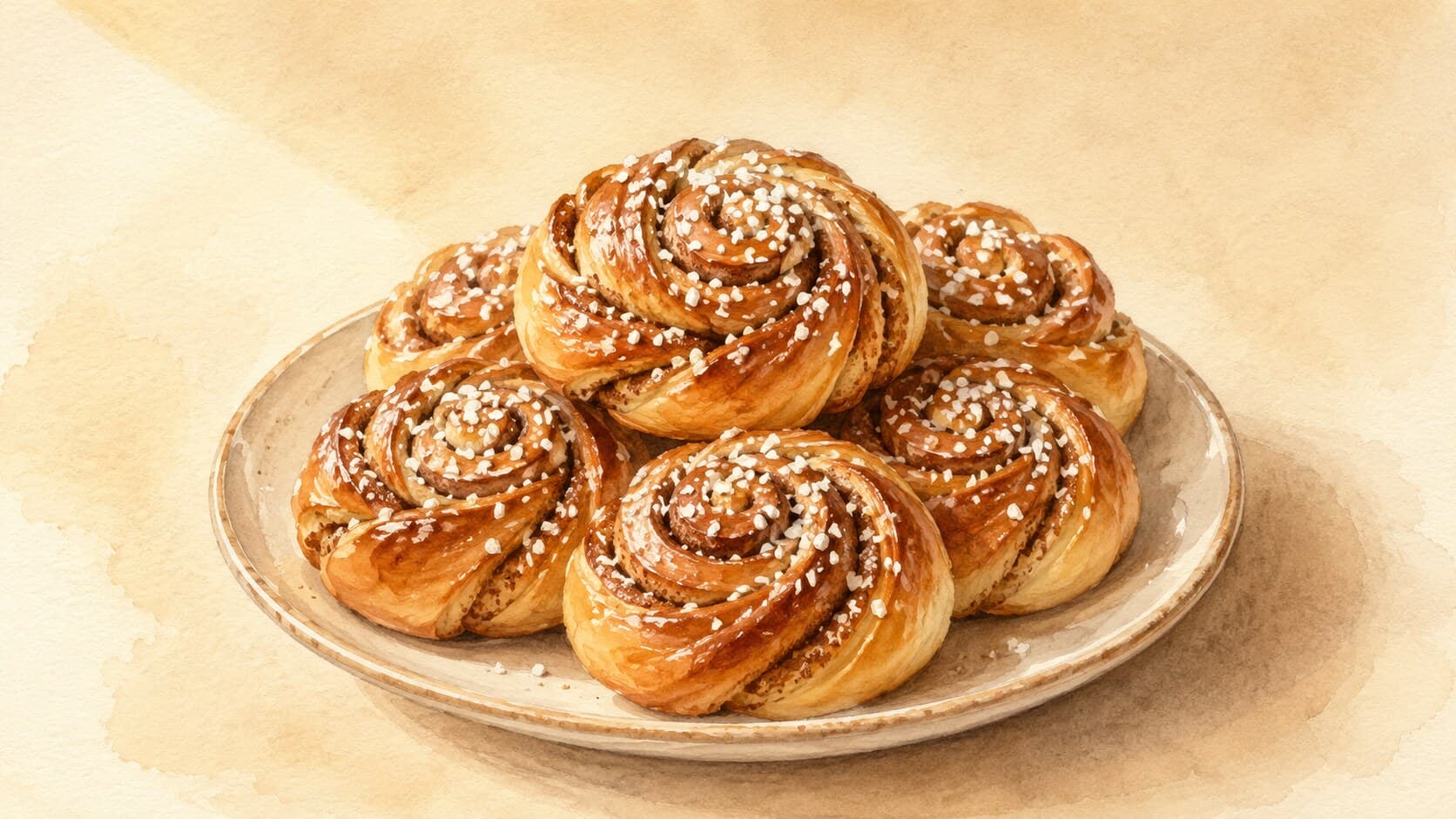
Kanelbulle are traditional Swedish cinnamon rolls made from a yeast dough, filled with a mixture of cinnamon and sugar, then rolled and baked.
Contents (5 sections)▾
Ingredients
- 500 g all-purpose flour
- 75 g granulated sugar
- 10 g salt
- 20 g active dry yeast
- 250 ml whole milk, warm
- 100 g unsalted butter, melted
- 1 large egg
- 2 tsp ground cardamom
- 100 g brown sugar
- 2 tbsp ground cinnamon
- Pearl sugar for topping, to taste
Steps
In a bowl, combine warm milk and yeast. Let it sit for 5 minutes until frothy to ensure the yeast is active.
In a separate large bowl, mix flour, sugar, salt, and cardamom. Add melted butter and the yeast mixture, followed by the egg. Mix until a dough forms.
Knead the dough for about 10 minutes until smooth and elastic. Place it in a greased bowl, cover, and let it rise in a warm place for 1 hour or until doubled in size.
Once risen, roll out the dough into a rectangle (about 40x60 cm). Spread brown sugar mixed with cinnamon over the surface.
Roll the dough tightly from the long side and cut into 12 equal pieces. Shape them into knots and place on a baking tray lined with parchment paper.
Cover the rolls and let them rise for another 30 minutes. Preheat your oven to 225°C (437°F).
Bake for 12-15 minutes until golden brown. Once out of the oven, sprinkle with pearl sugar while still warm.
Why this works
The Kanelbulle (a Swedish cinnamon-and-cardamom bun shaped into a spiral or knot) is an enriched dough, which means it contains fat (in this case, butter) and sugar, allowing for a tender, flavorful roll. The addition of cardamom not only enhances the aromatic profile but is traditional in Swedish baking, providing the authentic taste that distinguishes Kanelbulle. Kneading is essential for developing gluten, which gives the dough its structure and chewiness. If your dough seems too sticky, add a little more flour, a tablespoon at a time, until it is manageable. If the rolls break apart while shaping, ensure you're not rolling them too tightly or using too much flour, which can hinder their rise. Rising times are crucial; don't rush them as they contribute significantly to the final texture. Baking at a high temperature ensures a crisp exterior while maintaining a soft interior. The pearl sugar adds a delightful crunch, making each bite a perfect blend of textures.
Common mistakes
Killing the yeast with hot milk.
Target: Milk warm to the inside of the wrist (≈37 °C / 99 °F) — body-temperature, never hot. The yeast should foam within 5 minutes.
Why it matters: Yeast is a living organism (single-celled fungi that eat sugar and release CO₂). Above roughly 50 °C the cells start dying; above 60 °C they're gone. Dough made with overheated milk simply doesn't rise — there's nothing alive in it. Cold milk (under ~25 °C) only slows things down, but lukewarm hot-water-tap milk is a common kill.
What to do: Heat the milk briefly, then dip a clean finger in — it should feel barely warm, not warm. If you accidentally overheated it, let it cool to wrist temperature before adding the yeast. If the milk-yeast mix doesn't foam in 5 minutes, the yeast is dead; start again.
Skipping the cardamom or using stale ground cardamom.
Target: Freshly ground green cardamom — ideally the seeds crushed in a mortar shortly before mixing. Pre-ground cardamom that's been in a jar for a year has lost most of its volatile aromatics.
Why it matters: Cardamom is the signature aroma that separates a Swedish kanelbulle from a generic cinnamon roll. Its essential oils evaporate quickly once ground — old jarred cardamom smells faintly woody, not perfumed. If you can't smell the spice across the kitchen when you open the jar, it's no longer doing the work.
What to do: Buy whole pods or seeds and crush as needed. If you only have ground, smell it first; if it's flat, double the quantity or replace it.
Under-proofing the dough.
Target: First rise until the dough has roughly doubled in size (about 60–90 minutes in a warm kitchen); second rise (after shaping) until the rolls look visibly puffed and feel pillowy when gently pressed, springing back slowly — 30–45 minutes.
Why it matters: Enriched dough (one made with butter, milk, sugar, eggs) is heavy — the fat and sugar slow the yeast and weaken the gluten net. Rushing the proof gives a dense, tight crumb instead of the airy, layered spiral that's the whole point. The CO₂ from the yeast needs time to inflate the dough into a network of fine bubbles.
What to do: Treat proofing times as minimums, not maximums. If the kitchen is cool, expect to add 30+ minutes. The dough tells you when it's ready, not the clock.
Over-flouring while rolling out.
Target: A lightly floured surface — just enough to keep the dough from sticking. The dough should still feel soft and slightly tacky to a fingertip.
Why it matters: Each handful of extra flour absorbs moisture from the dough surface, drying it out. Dry dough won't seal cleanly when you roll up the rectangle, so the cinnamon spiral unravels in the oven, and the baked crumb is tough rather than tender.
What to do: Start with a thin dusting and add only what you need. If the dough resists rolling, give it 5 minutes to relax (the gluten net needs time to unwind) instead of adding more flour.
What to look for
- Active yeast slurry: a thin layer of foam on the warm milk within 5 minutes; smells faintly bready. No foam means dead yeast.
- Well-kneaded dough: smooth, elastic, slightly tacky; passes a windowpane test — stretch a small piece thin enough to see light through without tearing.
- First rise complete: roughly doubled in volume; a fingertip pressed gently leaves a dent that springs back slowly.
- Final proof on the tray: the shaped rolls look puffy and almost touch each other; the surface is no longer tight or smooth but slightly relaxed.
- Just-baked rolls: deeply golden-brown across the top with the cinnamon visible at the edges of the spiral; cardamom should be smellable from across the room.
A note on history
The kanelbulle as we know it is a 20th-century Swedish creation — cinnamon rolls themselves trace back to earlier European baking, but the specifically Swedish version became a home and café staple only after the First World War, when wartime rationing of butter, sugar, wheat flour, and cinnamon ended and bakeries could once again afford to use them generously. In the 1920s the buns were a relative luxury; through the folkhemmet era of the 1950s, as household budgets and home baking expanded, they became the everyday pastry of fika — Sweden's coffee-and-cake pause. October 4 is celebrated nationally as Kanelbullens dag (Cinnamon Bun Day), introduced in 1999 to mark the bun's place in everyday Swedish life (196 flavors, Gambero Rosso, The Local Sweden).
Get the essays in your inbox — free
Weekly notes on flavor, fermentation, and food history — the writing behind the Atlas of Flavor. No spam; unsubscribe anytime.