
Kaiserschmarrn
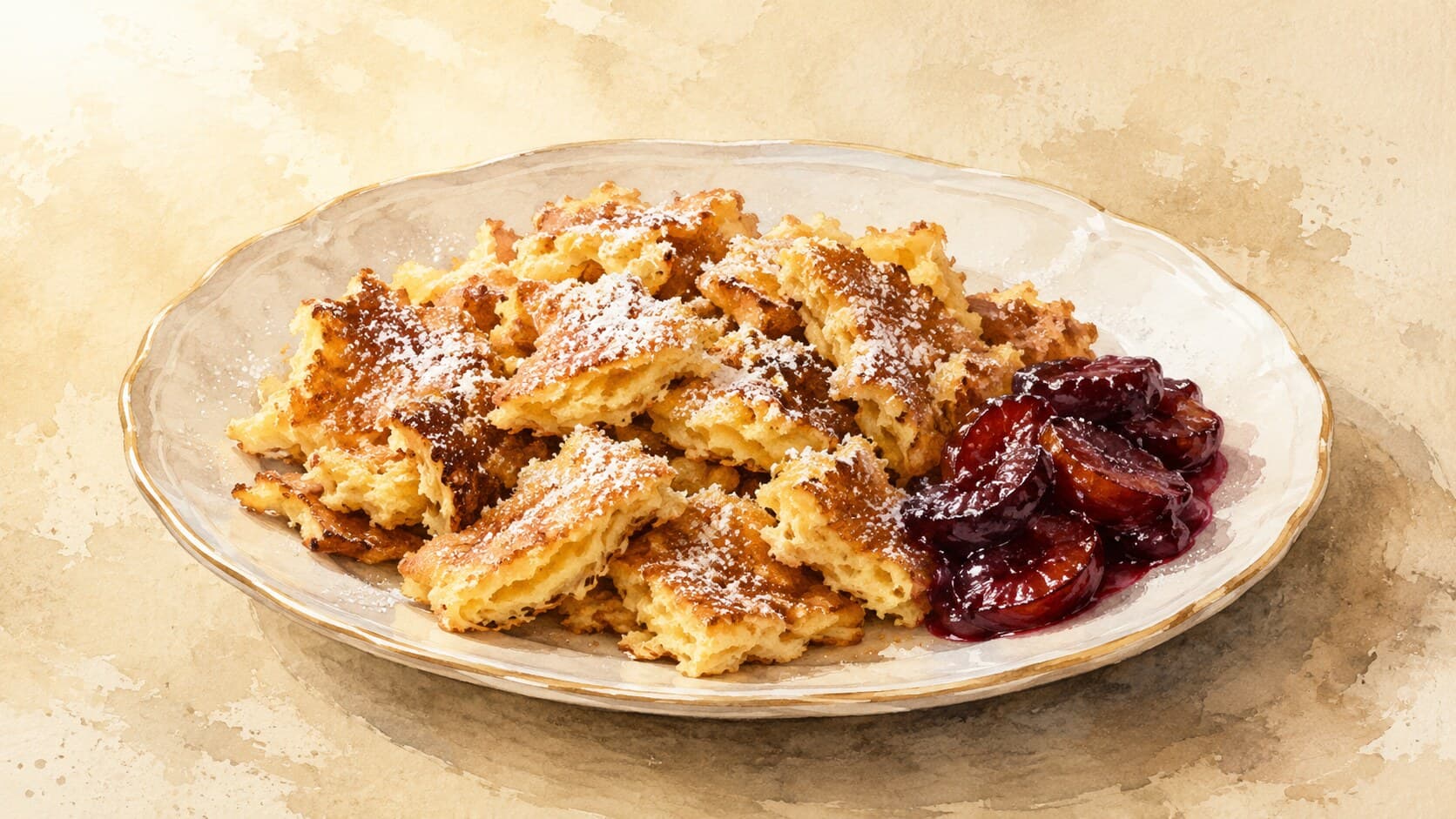
Kaiserschmarrn is a decadent Austrian dessert featuring fluffy, shredded pancakes served with fruit compote.
Contents (5 sections)▾
Ingredients
- 4 large eggs
- 100 g all-purpose flour
- 300 ml milk
- 30 g granulated sugar
- 1 tsp vanilla extract
- 1 pinch salt
- 30 g unsalted butter
- Powdered sugar for dusting
- Plum compote, for serving
Steps
Separate the egg yolks and whites. In a bowl, whisk together egg yolks, flour, milk, sugar, vanilla extract, and salt until smooth.
In another bowl, beat the egg whites until soft peaks form. This will help make the batter light and fluffy.
Gently fold the beaten egg whites into the batter, being careful not to deflate the mixture.
Heat a large skillet over medium heat and add half of the butter. Once melted, pour in half of the batter and cook for about 3-4 minutes, until the bottom is golden brown.
Using a spatula, flip the pancake and cook for another 3-4 minutes. Once cooked, tear it into bite-sized pieces and continue cooking until golden.
Repeat the process with the remaining batter, adding the rest of the butter to the pan. Dust with powdered sugar before serving.
Serve warm with plum compote on the side.
Why this works
Kaiserschmarrn's (a fluffy Austrian pancake that's torn into bite-sized pieces in the pan and dusted with powdered sugar) unique texture comes from the combination of a rich batter and the incorporation of whipped egg whites. Separating the eggs allows for a lighter batter, as the whipped whites create air pockets, leading to a fluffy outcome. The cooking method, which involves frying in butter, gives a beautiful golden crust that contrasts with the soft interior. If the pancake seems too dense, ensure the egg whites are beaten until soft peaks form, as this is critical for achieving the desired fluffiness. If it breaks while flipping, don't worry; simply piece it back together in the pan and allow it to cook further. This dish is versatile, often served with various fruit compotes, enhancing its flavor and making it a delightful end to any meal.
Common mistakes
Over-whipping the egg whites.
Target: Soft peaks — when you lift the whisk, the peak should fold back over on itself, not stand sharp and dry. Stop the moment the whites hold a shape.
Why it matters: Soft peaks still hold water and fold smoothly into the yolk batter. Stiff or grainy whites have lost their ability to stretch — they break into clumps when folded, releasing the trapped air. The pancake comes out dense and patchy instead of evenly fluffy. The egg foam (a network of unfolded protein wrapping air bubbles) is what makes Kaiserschmarrn rise; if it collapses before the pan, nothing in cooking will bring it back.
What to do: Watch the whisk, not the clock. As soon as the foam stops sliding around the bowl and holds the whisk's track, it's done. Fold immediately while the foam is fresh.
Deflating the batter by folding too hard.
Target: A gentle cut-and-fold with a flexible spatula — turn the bowl, cut down through the centre, lift up and over, repeat about 10–12 times. Stop when no white streaks remain.
Why it matters: Stirring or whisking the whites into the yolk batter pops the air bubbles you just worked to build. Over-folded batter looks soupy and bakes flat.
What to do: Add a third of the whites first to slacken the heavy yolk batter, then fold in the rest in two additions. Accept a few small streaks of white over a deflated, smooth batter.
Pan too hot at the start.
Target: Medium-low heat under a generously buttered pan; the butter should foam and smell nutty but not brown when you add the batter.
Why it matters: Kaiserschmarrn must cook through (eggs must be fully cooked through — the centre set, no glossy raw batter — for food safety as well as texture). Too-hot a pan gives a brown crust over a wet, undercooked centre. Medium-low lets heat reach the middle while the bottom sets golden, not burned.
What to do: Pour the batter and don't touch it for the first few minutes. If the underside is browning faster than the top is setting, slide the pan off the heat and finish under a lid or briefly in a warm oven.
Tearing the pancake too early.
Target: Tear (or use two forks to pull apart) only after the second side has set and the interior is no longer wet. Then continue cooking the torn pieces for another minute or two so the cut edges crisp.
Why it matters: "Schmarrn" — the shredding step — is what gives the dish its name and its signature contrast: caramelised torn edges around a tender, custardy crumb. Tearing too early exposes raw batter that gums up the pan; tearing too late, after the surface has dried, gives leathery pieces with no new crust.
What to do: When you can lift a corner cleanly with a spatula and the underside is golden, flip, finish the second side, then tear. A short final toss in the buttery pan caramelises the new edges and lifts the powdered-sugar finish.
What to look for
- Folded batter ready for the pan: pale yellow, airy, holds a soft mound on the spatula. If it pours like crêpe batter, the whites have been over-folded.
- First side, about to flip: the underside is even golden-brown when you lift a corner; the top has lost its wet shine and bubbles are slowing.
- Inside the torn pieces: tender, custard-like, fully set with no glossy raw batter. If a piece pulls a thread of wet batter, it needs another minute.
- Final toss in the pan: the torn edges turn deeper gold and the powdered sugar dusted on top should melt into a thin glaze, not stay chalky.
A note on history
Kaiserschmarrn — literally "the Emperor's mess" — takes its name from Emperor Franz Joseph I of Austria (1830–1916), who, the popular story goes, was particularly fond of the dish. Several legends compete: one places it at the imperial table when Empress Elisabeth refused a too-rich dessert and Franz Joseph cheerfully ate her portion as well; another sets it in the Salzkammergut hunting region, where a rustic Holzfällerschmarrn (woodcutter's shredded pancake) was enriched with milk, eggs and raisins in the emperor's honour. No single origin has been historically verified, but the dish is firmly anchored in 19th-century Austrian court and alpine cuisine and remains a fixture of mountain-hut menus across the former empire (Wikipedia, Tasting History, Visiting Vienna).
Get the essays in your inbox — free
Weekly notes on flavor, fermentation, and food history — the writing behind the Atlas of Flavor. No spam; unsubscribe anytime.