
Hyderabad Biryani
A fragrant and flavorful Hyderabadi dum biryani made with marinated lamb and basmati rice, cooked to perfection.
Contents (5 sections)▾
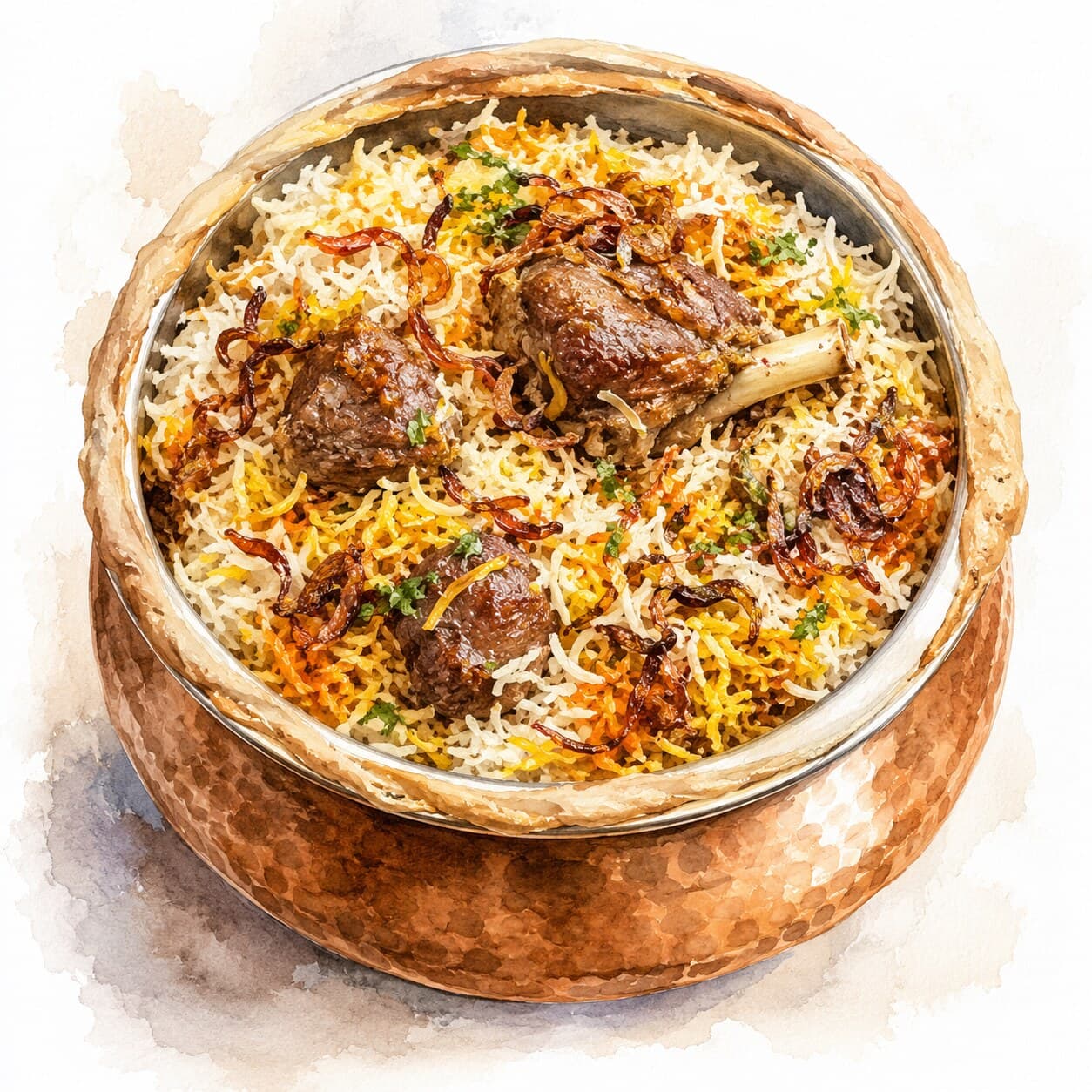
Ingredients
- 500 g lamb, cut into pieces
- 300 g basmati rice
- 200 g yogurt
- 1 pinch saffron
- 60 ml kewra water
- 2 large onions, fried until golden
- 1 cup fresh mint leaves
- 2 tbsp ginger-garlic paste
- 2-3 green chilies, slit
- 4-5 whole cloves
- 2-3 cardamom pods
- 1 stick cinnamon
- Salt to taste
- Water as needed
- Dough for sealing (flour and water)
Steps
Marinate the lamb with yogurt, ginger-garlic paste, green chilies, saffron, salt, and half of the fried onions. Let it rest for at least 30 minutes.
Rinse the basmati rice until the water runs clear, then soak it in water for 30 minutes. Drain and set aside.
Boil water in a large pot, add whole spices (cloves, cardamom, cinnamon), and salt. Add the soaked rice and par-cook for 5-7 minutes until it's 70% cooked. Drain the rice.
In a heavy-bottomed pot, layer the marinated lamb at the bottom, followed by the par-cooked rice. Top with remaining fried onions, mint leaves, and drizzle kewra water.
Seal the pot with dough to trap steam, then cook on low heat (dum) for about 30-35 minutes. This allows the flavors to meld together and the lamb to tenderize.
Once cooked, carefully open the pot, fluff the biryani with a fork, and serve hot, garnished with additional mint if desired.
Why this works
The technique of Hyderabadi dum biryani relies heavily on the sealing of the pot, which allows steam to cook the marinated raw meat and the rice simultaneously. The marination process infuses the lamb with flavor and tenderizes it, ensuring a succulent bite. Par-cooking the rice prevents it from becoming mushy during the steam cooking process. This kacchi (raw-meat) method is what gives the dish its character.
Safety (kacchi dum): Because the meat goes in RAW and the pot is sealed, the dum (sealed-steam phase) must run for the full 60 minutes minimum on low heat. Do NOT shorten — the technique only works at the full time. After the rest, probe-check the meat at the thickest part: lamb chunks should reach 70 °C internal before serving. If still pink-and-cool, extend 15–20 minutes more. The dum is non-negotiable.
Common mistakes
Skipping or shortcutting the dough seal on the pot.
Target: Seal the pot's lid completely with the flour-and-water dough (or, at minimum, a tight-fitting lid plus a layer of foil) so no steam can escape.
Why it matters: The entire kacchi (raw-meat) method depends on trapped steam cooking the marinated raw lamb from below the rice layered above it; if steam escapes, the pot loses the heat and moisture the technique relies on, and the meat can end up undercooked while the rice on top dries out.
What to do: Press the dough firmly around the entire rim before the pot goes on the heat, and resist lifting the lid to check on it partway through — that's exactly the steam you need to keep trapped.
Par-cooking the rice too far.
Target: Boil the soaked rice only until it is about 70% cooked — still with a firm bite at the center — before draining.
Why it matters: The rice finishes cooking during the sealed dum (steaming) phase; if it's already fully soft going into the pot, the extra time under steam turns it mushy and clumped by the time the lamb is done.
What to do: Bite into a grain around the 5–7 minute mark — it should be soft on the outside but still firm at the core — then drain it immediately so it doesn't keep cooking in its own residual heat.
Rushing or shortening the dum.
Target: Keep the sealed pot on low heat for the full 30–35 minutes this recipe calls for, without opening it early.
Why it matters: Because the lamb goes into the pot raw, the dum is the only cooking the meat gets; cutting it short leaves raw or undercooked meat underneath a pot of fully cooked rice, which isn't obvious from the outside.
What to do: Set a timer for the full time listed and don't rely on smell or guesswork alone; if there's any doubt when you open it, probe the thickest lamb pieces before serving.
Layering the ingredients unevenly.
Target: Spread the marinated lamb in an even layer at the bottom of the pot, then distribute the rice, fried onions, and mint evenly over the top rather than piling them into one section.
Why it matters: Uneven layering means steam reaches some of the meat more directly than the rest, so thin or clumped patches of lamb can cook faster or slower than the rest of the pot, leaving undercooked pockets.
What to do: Take a moment to spread each layer flat with the back of a spoon before adding the next one, so steam and heat move through the pot evenly.
What to look for
- Lamb pieces that show no raw or pink color at the center when a larger piece is cut open. Because the meat went into the pot raw, this is the check that matters most — if there's any doubt, probe the thickest piece; it should read at least 70 °C, matching the dum's own minimum safe threshold.
- Rice grains that are separate and fully tender, not clumped together or chalky at the core. A properly timed par-boil and a full dum should leave each grain distinct; mushy, stuck-together rice usually means the par-boil went too far, while a chalky core means the dum time was cut short.
- A rush of fragrant steam and a distinct saffron-and-spice aroma when the seal is first broken. That burst of aroma is a sign the seal held through the full cooking time; a flat or faint smell can mean steam escaped early.
- Lamb that is tender enough to pull apart with a fork but not falling into shreds. It should offer a little resistance before giving way — noticeably firmer than a long-braised stew, since this method steams the meat rather than simmering it in liquid for hours.
A note on history
Biryani's roots trace back to Persian-influenced traditions of layering rice with meat, spread across the Indian subcontinent through centuries of Persianate courts and trade — though food historians disagree on the exact route. Some emphasize the Mughal royal kitchens from the 16th and 17th centuries onward; others point to earlier Persian and Central Asian influence arriving through the Deccan's own sultanates, independent of the Mughal courts further north.
The Hyderabadi style specifically took shape in and around the kitchens of the Nizams, the rulers of Hyderabad state, where Mughlai cooking mixed with local Deccani and Telugu ingredients and techniques. That court setting is generally credited with the kacchi (raw-meat) method used here — marinating the meat raw and layering it directly under the rice to cook together under seal — which is what distinguishes Hyderabadi biryani from the pakki (pre-cooked meat) style more common in many other regional biryanis.
Get the essays in your inbox — free
Weekly notes on flavor, fermentation, and food history — the writing behind the Atlas of Flavor. No spam; unsubscribe anytime.