
Guo Bao Rou (Sweet-Sour Crispy Pork)
Guo Bao Rou is a delightful Northeast Chinese dish featuring crispy pork loin coated in a vibrant sweet-sour sauce.
Contents (5 sections)▾
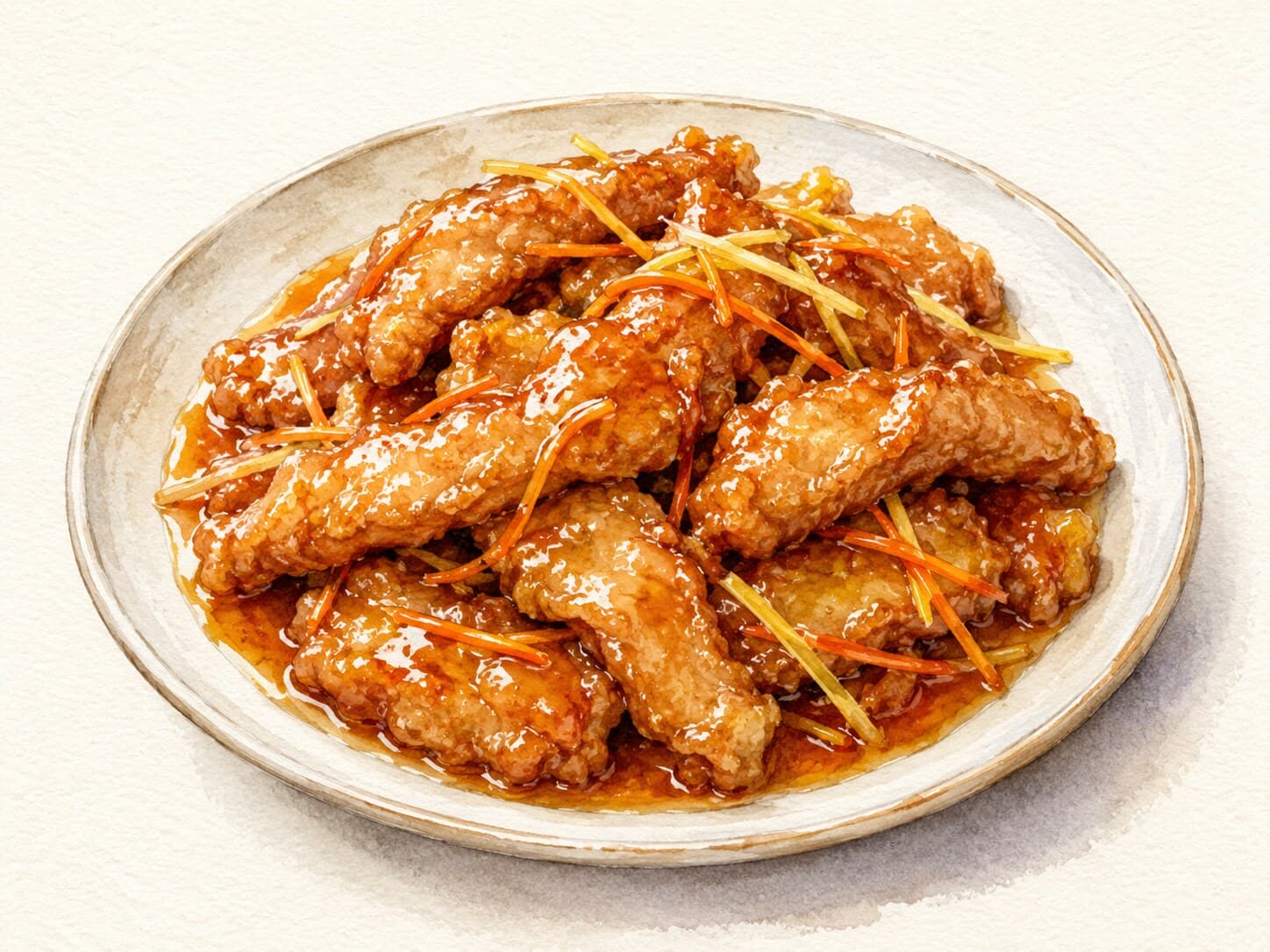
Ingredients
- 500 g pork loin, sliced thinly
- 1 cup all-purpose flour
- 1/2 cup cornstarch
- 1 tsp baking powder
- 1/2 tsp salt
- 1/2 cup water, cold
- Vegetable oil, for frying
- 3 tbsp sugar
- 3 tbsp rice vinegar
- 2 tbsp soy sauce
- 1 tbsp ketchup
- 1/2 tsp ginger, minced
- 1/2 tsp garlic, minced
- 1 green onion, chopped, for garnish
Steps
In a bowl, mix flour, cornstarch, baking powder, and salt. Gradually add cold water to create a thick batter.
Heat vegetable oil in a deep pan to 180°C (356°F). Dip each pork slice in the batter and carefully place in the hot oil.
Fry the pork in batches for 4-5 minutes until golden and crispy. Remove and drain on paper towels.
Double-fry the pork at the same temperature for an additional 2-3 minutes for an extra crunch. Drain again.
In a separate pan, combine sugar, rice vinegar, soy sauce, ketchup, ginger, and garlic. Bring to a simmer over medium heat.
Add the double-fried pork to the sauce and toss quickly to coat without losing crunch. Serve immediately, garnished with green onions.
Tools you'll want
Why this works
The key to achieving the perfect texture in Guo Bao Rou lies in the double-frying technique, which creates a hard crunch that can withstand the sweet-sour sauce. By first frying the battered pork at a high temperature, the moisture is rapidly expelled, forming a crust. The second fry enhances this crunch, ensuring that the exterior remains crisp even after being tossed in the sauce. If the pork seems too soft after the first fry, ensure your oil is hot enough (around 180°C) to achieve that golden color. The sauce should be heated just enough to meld the flavors without boiling too long, as excess heat can make it overly thick, risking the crispiness of the pork.
Common mistakes
Pork sliced too thick. Target: 3–5 mm slices, pounded gently flat to even thickness. Why it matters: Twice-frying (frying once, resting, then frying a second time) is a thin-cut technique. Thick slices stay raw inside while the batter darkens outside, forcing you to choose between food-safety risk and burnt crust. What to do: Partially freeze the pork loin for 20–30 minutes before slicing — firms the meat so the knife runs through evenly. Aim for postcard-thin pieces no thicker than 5 mm. The interior should be cooked through by the end of the second fry — the safety standard for this whole-cut pork is a measured 63 °C / 145 °F followed by a rest of at least 3 minutes, confirmed with a thermometer rather than by colour ("no pink") or clear juices.
Wet batter, wet pork. Target: Pork patted bone-dry, batter thick enough to coat the back of a spoon without sliding off in a sheet. Why it matters: Surface moisture flashes to steam in hot oil and blows the batter off the meat — you get bare pork floating beside loose batter shards. A thick, dry contact surface lets the starch latch on. What to do: Blot every slice with paper towels just before dipping. If your batter feels thin, add a tablespoon of cornstarch at a time until it ribbons slowly off the whisk.
Oil temperature drifts low. Target: 170–180°C for the first fry; recover to 190°C for the second fry. Why it matters: Below 160°C the batter absorbs oil instead of crisping (the starch grains swell with grease rather than forming a brittle shell). Above 200°C the outside scorches before the inside cooks through — a real food-safety problem with pork. What to do: Fry in small batches (5–6 pieces at a time) so the temperature recovers between drops. A clip-on or instant-read thermometer is the cheapest fix; if you don't have one, a wooden chopstick dipped in the oil should fizz steady bubbles within a second.
Sauce-tossing too long. Target: 10–15 seconds of toss, then immediately onto the plate. Why it matters: The crust survives sauce contact only briefly. Hold the pork in the pan and the starch shell rehydrates — you get sweet-sour mush. The dish is built around the contrast between a wet glaze and a dry crunch. What to do: Have the plate ready before the pork hits the sauce. Two quick tosses with a spider (a wide wire-mesh skimmer for lifting things out of hot oil) or tongs, then out. Serve at once.
What to look for
- Batter on the whisk: thick enough to coat a spoon and fall in a slow ribbon, not a stream. If it sheets off like water, add more cornstarch.
- First-fry pork: pale gold, set but not yet deep brown; bubbles around it slow from a roar to a steady fizz. This is the cue to lift and rest.
- Second-fry pork: deep amber, hard-shell appearance; the slice rings faintly when tapped against the spider. Cooked through — the safety standard for whole-cut pork is a measured 63 °C / 145 °F (plus a 3-minute rest), confirmed with a thermometer; colour is a doneness cue, not the safety test.
- Sauce just before tossing: glossy, syrup-thick, large lazy bubbles. If the bubbles are small and fast, the sauce is still too thin; reduce a touch more before adding the pork.
A note on history
Guo bao rou was invented around 1907 in Harbin, in what is now Heilongjiang Province, by a chef named Zheng Xingwen working in the kitchen of the Taotai (circuit intendant) Du Xueying. Harbin was then a Russian-influenced railway city, and Zheng adapted an older salty "fried pork strip" dish into a sweet-and-sour version to suit visiting Russian diplomats — by some accounts including his own Russian wife. The dish was later praised at the 1911 International Plague Conference in Shenyang and became a signature of Northeastern Chinese cuisine (ECNS, Chinatripedia).
Get the essays in your inbox — free
Weekly notes on flavor, fermentation, and food history — the writing behind the Atlas of Flavor. No spam; unsubscribe anytime.