
Fish Amok (Cambodian Steamed Curry)
Fish Amok is a traditional Cambodian steamed curry featuring white fish and coconut, set in a banana leaf cup.
Contents (5 sections)▾
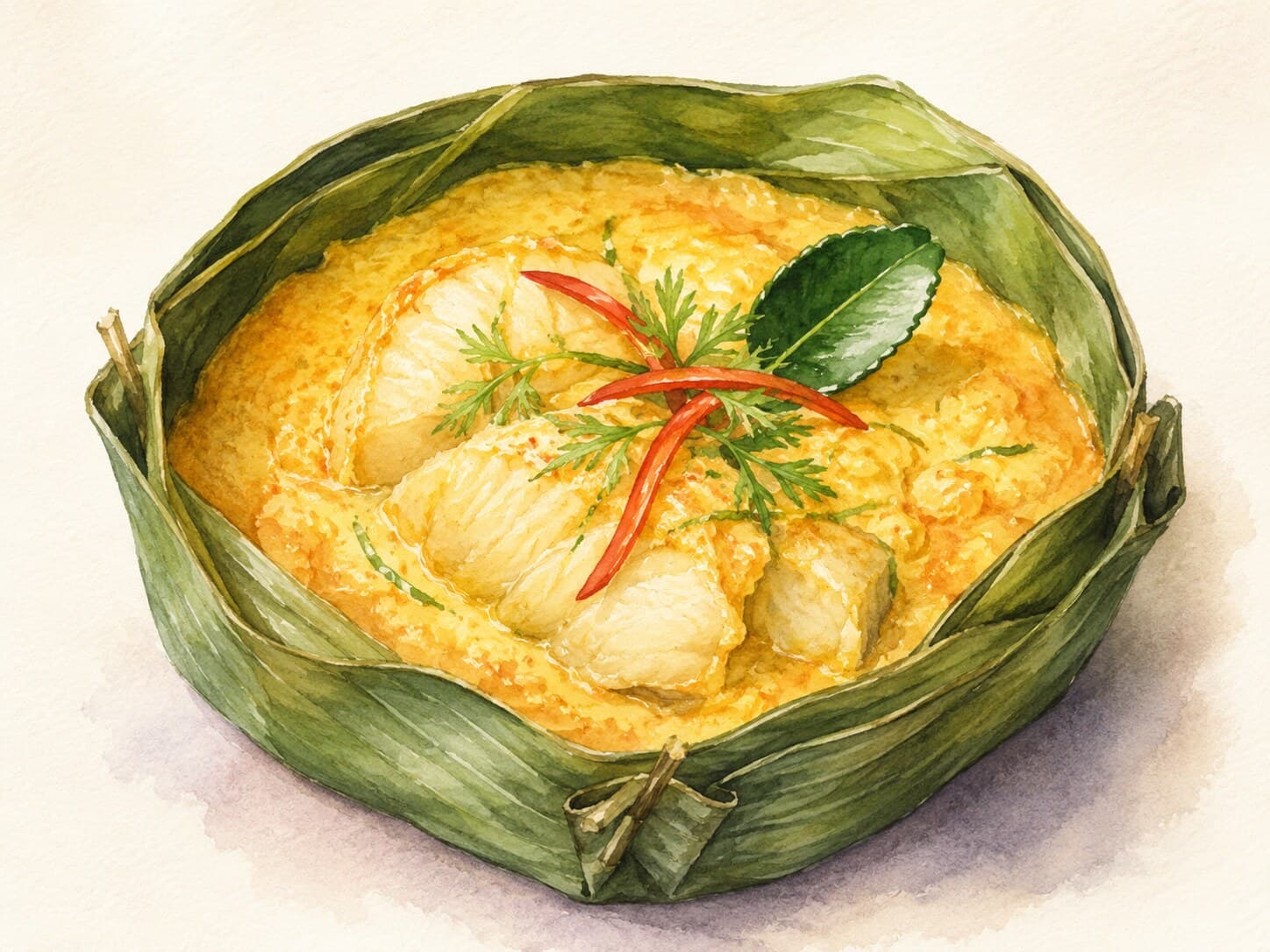
Ingredients
- 400 g white fish fillets, such as cod or tilapia
- 200 ml coconut milk
- 100 g kroeung spice paste
- 2 tbsp fish sauce
- 1 tbsp palm sugar
- 1 tsp salt
- 4 banana leaves, cut into squares (for cups)
- Fresh cilantro for garnish, to taste
Steps
Start by preparing the kroeung paste. Blend or pound 100g of kroeung spice paste with fish sauce, palm sugar, and salt until well combined.
In a mixing bowl, combine the white fish fillets with the kroeung paste and coconut milk, folding gently to incorporate without breaking the fish.
Prepare the banana leaf cups by folding the squares into cup shapes, securing with toothpicks if necessary. Place them in a steamer.
Spoon the fish mixture into each banana leaf cup, filling them about three-quarters full to allow for expansion during cooking.
Steam the cups in a steamer over simmering water for about 15 minutes on medium heat, or until the mixture is set and has a mousse-like texture.
Once cooked, carefully remove the cups from the steamer. Garnish with fresh cilantro before serving.
Tools you'll want
Why this works
The technique of folding the fish through the kroeung spice paste (a Khmer aromatic paste of lemongrass, galangal, garlic, and more) and coconut milk allows the flavors to meld harmoniously, ensuring that the fish remains tender and absorbs the spices' depth. Steaming in banana leaves retains moisture while imparting a subtle flavor, resulting in a soft custard-like texture that is characteristic of Fish Amok. If the mixture seems too runny after folding, ensure to steam it longer; this will help it set properly. Conversely, if it appears too thick, you can add a little more coconut milk to achieve the desired consistency before steaming.
Common mistakes
Pulling the cups before the custard is set.
Target: Steam 15 minutes over actively simmering water, until the center is firm and springs back, not liquid.
Why it matters: Amok is a steamed fish custard — the egg and coconut proteins have to coagulate (set from liquid into a soft solid as heat unfolds and links them) all the way to the center. A wobbly, still-runny middle means the fish is undercooked, which is both unpleasant and a food-safety risk.
What to do: Test the center with the tip of a knife or a toothpick — it should come out clean and hot, not slimy. If still loose, steam a few minutes more and check again.
Boiling the coconut milk instead of steaming it gently.
Target: A steady, gentle simmer below the lid — gentle wisps of steam, not a violent rolling boil.
Why it matters: Coconut milk is an emulsion (fat and water held together in a smooth, stable mix). Hard, fast heat shears that emulsion apart, so the fat breaks out and the surface turns oily and grainy instead of staying glossy and mousse-like.
What to do: Keep the water at a quiet simmer. If your steamer runs hot, crack the lid slightly to release pressure and hold the temperature down.
Stirring the fish so hard it turns to paste.
Target: Fold the fish through the kroeung (the Khmer aromatic paste of lemongrass, galangal, garlic, and more) just until coated — pieces still intact.
Why it matters: Over-mixing breaks the fish into mush and works the mixture into a dense, rubbery set rather than a tender, custardy one. The contrast of soft custard around distinct fish is part of the dish.
What to do: Use a light folding motion with a spatula, turning the bowl as you go, and stop the moment the fish is evenly dressed.
Overfilling the banana-leaf cups.
Target: Fill each cup about three-quarters full.
Why it matters: The mixture expands as the proteins set and trapped air warms. A cup filled to the brim overflows into the steamer and steams unevenly, leaving the rim cooked and the core raw.
What to do: Leave a clear finger-width of space below the rim. Steam any extra mixture in a small heatproof dish alongside.
What to look for
- Kroeung before it meets the fish: a damp, fragrant paste that smells of lemongrass and galangal, not raw garlic alone. Well-pounded kroeung is the flavor engine; a coarse, dry paste will taste thin.
- The mixture before steaming: loose but cohesive, like a soft batter that just holds a ripple. Too runny and it won't set; too stiff and it steams dense.
- The surface as it finishes: set, matte, and gently domed, with no liquid pooling when you tilt the cup. A glossy liquid center means it needs more time.
- The center when probed: firm, hot all the way through, springing back to a light touch. This is your doneness signal — fish custard is safe and pleasant only when fully set.
A note on history
Fish amok (amok trey) is widely regarded as Cambodia's national dish, and its roots are often traced to the kitchens of the Khmer Empire (9th–15th centuries), when it is thought to have been a refined royal preparation (Wikipedia; South East Asia Backpacker). The word amok refers to the steaming-in-banana-leaf technique itself, which is what gives the dish its signature soft, mousse-like texture (Go Cambodia Tours). Closely related steamed-curry dishes appear in neighboring countries, so the precise origin is a matter of regional debate (Wikipedia).
Get the essays in your inbox — free
Weekly notes on flavor, fermentation, and food history — the writing behind the Atlas of Flavor. No spam; unsubscribe anytime.