
Dosa
This South Indian masala dosa features a crispy fermented rice and urad dal crepe filled with spiced potato masala.
Contents (5 sections)▾
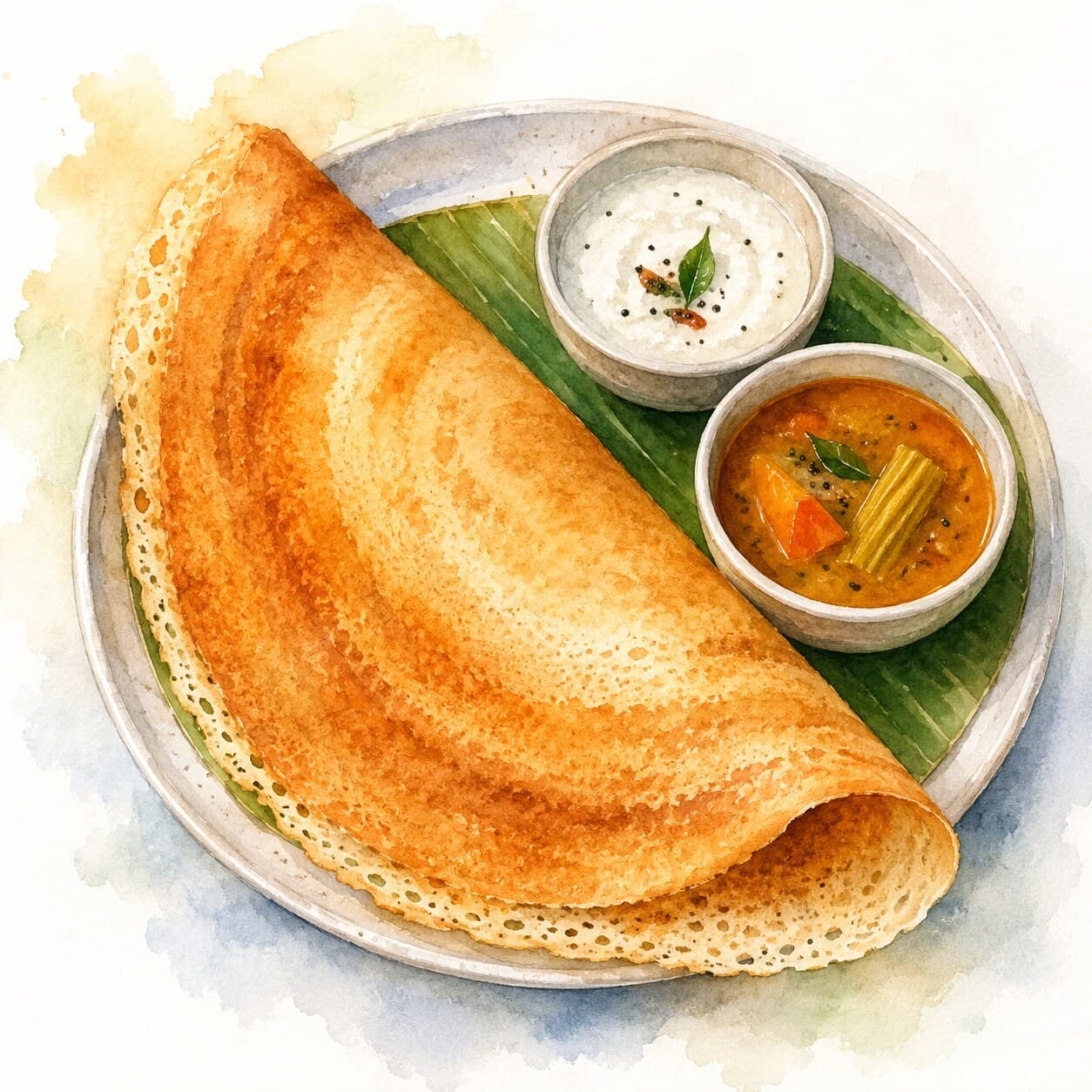
Ingredients
- 250 g urad dal
- 500 g rice
- 1 tsp salt
- water, as needed
- ghee, for cooking
- 2 medium potatoes, boiled and mashed
- 1 onion, finely chopped
- 2 green chilies, finely chopped
- 1 tsp mustard seeds
- 1 tsp cumin seeds
- 1/4 tsp turmeric powder
- coriander leaves, chopped, to taste
Steps
Soak the urad dal and rice separately in water for at least 6 hours or overnight. This softens them and initiates fermentation.
Drain the soaked dal and rice, then blend them together with a little water until smooth. The batter should be thick but pourable.
Transfer the batter to a large bowl, cover, and let it ferment in a warm place for 6-8 hours until it doubles in size and bubbles form.
For the potato filling, heat 1 tbsp ghee in a pan, add mustard seeds and cumin seeds, and wait for them to crackle. Then add onions and chilies, sautéing until translucent.
Mix in the turmeric and mashed potatoes, and season with salt and coriander leaves. Cook for a few minutes, then set aside.
Heat a non-stick griddle over medium heat and grease lightly with ghee. Pour a ladleful of batter and spread it thinly in a circular motion.
Cook for 2-3 minutes until the edges lift and the bottom is golden brown. Optionally, spread a little ghee on top before flipping.
If desired, place a portion of the potato filling in the center, fold the dosa over, and cook for another minute before serving.
Why this works
The fermentation of the rice and urad dal (skinned split black lentils, also called black gram) batter is crucial for achieving the characteristic tang and lightness of dosa. The process helps develop flavor and enhances the batter’s leavening properties, resulting in a crispy texture when cooked. The use of a non-stick griddle and the right amount of ghee ensures even cooking and prevents sticking. If the dosa breaks while flipping, it may be too thin; simply reduce the amount of batter poured next time. Additionally, if the dosa seems too soft and not crisping up, make sure the griddle is adequately heated and allow it to cook longer before flipping.
Common mistakes
Rushing the fermentation instead of giving it real time and warmth.
Target: Let the batter ferment somewhere warm (around 25–30°C / 77–86°F) for the full 6–8 hours, or until it has visibly doubled and is dotted with bubbles.
Why it matters: Fermentation (the process by which naturally occurring bacteria and wild yeast feed on the batter's starches, producing gas bubbles and mild acidity) is what gives dosa its characteristic tang and light, lacy crumb. A batter that hasn't fully fermented stays dense and flat, so the cooked dosa turns out thick and chewy instead of thin and crisp.
What to do: Find the warmest corner of the kitchen (near a switched-on oven light or on top of the fridge both work), cover the bowl loosely, and judge readiness by sight and smell rather than the clock — it's ready when it smells faintly sour and has risen visibly.
Salting the batter before it has finished fermenting.
Target: Hold back the salt and stir it in only after fermentation is complete, right before cooking.
Why it matters: Salt draws water out of the bacteria and yeast driving fermentation and slows their activity, so adding it too early can blunt the rise and the tang you're waiting for.
What to do: Ferment the plain batter first, then mix in the salt at the end and stir just enough to combine.
Cooking on a griddle that isn't properly heated, or over-greasing it.
Target: Heat the griddle until a drop of batter sizzles gently on contact, then wipe it with only a thin film of ghee between dosas.
Why it matters: A lukewarm griddle lets the batter sit and steam rather than sear, so the dosa stays pale and soft and sticks instead of releasing cleanly; too much ghee pools and fries the edges unevenly instead of crisping the whole surface.
What to do: Test the heat with a small drop of batter before pouring the full ladleful, and wipe excess ghee off with a folded paper towel or cloth between rounds.
Spreading the batter too thick or flipping before it's ready.
Target: Spread the batter in one continuous outward spiral into a thin, even layer, and wait until the edges visibly lift and curl before touching it.
Why it matters: A thick pour cooks more like a pancake than a dosa, staying soft in the middle; trying to flip or fold it before the underside has fully browned and released means it tears or sticks rather than lifting away cleanly.
What to do: Work quickly from the center outward while the batter is still loose enough to spread, then leave it undisturbed until the edges curl and the surface looks dry.
What to look for
- Batter that has visibly doubled and is webbed with small bubbles, smelling faintly sour. That's the sign fermentation has gone far enough; flat, dense batter with no smell needs more time in a warmer spot.
- A thin, lacy dosa with a golden-brown, evenly speckled underside. Even color across the surface means the griddle heat and batter thickness were both right; pale patches mean the griddle was too cool or the batter too thick there.
- Edges that lift and curl on their own, releasing from the griddle with a gentle nudge. If it resists and tears when you try to lift it, give it another 30–60 seconds before touching it again.
- A crisp, audible crackle when you break off a piece. A soft, bendy dosa usually means it came off the heat a little early.
A note on history
Food historians disagree about exactly when and where dosa first appeared. Some trace it to ancient Tamil Nadu, citing descriptions of fermented rice-and-lentil cakes in early Tamil literature, while others point to Karnataka, citing a dish resembling dosa recorded in the 12th-century Sanskrit text Manasollasa. Its more recent history is clearer: the thin, crisp version most people recognize today, often filled with spiced potato, spread across India and then abroad largely through Udupi restaurants — eateries founded by Brahmin cooks from the coastal Karnataka town of Udupi — which carried South Indian vegetarian cooking into cities nationwide over the 20th century.
Get the essays in your inbox — free
Weekly notes on flavor, fermentation, and food history — the writing behind the Atlas of Flavor. No spam; unsubscribe anytime.