
Dal Bhat
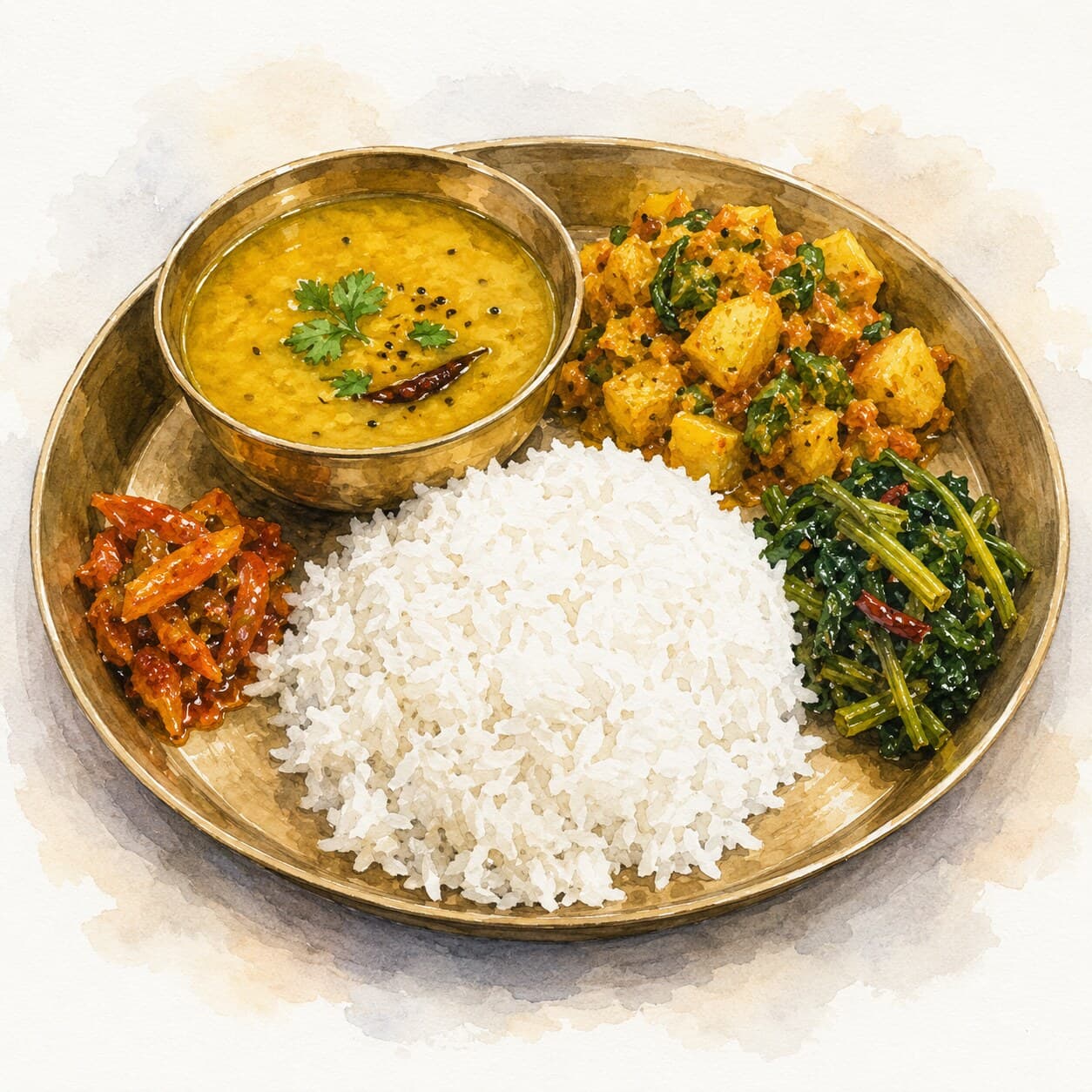
Dal Bhat is a traditional Nepali meal featuring rice, lentil dal, vegetables, and pickles, commonly enjoyed twice a day.
Contents (5 sections)▾
Ingredients
- 300 g rice
- 200 g lentils (e.g., red or green)
- 1 medium onion, chopped
- 2 cloves garlic, minced
- 1 tsp turmeric powder
- 1 tsp cumin seeds
- 400 ml water
- 200 g mixed vegetables (e.g., carrots, peas, potatoes), chopped
- 2 tbsp vegetable oil
- Salt to taste
- 200 g spinach or other greens, chopped
- 100 g pickle (achaar) of choice
Steps
Rinse the rice under cold water until the water runs clear, then soak it for 15 minutes.
In a pot, heat 2 tbsp of vegetable oil over medium heat, and sauté the chopped onions and minced garlic until golden brown (about 5 minutes).
Add the lentils, turmeric powder, cumin seeds, and 400 ml of water to the pot. Bring to a boil, then reduce the heat and let it simmer for 10 minutes until the lentils are soft.
In a separate pot, cook the soaked rice in boiling water with a pinch of salt for about 10-12 minutes until tender. Drain and set aside.
In the same pot as the lentils, add the mixed vegetables and cook for an additional 5 minutes until they are tender.
In the last minute of cooking, stir in the chopped greens until wilted, and season with salt to taste.
Why this works
Dal Bhat is a quintessential meal in the Himalayan region, combining essential food groups into a harmonious dish. Cooking rice and dal separately ensures that each component retains its distinct flavor and texture. The lentils provide protein while the vegetables contribute fiber and vitamins, making it a balanced meal. If the dal seems too thick after cooking, simply add a splash of water to achieve your desired consistency. The use of spices like turmeric and cumin enhances flavor and adds depth to the dish. Serving everything on one platter encourages the mixing of flavors, a hallmark of Himalayan dining culture, and helps to create a satisfying experience. This meal is traditionally enjoyed with the hand, connecting the eater to their food, but a spoon works just as well for those who prefer it that way.
Common mistakes
Rinsing the rice quickly and calling it done.
Target: Rinse the rice under cold water until the water runs clear — not just once or twice — before the 15-minute soak.
Why it matters: Raw rice grains are coated in loose surface starch; if it isn't rinsed away, that starch gelatinizes in the cooking water and glues the grains together, so the bhat (rice) comes out sticky and clumped instead of light and separate.
What to do: Swirl the rice in a bowl of cold water, drain, and repeat three or four times until the water is no longer cloudy, then move on to soaking.
Adding the cumin seeds straight into the watery lentils.
Target: Let the cumin seeds sizzle in the hot oil for a few seconds — ideally alongside or just after the onion and garlic — before the water and lentils go in, rather than only simmering them in the liquid.
Why it matters: This is a foundational technique across Himalayan and Indian cooking, often called tempering or tadka (briefly frying whole spices in hot fat to release their aromatic oils); simmering cumin seeds in water alone extracts far less fragrance than a few seconds in hot oil does.
What to do: Add the cumin seeds to the pot while the onion and garlic are still sizzling, let them pop and turn fragrant, then stir in the turmeric briefly before adding the lentils and water.
Boiling the rice hard and stirring it like risotto.
Target: Keep the rice at a gentle boil and stir only once or twice while it cooks, rather than a rolling boil with frequent stirring.
Why it matters: Vigorous boiling and frequent stirring knock the starchy surface off the grains and release it into the water, which is exactly what makes rice turn gummy; rice wants to be left mostly alone once it's in the pot.
What to do: Bring the water to a boil, add the rice, then reduce to a gentle simmer, cover, and check only near the end of the 10-12 minutes rather than stirring throughout.
Adding the greens too early "to be safe."
Target: Stir the greens in only during the final minute of cooking, as the recipe specifies, not several minutes ahead of time.
Why it matters: Leafy greens wilt in well under a minute in a hot pot; extra time turns them a dull, drab color, softens their texture past the pleasant tender-but-present bite, and cooks away some of their nutrients.
What to do: Have the greens washed, dried, and roughly chopped ahead of time so they're ready to stir in right at the end, then take the pot off the heat as soon as they've wilted.
What to look for
- Rice grains that look separate and light, not stuck together in a single mass. That separateness is the sign the starch was rinsed off before cooking and the pot wasn't over-stirred.
- A rounded, toasted cumin smell rising from the dal rather than a flat, boiled-spice smell. That fuller aroma means the spices got their moment in hot oil rather than only simmering in the liquid.
- Lentils that have broken down into a soft, thick, spoonable mass rather than staying whole and separate. Well-cooked dal should look more like a thick soup than a pot of intact lentils floating in water.
- Greens that are still bright green and just wilted, not khaki or waterlogged. That brightness means they went in at the very end, as intended.
A note on history
Dal bhat is the everyday, twice-daily meal across much of Nepal, and the phrase "dal bhat power, 24 hour" has become a well-known saying among trekkers and porters in the Himalayas, reflecting how central this plate of rice and lentils is to sustaining a day of hard walking at altitude. The meal reflects Nepal's geography and agriculture: rice traditionally grown in the warmer valleys and mid-hills, lentils and other pulses suited to drier terraced land, and the plate typically rounded out with a vegetable curry (tarkari), a spoonful of pickle (achar) for sharpness, and often a leafy green like the spinach used here.
There's no single fixed version of dal bhat — the lentils, vegetables, and pickles shift with season, region, and household — but the underlying structure of rice, dal, vegetable, and something pickled served together on one plate stays remarkably consistent across the country, eaten traditionally with the right hand and, in many households, refilled more than once in a sitting.
Get the essays in your inbox — free
Weekly notes on flavor, fermentation, and food history — the writing behind the Atlas of Flavor. No spam; unsubscribe anytime.