
Svickova (Czech Braised Beef in Root Sauce)
Svickova is a classic Czech dish featuring braised beef in a velvety root vegetable sauce, perfect for a comforting meal.
Contents (5 sections)▾
Ingredients
- 800 g beef sirloin, trimmed
- 150 g bacon, diced
- 2 tbsp vegetable oil
- 2 medium carrots, peeled and chopped
- 1 medium parsnip, peeled and chopped
- 1 medium onion, finely chopped
- 1 stalk celery, chopped
- 1 clove garlic, minced
- 500 ml beef broth
- 200 ml sour cream
- 2 tbsp white wine vinegar
- 1 tbsp sugar
- Salt and pepper, to taste
- 4 bread dumplings, for serving
- Fresh parsley, for garnish
Steps
Preheat the oven to 160°C (320°F). This temperature allows the beef to become tender while absorbing flavors from the vegetables.
In a large pot, heat the vegetable oil over medium heat and sauté the bacon until crispy, about 5 minutes.
Add the chopped onions, carrots, parsnip, celery, and garlic to the pot. Cook for 10 minutes until softened.
Season the beef sirloin with salt and pepper, then add it to the pot, browning it on all sides for about 8-10 minutes.
Pour in the beef broth, ensuring the meat is partially submerged. Cover and transfer the pot to the oven. Braise for 1.5 hours.
Once the meat is tender, remove it from the pot and set aside. Blend the vegetable mixture into a smooth sauce, then stir in sour cream, vinegar, and sugar.
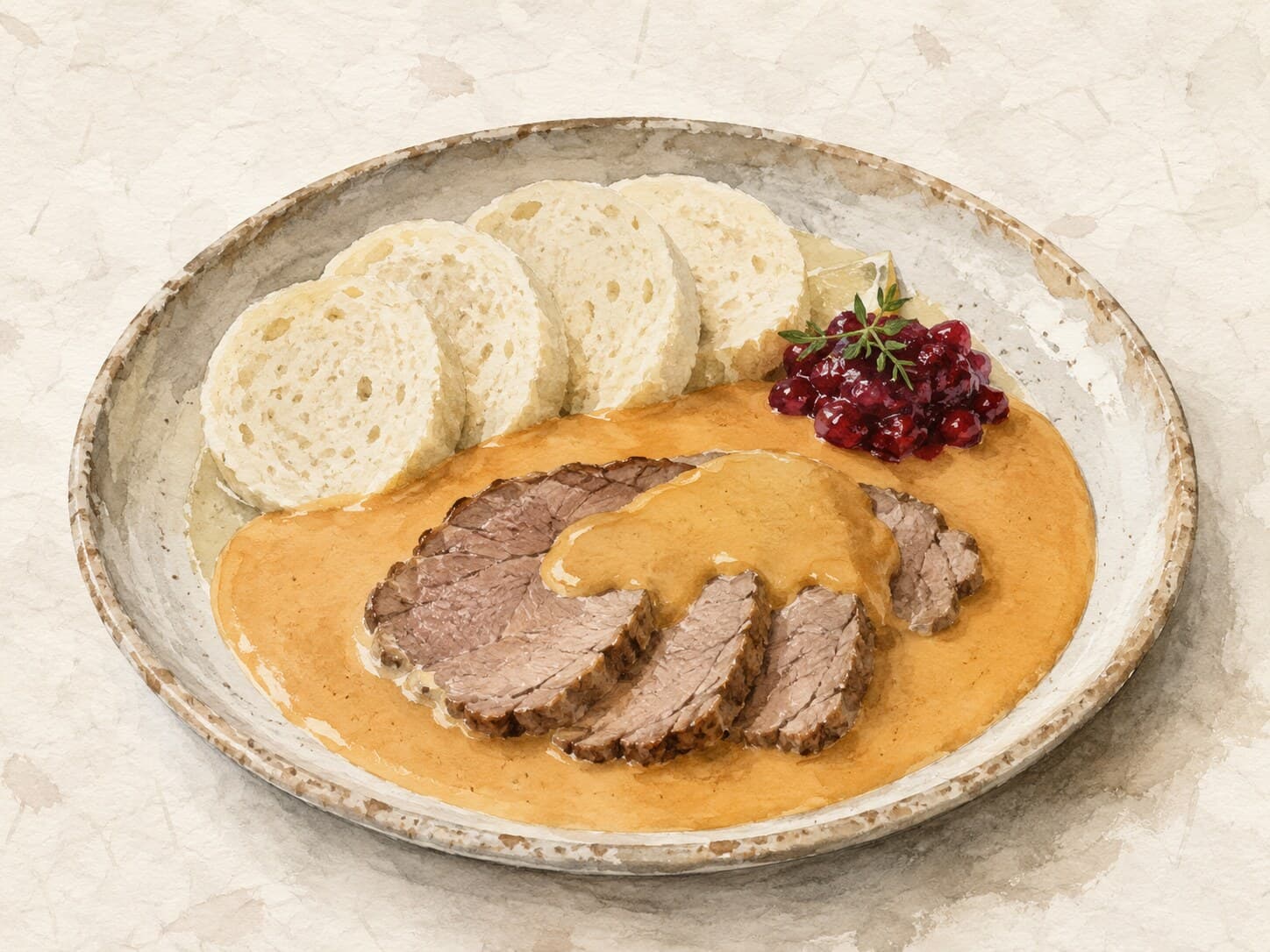
Slice the beef and serve it on a bed of the root sauce, accompanied by warm bread dumplings and garnished with fresh parsley.
Why this works
The technique of braising allows the beef sirloin to cook slowly in a flavorful liquid, resulting in tender meat infused with the sweetness of the root vegetables. The larding process, where bacon is used, adds depth and richness to the dish, contributing umami notes. The root vegetables, once blended, create a creamy sauce with a perfect balance of sweet and sour thanks to the addition of vinegar and sugar. If the sauce appears too thick, simply add a bit more beef broth or water until reaching the desired consistency. Conversely, if the sauce is too thin, allow it to simmer uncovered for a few minutes to reduce and thicken. This dish exemplifies the Czech tradition of hearty, comforting meals, making it a perfect centerpiece for Sunday lunch.
Common mistakes
Skipping the sear on the beef.
Target: A deep brown crust on every side of the sirloin before it goes into the oven — brown, not gray.
Why it matters: Searing drives the Maillard reaction (the heat-driven chemistry between proteins and sugars that builds roasted, savory depth). Svíčková's sauce is gentle and sweet-sour; without a browned exterior on the meat, the whole dish reads pale and one-note. The crust is the backbone the creamy sauce is built around.
What to do: Pat the beef dry, season it, and brown it hard in the hot fat on all sides — a full 8–10 minutes — before adding any liquid. Don't crowd the pot, or the meat steams instead of coloring.
Braising too hot, so the beef turns dry and stringy.
Target: A low oven (160°C / 320°F) and a bare simmer in the pot, until the sirloin is fork-tender — typically 1.5 to 2 hours, cooked fully through.
Why it matters: Sirloin is leaner than a classic stewing cut, so it is easy to overshoot. A violent boil squeezes water out of the muscle fibers faster than the connective tissue softens — tough, fibrous meat. Gentle moist heat lets it cook through to tender without drying.
What to do: Keep it covered at a low simmer; check tenderness with a fork rather than the clock. If it isn't yielding yet, give it more time at low heat — pushing the temperature up will not rescue it.
A sauce that splits or turns grainy when the sour cream goes in.
Target: A smooth, velvety sauce — temper the sour cream in, off a hard boil.
Why it matters: Sour cream's proteins curdle (clump into grainy curds) when they hit fierce heat too fast. Stirring cold cream straight into a furiously boiling sauce is the classic way to break it.
What to do: Pull the blended sauce off a rolling boil first. Stir a ladle of the warm sauce into the sour cream to warm it gradually, then return that mixture to the pot over low heat. Warm it through gently — don't boil it hard again.
Letting sweet and sour fall out of balance.
Target: A sauce that lands sweet-and-sour at once, neither sharp nor cloying.
Why it matters: Svíčková lives on the tension between the vinegar's acidity and the sugar's sweetness, carried on a creamy, root-vegetable base. Too much vinegar and it's harsh; too much sugar and it's flat and candied. The two have to meet in the middle.
What to do: Add the vinegar and sugar gradually, tasting as you go. Adjust in small increments until the sauce reads balanced — bright but rounded — rather than dumping both in at once.
What to look for
- A well-seared sirloin: a dark, even brown crust on every face, with a roasted aroma rising from the pot. Pale or gray meat means the sear was rushed.
- Fork-tender beef: a fork meets almost no resistance and the meat slices cleanly without shredding. This is doneness and texture in one test — keep braising if it resists.
- A velvety, unbroken sauce: smooth and glossy after the sour cream, with no grainy curdled flecks. Graininess means it went in over too high a heat.
- Balanced sweet-and-sour: the vinegar's brightness and the sugar's sweetness arrive together, neither one dominating. Adjust in small steps until it sits in the middle.
A note on history
Svíčková belongs to a Czech tradition of larded, braised beef in a root-vegetable sauce that appears in print as early as the 1805 Prague cookbook, with the cream-sauce version recorded in Magdalena Dobromila Rettigová's celebrated 1826 cookbook (Remitly; Radio Prague International). The dish carries influences from Central European court cooking, refined through the Habsburg connection to Vienna (Remitly). Today it is widely regarded as the Czech national dish — the crown of the Sunday lunch table, served with bread dumplings and a spoon of cranberry (Radio Prague International).
Get the essays in your inbox — free
Weekly notes on flavor, fermentation, and food history — the writing behind the Atlas of Flavor. No spam; unsubscribe anytime.