
Couscous Royal
Couscous Royal features a delightful combination of steamed couscous with lamb, chicken, and merguez, enriched with vegetables.
Contents (5 sections)▾
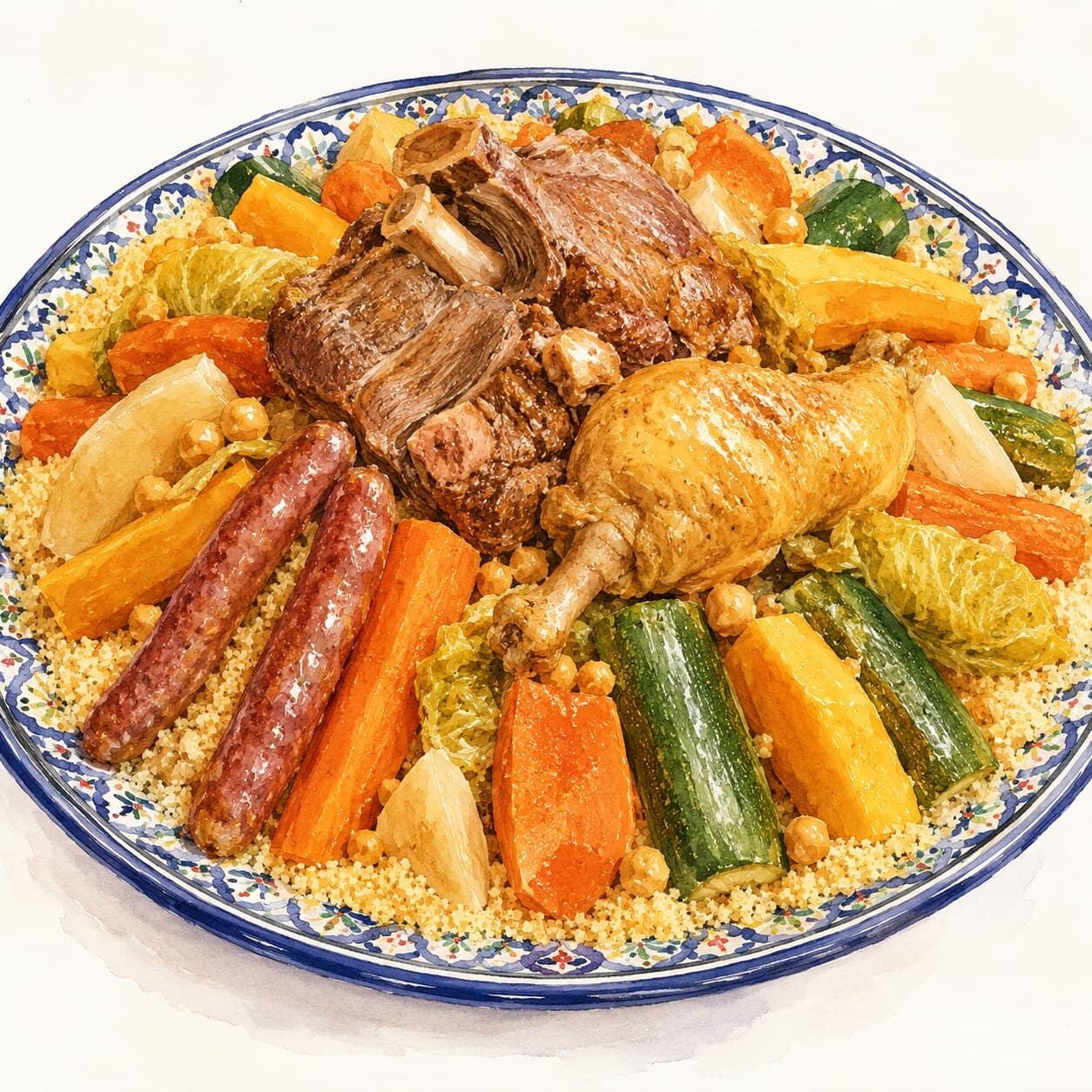
Ingredients
- 500 g couscous
- 300 g lamb shoulder, cut into chunks
- 300 g chicken, cut into pieces
- 200 g merguez sausages, sliced
- 400 g chickpeas, cooked
- 2 large carrots, peeled and diced
- 1 medium turnip, peeled and diced
- 1 medium zucchini, diced
- 1.5 liters vegetable broth
- 1 tsp ground cumin
- 1 tsp ground coriander
- Salt, to taste
- Olive oil, for drizzling
Steps
In a large pot, heat the vegetable broth to a simmer over medium heat (about 80-90°C). This will prepare the base for the couscous steam.
In a separate pot, brown the lamb and chicken pieces in olive oil over medium-high heat for about 5-7 minutes until they are golden, adding salt, cumin, and coriander for flavor.
Add the merguez sausages to the meat pot and cook for an additional 5 minutes, allowing the flavors to meld.
Stir in the carrots, turnip, and zucchini, cooking for another 10 minutes until the vegetables are slightly tender.
In a large bowl, combine couscous with a drizzle of olive oil and a pinch of salt, then pour the simmering vegetable broth over it. Cover and let it sit for 10 minutes to absorb the liquid.
Fluff the couscous with a fork, then place it in a steamer basket over the meat and vegetable mixture. Cover tightly and steam for 15-20 minutes to allow the couscous to develop a light and fluffy texture.
Serve the couscous on a large platter, topped with the meat and vegetable mixture, ensuring to drizzle with a little more olive oil before serving.
Tools you'll want
Why this works
This Couscous Royal recipe successfully combines different textures and flavors through a well-structured technique of steaming the couscous while simultaneously cooking the meats and vegetables. By browning the lamb and chicken first, we build deep, browned flavor. The merguez (a spicy North African sausage) serves as a spicy element that complements the richer meats. If the couscous seems too dry after steaming, adding a small amount of warm broth or olive oil while fluffing it can bring it back to the desired consistency. The key to this dish is patience; allowing each component to cook through without rushing leads to a harmonious blend of flavors. The use of a steamer ensures that the couscous remains light and airy, absorbing the nuances of the broth below without becoming soggy. This method also keeps the meats succulent and prevents them from overcooking, which is crucial for achieving the authentic texture of this classic bistro Maghrebi dish.
Common mistakes
Piling all the broth onto the couscous at once and letting it turn gluey.
Target: Pour the broth over the couscous gradually if you can, and fluff thoroughly with a fork (or lightly oiled fingers) to separate the grains before steaming, rather than leaving it to sit as one soaked block.
Why it matters: Couscous grains are coated in starch; when they're saturated all at once and left undisturbed, that starch gels the grains together into clumps instead of separate, fluffy granules, and the steaming step afterward can't undo clumps that have already formed.
What to do: After the 10-minute soak, rake through the couscous with a fork or your fingers to break up every clump before it goes into the steamer basket, then fluff again once it comes out.
Simmering the chicken for as long as the lamb.
Target: Treat the chicken and lamb as two different cooking clocks — brown both together, but if the lamb needs a longer simmer to tenderize, add the chicken later or check it independently rather than trusting one timer for both.
Why it matters: Lamb shoulder is a well-worked cut rich in connective tissue (the tough tissue that dissolves into gelatin with time and heat), so it needs a real simmer to tenderize, while chicken pieces cook through much faster and turn dry and stringy if left in the pot as long as the lamb needs.
What to do: Check the chicken for doneness (see What to look for) before the lamb is fully tender; if the lamb needs more time, lift the chicken out and rest it, then return it to the pot just to warm through before serving.
Skipping the skim.
Target: Skim the foam and excess fat that rise to the surface once the browned meats start simmering in the broth, checking every few minutes early in the cook.
Why it matters: Browning three different meats releases a fair amount of fat and protein foam into the broth; left in, it clouds the broth and leaves the finished dish tasting greasy and muddy rather than clean.
What to do: Keep a spoon or small ladle nearby during the first 15-20 minutes of simmering and skim off anything that collects on the surface.
Judging the meats done by time alone.
Target: Confirm the chicken shows no pink and reaches at least 74 °C (165 °F), the merguez is cooked through with no raw color at the center, and the lamb is fork-tender — rather than trusting the clock alone.
Why it matters: Three different proteins, cut into different sizes, rarely all finish at exactly the timed mark; the recipe's timing is a guide, and stopping at a fixed number of minutes can leave one protein underdone even while another is exactly done.
What to do: Cut into the thickest piece of chicken and a slice of merguez to check for any pink before serving, and confirm a lamb chunk yields easily to a fork.
What to look for
- Couscous grains that separate easily and look light rather than clumped or pasty. Fluffy, individual grains mean the soak and steam went as intended; a solid, gluey mass means the starch gelled before it had a chance to steam apart.
- Chicken that shows no pink at the thickest point, with juices running clear. That's your doneness check for poultry — chicken should reach at least 74 °C (165 °F) with no rosy color remaining.
- Merguez sausage that's firm throughout with no raw or pink center when sliced. Like any raw sausage, it needs to cook through completely before serving.
- Lamb that yields easily when pressed with a fork and pulls apart without resistance. That tenderness signals the connective tissue has broken down; if it still feels springy or tough, it needs more time in the broth.
A note on history
Couscous itself is an ancient staple of North Africa, long associated with the Berber (Amazigh) communities of the Maghreb, and it spread across the wider Mediterranean and Sahara through centuries of trade. "Couscous Royal," in the elaborate three-meat form served here, is largely a French phenomenon: the dish took shape in France over the twentieth century as large Algerian, Moroccan, and Tunisian communities settled in French cities and North African restaurants adapted home cooking for a wider public, assembling a single deluxe combination — lamb, chicken, and merguez together — that isn't necessarily how any one Maghrebi household would serve it day to day.
Today it's one of France's most widely eaten "adopted" dishes, regularly turning up in polls of the country's favorite meals, sitting somewhere between a North African tradition and a French bistro classic.
Get the essays in your inbox — free
Weekly notes on flavor, fermentation, and food history — the writing behind the Atlas of Flavor. No spam; unsubscribe anytime.