
Chinese Steamed Egg
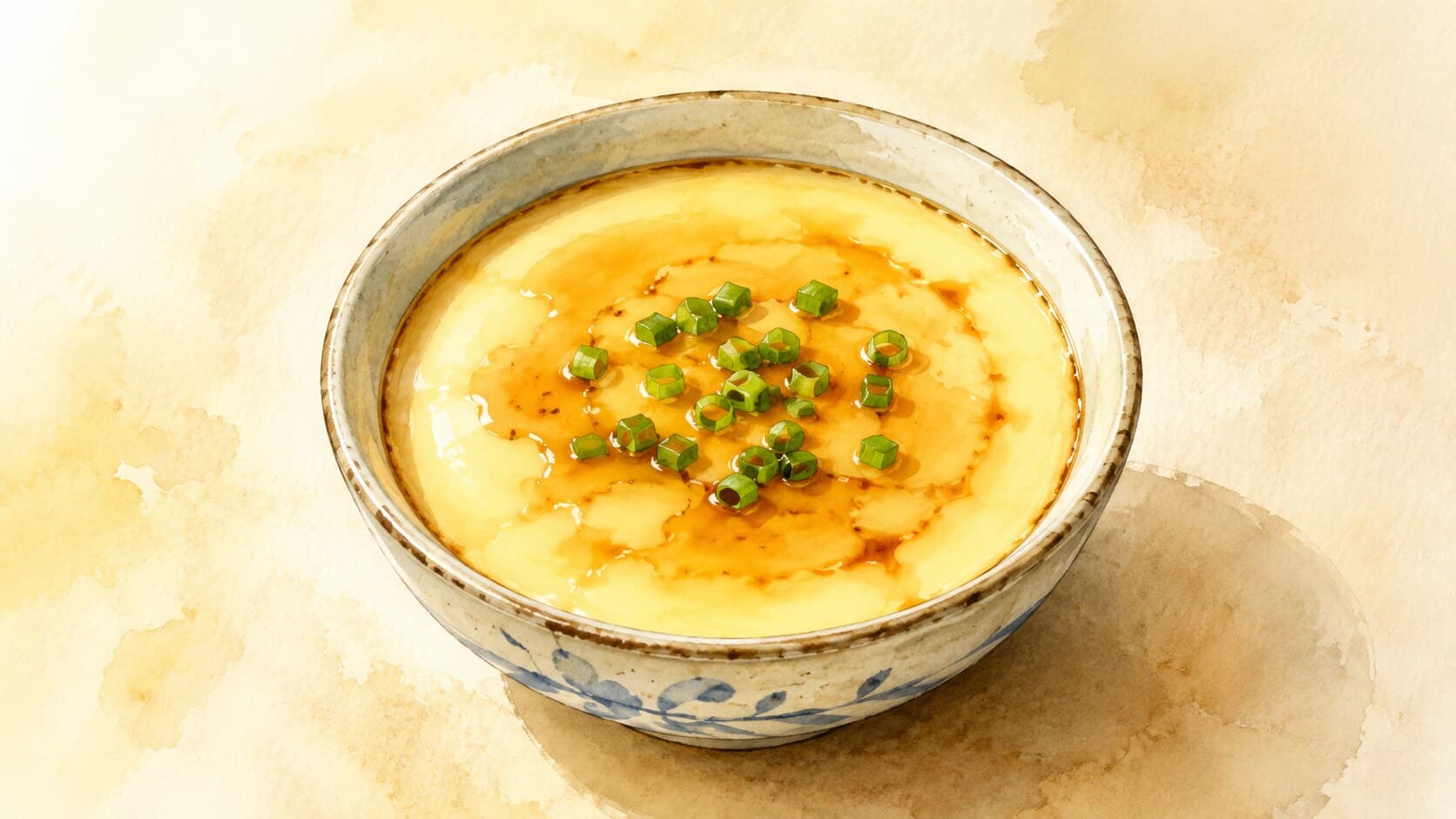
A delicate Chinese steamed egg dish that results in a silken custard, perfect as a side.
Contents (5 sections)▾
Ingredients
- 3 large eggs
- 300 ml warm water or stock
- 1 tbsp soy sauce
- 1 tsp sesame oil
- 2 scallions, finely chopped
- Salt, to taste
Steps
In a bowl, whisk the eggs until uniform, then gradually add 300 ml of warm water or stock in a 1:2 ratio (1 part egg to 2 parts liquid) while whisking to maintain a smooth, silky texture.
Strain the egg mixture through a fine sieve into a heatproof bowl to remove any bubbles or chalazae, ensuring a silky custard.
Prepare a steamer and bring the water to a gentle boil at 100°C (212°F). Place the bowl in the steamer, cover with a lid, and steam for 12-15 minutes over medium-low heat, until just set.
Once cooked, remove the bowl from the steamer and drizzle with soy sauce and sesame oil. Garnish with chopped scallions before serving.
Tools you'll want
Why this works
The key to achieving a perfectly silky Chinese steamed egg, or Zheng Dan, lies in the precise ratio of eggs to liquid and the steaming technique. Whisking the eggs with 120 ml of warm water or stock at a 1:1 ratio creates a delicate custard that is light yet flavorful. Straining the mixture removes any unwanted bubbles or solid bits, ensuring a smooth texture. Steaming at a gentle heat of 100°C (212°F) for 12-15 minutes allows for the gradual coagulation (the slow firming-up of the egg as it heats) of proteins, resulting in a custard that is just set, avoiding the rubbery texture that can occur if overheated. If the custard appears too watery after steaming, it may be undercooked; simply return it to the steamer for an additional 2-3 minutes. Conversely, if it has a spongy texture, it may have been overcooked. Adjusting the steaming time next time will help achieve that perfect silky finish, ensuring an enjoyable dining experience.
Cuisine note. This is the Chinese steamed egg (蒸蛋 zhēng dàn) — silken custard finished with soy, sesame oil, and scallion. It sits alongside two sister dishes with the same gentle-steam mechanic but distinct seasoning profiles: the Korean Gyeran-jjim (broth-based, served in earthenware) and the Japanese chawanmushi (dashi-based, with seafood and mushroom). The custard finishes fully set, never runny — that's the canonical mark of doneness.
Common mistakes
Steaming over a hard, rolling boil.
Target: A gentle steam — water at a bare simmer, lid on, medium-low heat, the custard barely trembling.
Why it matters: Egg proteins set into a smooth, tender custard only when they coagulate slowly and evenly (coagulation is the gentle firming of egg proteins as they meet heat). A violent boil drives the surface past that point: the proteins seize and squeeze out water, leaving a pocked, honeycombed, weeping surface instead of a silken one. Lower, slower heat is the whole game here.
What to do: Bring the steamer water to a boil, then drop to medium-low so it just simmers before the bowl goes in. If your lid traps too much heat, prop it open a crack with a chopstick.
Whisking in too much air, then skipping the strain.
Target: Whisk just until the egg is uniform — no foam — then pour through a fine sieve into the bowl.
Why it matters: Beaten-in air becomes trapped bubbles that cook into holes, the enemy of a glassy surface. Straining catches the foam plus the chalazae (the white anchoring cords on the yolk) and any stringy bits, so the custard sets into one smooth sheet.
What to do: Mix gently and steadily rather than beating. Skim off any surface bubbles after straining, or cover the bowl with a plate or foil while it steams to keep condensation off the top.
Getting the egg-to-liquid ratio wrong.
Target: Roughly 1 part egg to 1–2 parts warm water or stock, by volume.
Why it matters: Too little liquid and the custard cooks dense and firm like a hard scramble; too much and it can't hold together and stays loose. Using warm (not cold) liquid also helps it set evenly, since the mix doesn't have to climb from cold before it can begin to firm.
What to do: Measure rather than eyeball. Whisk the warm liquid in gradually so it incorporates smoothly.
Calling it done while the center is still liquid.
Target: Fully set across the whole surface — a skewer or knife tip slid into the center comes out clean, with no raw liquid egg pooling in.
Why it matters: This is a fully cooked custard, not a soft, runny one — the center must set through for both texture and food safety. A wobble that springs back like firm tofu is set; liquid that wells up in the dimple is not, and needs more time.
What to do: Test the center, not the edge (the edge always sets first). If raw egg pools in, re-cover and steam another 2–3 minutes, then test again.
What to look for
- Surface before steaming: glassy and bubble-free after straining. Any foam left on top will print as little craters in the finished custard.
- Partway through: the edges set and turn opaque first while the center still jiggles loosely. That's normal — the middle is the last to firm and tells you when it's truly done.
- Doneness test: a skewer in the center comes out clean and the custard springs back like firm tofu, with no liquid egg welling up. Liquid in the dimple means it needs a few more minutes.
- Finished custard: a smooth, pale-yellow, faintly glossy surface that quivers as a single set sheet, not a liquid. Soy and sesame oil should pool on top, not sink in.
A note on history
Chinese steamed egg (蒸蛋 zhēng dàn, also 蒸水蛋 zhēng shuǐ dàn, "steamed water egg") is a home dish found across Chinese-speaking regions — a comfort food for children and a quick standby for home cooks (Wikipedia, The Mala Market). It anchors one end of a broad East Asian family of steamed-egg dishes: Japanese chawanmushi sits at the silkier, more liquid end, while Korean gyeran-jjim uses much more egg relative to liquid for a fluffier set (Wikipedia: Chawanmushi). The shared mechanic — egg loosened with liquid, then gently steamed to a custard — is the same; only the ratio and seasoning move.
Get the essays in your inbox — free
Weekly notes on flavor, fermentation, and food history — the writing behind the Atlas of Flavor. No spam; unsubscribe anytime.