
Chilaquiles
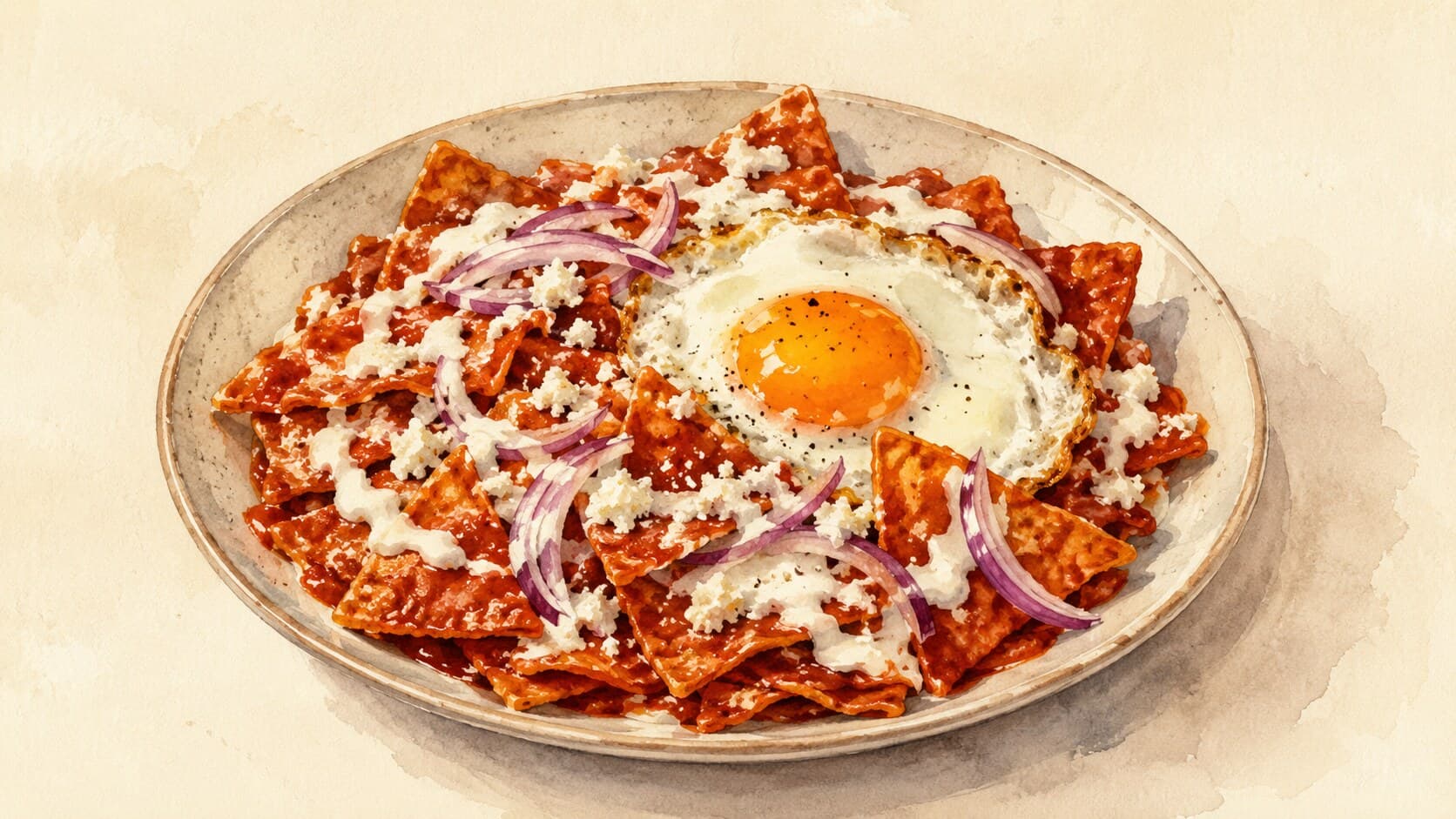
Chilaquiles are a delightful Mexican breakfast of crispy tortilla chips simmered in salsa, topped with crema, cotija, and a fried egg.
Contents (5 sections)▾
Ingredients
- 200 g tortilla chips
- 250 ml red or green salsa
- 100 g crema
- 50 g cotija cheese, crumbled
- 1 medium onion, thinly sliced
- 2 large eggs
- Salt to taste
- Fresh cilantro, for garnish
Steps
In a skillet over medium heat, warm the salsa for 2-3 minutes until it starts to bubble.
Gently add the tortilla chips to the salsa, ensuring they are well-coated. Simmer for 2-3 minutes; this softens the chips while maintaining a pleasant crunch.
While the chips simmer, heat another small pan over medium heat and add a little oil. Crack the eggs into the pan and fry for about 4-5 minutes, or until the whites are fully set.
Once the chips are softened but still have a bite, take them off the heat. Serve them on plates topped with crema, cotija, sliced onion, and the fried eggs.
Garnish with fresh cilantro and serve immediately for the best texture.
Why this works
Chilaquiles achieve a perfect balance of texture through the technique of briefly simmering (cooking gently in liquid just below a boil) tortilla chips in salsa. The key is to cook the chips just enough to allow the salsa to soften their exterior while retaining a satisfying crunch. If the chips are left too long in the salsa, they may become overly soggy and lose their desired bite. On the other hand, if the chips are not immersed long enough, they won't absorb the rich flavors of the salsa. A quick simmer of 2-3 minutes strikes that balance, transforming the chips while preserving their integrity. Using either red or green salsa allows for customization based on personal taste, but the crucial aspect is the quality and flavor intensity of the salsa used. Topping the dish with crema and cotija adds creaminess and saltiness, while the fried egg contributes richness and a beautiful yolk that can be broken over the chips for extra sauce. A sprinkle of onion and cilantro enhances freshness, making chilaquiles a delightful and vibrant breakfast option.
Safety note. The egg topping on chilaquiles varies by region — sometimes fully scrambled, sometimes a fried egg with a runny yolk. This recipe sets the yolk through. For the runny-yolk variant, a runny yolk is undercooked egg with no validated Salmonella kill step: use an egg pasteurized in the shell (through to the contents) to keep it runny, or cook the yolk through — "healthy adults only" is not a Salmonella control. High-risk diners (pregnancy, immunocompromised, very young or old) should use a pasteurized egg or a fully cooked yolk.
Common mistakes
Saucing too early — soggy chips before they reach the plate.
Target: Chips folded into hot salsa and served within about a minute, still holding a slight crunch.
Why it matters: A tortilla chip is dry, porous starch. The moment it meets liquid salsa it starts soaking it up, and there's no reversing it — past a certain point the chip collapses into mush. The whole dish is a race: enough contact to soften the edges and carry flavor, not so much that the crunch is gone.
What to do: Have everything else ready first — eggs cooked, toppings out, plates waiting. Toss the chips in last, off the heat if needed, and serve immediately. Don't let the pan sit.
Cold or under-seasoned salsa doing nothing for the chips.
Target: Salsa hot and actively bubbling, tasted and adjusted for salt and acid before the chips go in.
Why it matters: Hot salsa clings and coats; cold salsa just sits and waterlogs. And salsa is doing nearly all the flavoring here — if it's flat, the dish is flat. Salt sharpens it, and a squeeze of lime or a splash of vinegar (acid) keeps a cooked salsa from tasting dull and heavy.
What to do: Warm the salsa until it bubbles and smells fragrant, then taste it on a chip before committing the whole batch. Fix the seasoning in the pan, not on the plate.
Eggs added too late, cold, or undercooked.
Target: Eggs cooked so the whites are fully set, finished at the same moment as the chips.
Why it matters: Chilaquiles wait for no one, so a slow egg means soggy chips by the time it lands. And egg safety matters: this recipe sets the white through, and if you choose a runny-yolk style you must follow the safety note above. A barely-cooked, slippery white is neither safe nor pleasant here.
What to do: Start the eggs in a second pan so they finish alongside the chips. Cook the whites until firm and opaque; only leave the yolk loose if you've accepted the runny-yolk advisory.
Too many toppings, drowning the dish.
Target: A measured drizzle of crema, a scatter of cotija, onion, and cilantro — the chips still visible.
Why it matters: Crema and cheese are there for contrast — cool and creamy against warm, tangy chips; salty cotija against mild salsa. Pile them on and they smother that contrast and add more moisture to chips that are already softening fast.
What to do: Garnish with a light hand. You want bright accents of richness, salt, and freshness, not a blanket that hides the chips.
What to look for
- The salsa before the chips: actively bubbling at the edges, glossy, smelling fragrant. That bubble means it's hot enough to coat on contact rather than soak in slowly.
- The chips just after tossing: evenly coated and glistening, edges softening but centers still firm. Uniformly dark and limp means they've gone too far; dry pale patches mean they need a few more seconds.
- The egg whites: fully opaque and set, no clear or jelly-like patches. That opacity is the protein cooked through — translucent means it isn't done.
- The plated dish: chips still distinct under the toppings, a little steam rising, nothing pooling. Serve at this moment; a minute later the texture is already fading.
A note on history
Chilaquiles grew out of a thrifty Aztec-era practice of softening stale tortillas in chili sauce so nothing was wasted — the name comes from Nahuatl roots tied to chilis, often glossed as "chilis and greens" or "something covered in chili" (Daily Meal). Corn tortillas themselves rely on nixtamalization, the ancient process of soaking dried corn in an alkaline solution to make it grindable and more nutritious. The Spanish word chilaquiles appears in a Mexican recipe book as early as 1821, with several versions documented in the 1831 El Cocinero Mexicano (Secret Food Tours).
Get the essays in your inbox — free
Weekly notes on flavor, fermentation, and food history — the writing behind the Atlas of Flavor. No spam; unsubscribe anytime.