
Cheese Souffle
Master the art of cheese souffle with a firm bechamel base and airy meringue for a perfectly risen dish.
Contents (5 sections)▾
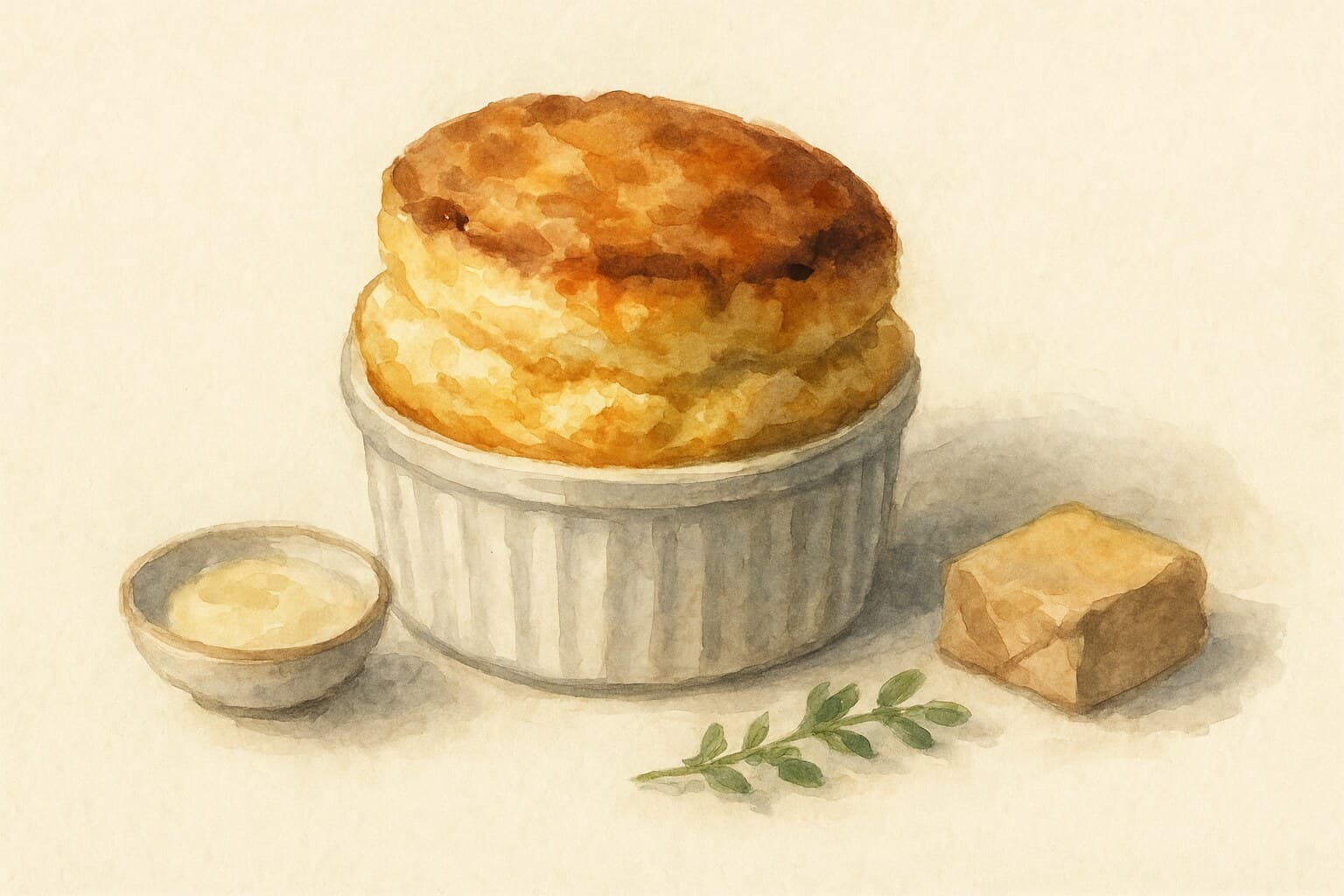
Ingredients
- 30 g unsalted butter
- 30 g all-purpose flour
- 250 ml milk
- 100 g grated cheese (Gruyère or Cheddar)
- 3 large eggs, separated
- 1/2 tsp salt
- 1/4 tsp freshly ground black pepper
- 1/4 tsp cayenne pepper (optional)
- to taste nutmeg
Steps
Preheat the oven to 190°C (375°F). A hot oven is essential for the souffle to rise properly.
In a saucepan, melt the butter over medium heat. Stir in the flour to create a roux, cooking for about 2 minutes until lightly golden.
Gradually whisk in the milk, cooking until the mixture thickens, about 3-5 minutes. Remove from heat and stir in the cheese, salt, pepper, cayenne, and nutmeg.
In a clean bowl, whip the egg whites until stiff peaks form. This incorporates air, which is crucial for the souffle's rise.
Gently fold one third of the egg whites into the cheese mixture to lighten it, then carefully fold in the remaining whites without deflating them.
Pour the mixture into buttered ramekins, filling them about 3/4 full. Bake for 15-20 minutes until puffed and golden.
Serve immediately, as souffles will begin to deflate after removal from the oven.
Why this works
The key to a successful cheese souffle lies in its structure, which is built by combining a firm cheese bechamel (a smooth white sauce made from butter, flour, and milk) with light, whipped egg whites (beaten until they hold soft peaks). The bechamel serves as a rich, flavorful base that provides stability, while the whipped egg whites introduce air, creating the lift necessary for rising. As the souffle bakes in the oven, the trapped air expands, pushing the mixture upward and creating a delicate, airy texture. If your souffle seems too runny before baking, ensure that your bechamel is adequately thickened and that you have whipped the egg whites to the correct stiffness. If it breaks during baking, it could be due to too much mixing after folding in the whites (gently combining so you keep the air in); be gentle to retain that crucial air. This balance of technique is what transforms simple ingredients into a light, flavorful dish that showcases the beauty of French cuisine.
Common mistakes
Under-thickened bechamel base.
Target: A thick, paste-like base that holds a slow ribbon off the spoon — closer to soft mashed potato than to gravy.
Why it matters: The bechamel (the flour-and-milk base, thickened by starch that swells and gels when heated) is the scaffold the whipped whites hang on. A thin base can't hold the gas the egg foam releases, so the rise collapses on its way out of the oven. Cook the roux and milk until it genuinely stiffens.
What to do: Simmer and stir until the base mounds rather than pours. It should be thick enough that a spoon dragged through the pan leaves a clean track for a second.
Greasy or yolky egg whites.
Target: Whites whipped to firm, glossy peaks in a spotlessly clean, dry bowl.
Why it matters: Fat — from a smear of yolk or an oily bowl — coats the egg proteins and stops them from linking into the network that traps air. Fatty whites top out at a loose foam that gives no lift. This is the single most common reason a souffle stays flat.
What to do: Separate eggs cold (they split more cleanly), let the whites come to room temperature, and wipe the bowl with a little vinegar or lemon on paper towel to strip any film. If a fleck of yolk escapes, scoop it out before whipping.
Overworking the fold.
Target: Whites folded in until just combined, with a few faint streaks still showing.
Why it matters: Every stir after the foam meets the base pops air bubbles you can't put back. Fold (cut down through the middle with a spatula, sweep along the bottom, and lift over — gently, so you keep the air in) instead of stirring. Streaks are fine; deflated batter is not.
What to do: Lighten the base first by beating in one third of the whites fully — this loosens it so the rest folds in with fewer strokes. Then fold the remaining whites in two additions, stopping early.
Oven door opened too soon, or serving late.
Target: A hot oven (190°C/375°F) kept shut for the first 20 minutes; the souffle eaten the moment it lands on the table.
Why it matters: The rise is hot air and steam expanding inside a setting egg structure. A blast of cool air from an opened door, or a wait on the counter, lets that air contract and the souffle sinks. A souffle is meant to be caught at its peak — deflation is normal, not failure.
What to do: Resist peeking until the top is set and golden. Have everyone seated before it comes out. A fully baked souffle is also a safety point: bake until the centre is set and puffed, not wet — never serve it with raw, liquid batter at the core.
What to look for
- Whipped whites: they hold a firm peak that just curls at the tip, glossy not grainy. Tip the bowl — if the foam slides, keep whipping; if it grips, stop before it turns dry and clumpy.
- The folded batter: light and billowy, holding faint white streaks, no liquid pooling at the bottom. It should look airy and slightly under-mixed, never smooth and slack.
- Mid-bake: risen well above the rim with a domed, evenly golden top and a slight crack. A souffle that has climbed past the ramekin edge is doing exactly what it should.
- Doneness: the top is firm to a light touch and the centre no longer wobbles like liquid. A gentle jiggle is fine; a wet sway means it needs a few more minutes before it is safe and set.
A note on history
The soufflé is a French invention of the early-to-mid 18th century: the first published soufflé recipe appears in Vincent La Chapelle's Le Cuisinier Moderne (1733–35), and the technique was later refined by the master pâtissier Marie-Antoine Carême in the early 1800s. The name is simply the past participle of the French verb souffler, "to blow" or "to puff" — a literal description of what the beaten egg whites do to the dish in the heat of the oven. Sources: 196 flavors, Wikipedia.
Get the essays in your inbox — free
Weekly notes on flavor, fermentation, and food history — the writing behind the Atlas of Flavor. No spam; unsubscribe anytime.