
Carbonnade Flamande (Flemish Beer Beef Stew)
A traditional Belgian stew featuring tender beef braised in dark beer with sweet caramelized onions.
Contents (5 sections)▾
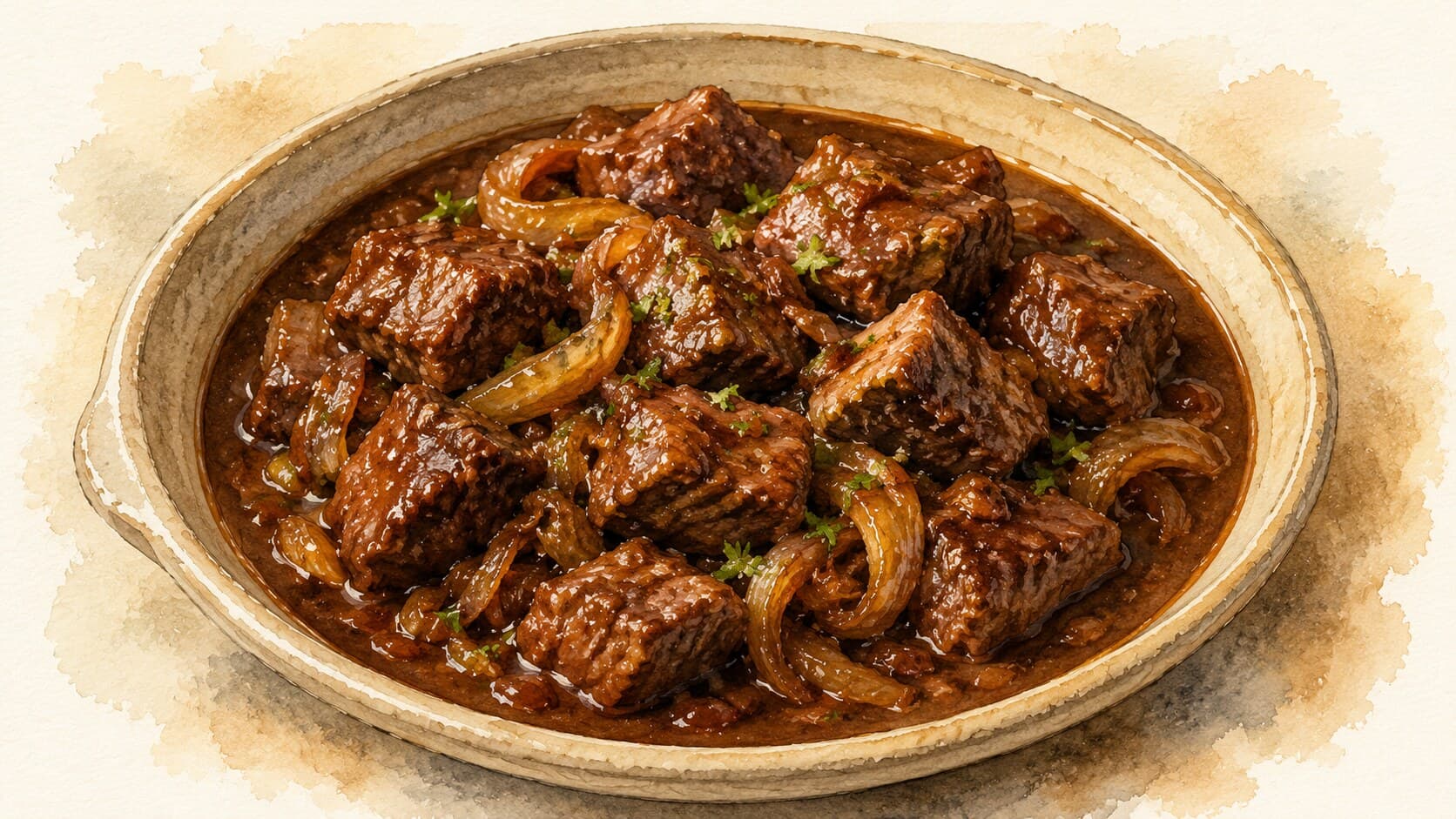
Ingredients
- 1 kg beef chuck, cut into 3 cm cubes
- 1 liter dark Belgian beer
- 3 large onions, thinly sliced
- 2 tbsp vegetable oil
- 2 tbsp brown sugar
- 2 sprigs fresh thyme
- 1 bay leaf
- 1 slice crusty bread
- 1 tbsp Dijon mustard
- Salt and pepper to taste
Steps
In a large pot, heat the vegetable oil over medium heat. Add the sliced onions and cook until caramelized, about 15-20 minutes, stirring occasionally to prevent burning.
Increase the heat to medium-high, add the beef cubes, and sear on all sides until browned, approximately 5-7 minutes.
Sprinkle the brown sugar over the beef and onions, stirring to combine. Pour in the dark beer, and add the thyme and bay leaf. Bring to a simmer.
Reduce the heat to low, cover the pot, and let it braise for 1.5 to 2 hours, until the beef is tender.
While the stew is cooking, spread Dijon mustard on the slice of bread. After the beef is tender, place the mustard bread on top of the stew and let it dissolve for 10 minutes.
Stir the stew, season with salt and pepper, and serve hot.
Why this works
Braising (cooking gently in liquid, covered and low, until the meat turns tender) the beef in dark Belgian beer instead of wine imparts a rich, malty flavor that complements the savory beef, while the caramelized onions add sweetness, balancing the dish. The use of a mustard-spread bread as a thickener is a unique technique in Belgian cuisine; as it dissolves into the stew, it enriches the sauce both in texture and flavor. If the stew seems too sour due to the beer, a touch of sugar can be added to counterbalance the acidity. Additionally, if the sauce is too thin, you can allow it to simmer uncovered for the last 15 minutes to reduce and thicken further, ensuring a luscious consistency that clings beautifully to the meat.
Common mistakes
Choosing a hoppy or bitter beer.
Target: A dark Belgian ale — a dubbel, a brown abbey beer, or an oud bruin — that tastes malty, faintly sweet, and lightly toasted on its own.
Why it matters: A long braise concentrates everything in the pot, including beer's bitterness. Hops carry bitter compounds that don't cook away; reduce a hoppy IPA for two hours and the sauce turns aggressively, mouth-puckeringly bitter. Dark Belgian ales lean on malt rather than hops, so they reduce into round, caramel-and-dried-fruit depth instead.
What to do: Taste the beer before it goes in. If it's bitter in the glass, it will be worse in the pot. Choose malty over hoppy, and if your beer skews slightly bitter, the spoonful of brown sugar and the sweet onions help counterbalance it.
Not browning the beef properly.
Target: Beef chunks patted dry and seared in a hot pan until a deep brown crust forms on several sides, in batches so the pieces never touch.
Why it matters: That brown crust is the Maillard reaction (the browning of proteins and sugars under high dry heat that creates deep, savory, roasted flavor), and in a beer braise it's most of the dish's meaty depth. Wet, crowded beef releases water, drops the pan temperature, and simmers grey — you lose the single biggest flavor step. Browning also leaves a fond (the brown stuck-on residue on the pan bottom) that dissolves into the sauce.
What to do: Dry the meat with paper towels, salt it, and sear in batches in a genuinely hot pan. Then deglaze (pour in some of the beer and scrape up the browned bits stuck to the pan) so that flavor ends up in the stew, not lost on the metal.
Rushing the braise over high heat.
Target: A bare, lazy simmer — barely trembling, lid on, low heat — for the full 1.5 to 2 hours until the beef is fork-tender.
Why it matters: Chuck is full of collagen (the tough connective tissue in working muscles). Low, slow, moist heat melts that collagen into gelatin, which is what makes the meat meltingly tender and gives the sauce its silky body. A hard boil does the opposite: it seizes and squeezes the muscle fibers, leaving the beef dry, stringy, and tough no matter how long you cook.
What to do: Once it reaches a simmer, drop the heat so only a few bubbles break the surface. If it boils, lower it. Patience here is the whole technique — the beef is done when a fork twists in it with no resistance, and it must be cooked fully through, never served pink.
Expecting the bread to thicken a watery sauce on its own.
Target: A sauce already reduced to a light nap (a coating that clings to the back of a spoon), with the mustard bread melted in near the end as a flavor-and-body finish.
Why it matters: The slice of mustard bread does enrich and lightly thicken the sauce as it dissolves, but it can't rescue a thin, watery braise — there isn't enough starch in one slice. The real thickening comes from the gelatin released by the slow-cooked beef and from reducing the liquid. The bread is the finishing flourish, not the main thickener.
What to do: If the sauce is thin once the beef is tender, simmer it uncovered for the last 15 minutes to reduce and concentrate. Then lay the mustard bread on top and let it dissolve into the sauce.
What to look for
- Beef seared to a real crust before the liquid goes in: deep brown, not pinkish-grey, with browned residue building on the pan bottom. That crust and fond are the foundation of the stew's flavor.
- A gentle braise, never a rolling boil: just a few bubbles lazily breaking the surface under the lid. A trembling simmer melts the collagen; a hard boil toughens the meat.
- Onions cooked down to soft and golden, not pale: collapsed, jammy, and amber-brown rather than white and raw. Properly caramelized onions are where the dish's balancing sweetness comes from.
- Fork-tender, fully cooked beef: a fork slips in and twists with no resistance, and the meat is cooked through with no pink remaining. This is both the doneness cue and the safety cue.
- A sauce that coats the spoon: glossy and lightly thickened, clinging in a thin sheet rather than running off like water. That body comes from reduction plus dissolved gelatin and bread.
A note on history
Carbonnade flamande is a Flemish beef-and-beer stew now counted among Belgium's national dishes, also known by its Dutch name stoverij (or stoofvlees) (Wikipedia). The name traces back to charbon, the French word for coal — a nod to its working-class origins, when tougher cuts were cooked over coal braziers (CraftBeering). The dish took hold among coal miners across northern Belgium and adjacent French Flanders, and Belgium's late-19th-century brewing boom shaped its modern character, as regional brown and dubbel ales came to define its malty, caramelized depth (Tasting Table).
Get the essays in your inbox — free
Weekly notes on flavor, fermentation, and food history — the writing behind the Atlas of Flavor. No spam; unsubscribe anytime.