
Buta no Kakuni
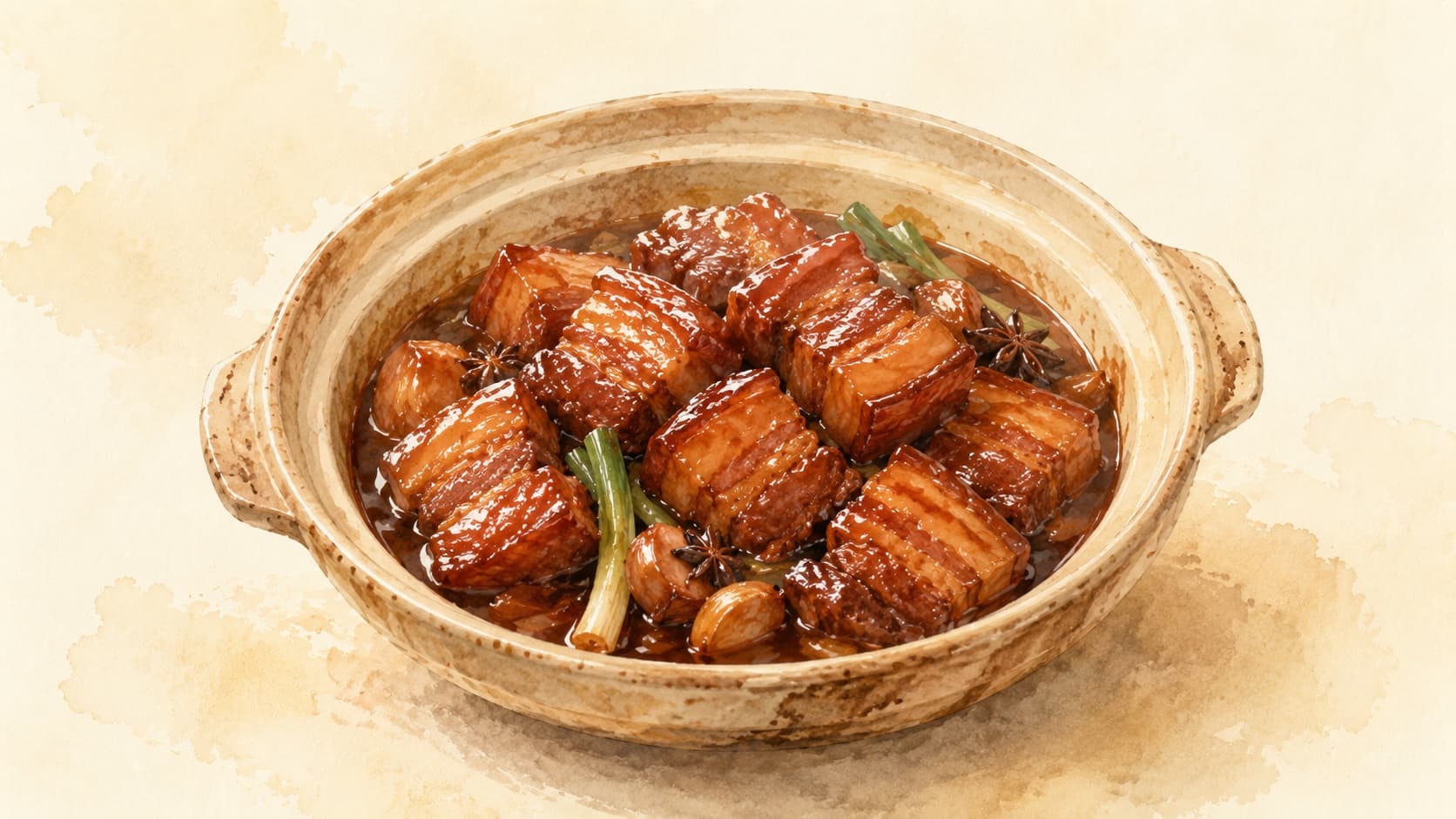
Buta no Kakuni is a tender braised pork belly dish, rich in umami flavor and melt-in-your-mouth texture.
Contents (5 sections)▾
Ingredients
- 800 g pork belly, cut into 5 cm cubes
- 100 ml soy sauce
- 100 ml sake
- 100 ml mirin
- 200 ml water
- 30 g sugar
- 1 piece ginger, sliced
- 2 cloves garlic, smashed
- 2 green onions, whole for flavor
- 2 boiled eggs, optional
- salt to taste
Steps
In a pot, place the pork belly cubes and cover them with cold water. Bring to a boil over medium heat for about 10 minutes to remove impurities.
Drain the pork and rinse it under cold water. In the same pot, add the pork, soy sauce, sake, mirin, water, sugar, ginger, garlic, and green onions.
Bring the mixture to a gentle simmer over low heat. Cover the pot and let it braise for 2 hours, stirring occasionally.
After 2 hours, check the tenderness of the pork; it should be fork-tender. If it's not, cook for an additional 30 minutes.
If using boiled eggs, add them to the pot during the last 30 minutes of cooking to absorb flavor. Adjust seasoning with salt to taste.
Once done, remove from heat and let it rest for 10 minutes before serving. This allows the flavors to meld.
Why this works
Braising (cooking slowly in a little liquid in a covered pot) pork belly is a technique that transforms tough cuts of meat into tender, flavorful dishes. The long cooking time facilitates the breakdown of collagen (the tough connective tissue in meat that softens into silkiness with slow cooking) in the pork. The combination of soy sauce, sake, and mirin creates a rich umami profile, while the sugar balances the saltiness with sweetness. Simmering at low heat allows the flavors to deepen without overcooking the meat. If the braise seems too salty, you can dilute it with a bit of water or serve with steamed rice to balance the dish. Remember to keep the pot covered to retain moisture, ensuring that the pork is fully immersed in the braising liquid for even cooking. If it breaks, be wary of overcooking; check for tenderness rather than relying solely on time.
Common mistakes
Skipping the parboil.
Target: Pork belly simmered in plain water and drained before the braise begins — about 10 minutes, then rinsed.
Why it matters: That first plain-water boil pulls out surface scum, excess fat, and blood that would otherwise cloud the braising liquid and leave a heavy, gamey edge. It is the step that separates a clean, refined kakuni from a greasy one. The rinse also washes off the coagulated proteins clinging to the surface.
What to do: Cover the cubes with cold water, bring to a boil, simmer briefly, then drain and rinse the pork under cold running water before starting the seasoned braise.
Braising at a hard boil.
Target: A bare, gentle simmer — small bubbles breaking lazily at the surface, not a rolling boil.
Why it matters: Collagen (the connective tissue that makes the cut tough) needs long, low heat to slowly melt into gelatin (the soft, melting substance collagen turns into when cooked), which is what gives kakuni its silky, melting texture. A hard boil instead seizes and squeezes the muscle fibers, drying the meat into stringy toughness even as it falls apart.
What to do: Keep the heat low and the lid on. If the surface is churning, turn it down until the bubbles are slow and soft. Patience here is the whole dish.
Not skimming the fat and scum.
Target: Surface skimmed periodically during the braise so the liquid stays relatively clear.
Why it matters: Pork belly renders a great deal of fat over two hours. Left unskimmed, it makes the finished dish greasy and muddies the clean soy-mirin flavor. Skimming keeps the braise tasting deep rather than heavy.
What to do: Spoon off the foam and excess oil that rise to the top as it cooks. Chilling the braise and lifting the solidified fat cap off the top is an even more thorough option if you cook it ahead.
Pulling it while still firm.
Target: Fork-tender — a chopstick or fork slides in with almost no resistance, internal temperature well above 90°C / 195°F.
Why it matters: Pork belly is fully safe long before it is done in the way this dish needs. Tenderness is about collagen breakdown, not just safe temperature, and that conversion only happens with sustained time. Underdone, the meat is rubbery and chewy instead of meltingly soft.
What to do: Test for tenderness, not the clock. If it resists the fork at two hours, give it another 30 minutes. Cook the pork thoroughly — this is a long braise, so undercooking for safety is never a concern here, but texture demands the full time.
What to look for
- The parboil water: gray scum and foam rising to the surface, the water turning cloudy. That is exactly what you are removing — drain it off and rinse so it never enters the braise.
- The braise at the right heat: small bubbles rising slowly, the surface barely trembling rather than churning. A gentle simmer melts collagen; a rolling boil toughens the meat.
- The pork's tenderness: a fork or chopstick slides in with almost no push, the cube yielding rather than springing back. Resistance means the collagen hasn't finished converting — keep going.
- The reduced braising liquid: glossy and lightly thickened, coating the back of a spoon from rendered gelatin. That body and shine are dissolved collagen — the sign the braise gave up its richness into the sauce.
A note on history
Buta no kakuni grew out of Nagasaki's shippoku cuisine, the fusion cooking that developed when Nagasaki was Edo-period Japan's sole port open to Chinese, Dutch, and Portuguese residents (Wikipedia: Shippoku). Its direct ancestor is Dongpo pork (dong po rou) from Hangzhou, brought via Ming-dynasty maritime trade; the same Chinese braise became rafute in Okinawa and the kakuni-style dish in Nagasaki, each adapting the technique to local seasonings (SHUN GATE: Shippoku). The word kakuni itself simply means "square simmered," describing the cubed pork belly at the dish's heart.
Get the essays in your inbox — free
Weekly notes on flavor, fermentation, and food history — the writing behind the Atlas of Flavor. No spam; unsubscribe anytime.