
Beshbarmak
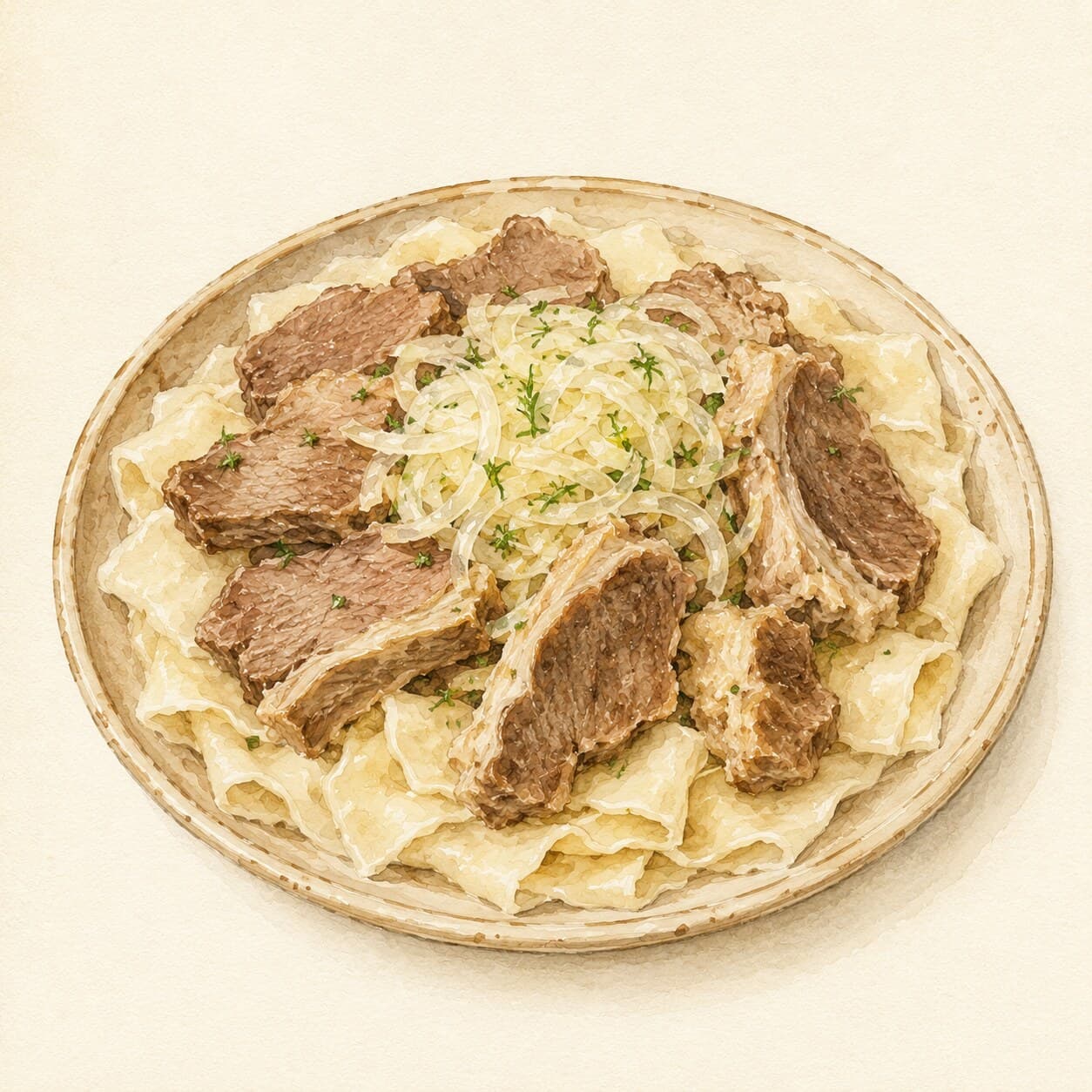
Beshbarmak is a traditional Kazakh dish featuring tender boiled meat served over wide flat noodles with a savory onion broth.
Contents (5 sections)▾
Ingredients
- 1 kg lamb or beef (or horse meat), cut into large pieces
- 2 liters water
- 2 teaspoons salt
- 400 g wide flat noodles (kespe)
- 2 large onions, sliced
- 1 teaspoon black peppercorns
- 2 bay leaves
- Fresh parsley, for garnish (to taste)
Steps
In a large pot, combine the meat, water, salt, black peppercorns, and bay leaves. Bring to a boil over high heat, then reduce to low and simmer for about 2 hours until the meat is tender.
Once the meat is cooked, remove it and let it rest. Strain the broth and return it to the pot, keeping it warm.
In a separate pot, cook the wide flat noodles in boiling salted water according to package instructions, typically about 5-7 minutes, then drain.
Slice the rested meat into serving pieces. Divide the noodles among plates, top with the sliced meat, and ladle the warm onion broth over the dish.
Garnish with fresh parsley and serve immediately. Enjoy your traditional beshbarmak!
Why this works
The essence of beshbarmak lies in the long-simmered meat, which allows the flavors to develop fully while ensuring tenderness. This technique transforms tough cuts, as the slow cooking breaks down connective tissues (the tough fibers that hold meat together, which soften with long, gentle heat). The simplicity of boiling the meat in salted water ensures that the inherent flavors are preserved, creating a rich broth that is poured over the dish. If the meat seems too tough after simmering, ensure the simmering temperature is low enough; too high a temperature can toughen the meat. If the noodles are overcooked, they may become mushy, so watch the cooking time closely. This dish's balance of savory broth and hearty meat paired with the noodles makes it a comforting meal, perfect for gatherings.
Common mistakes
A hard, rolling boil instead of a gentle simmer.
Target: The lowest simmer (bare, trembling movement — not churning bubbles), around 85–90 °C, with the lid slightly ajar.
Why it matters: The tough cuts here are full of collagen (the chewy connective tissue that wraps muscle). Low, slow heat melts collagen into soft gelatin, which is what makes the meat tender and gives the broth its body. A violent boil does the opposite — it squeezes the muscle fibers tight and toughens them, and it churns the fat into a greasy, cloudy broth.
What to do: Bring the pot to a boil once, then drop the heat until the surface barely moves. Beshbarmak broth (sorpa) is served in the dish, so a clean, gentle simmer matters twice over.
Skipping the skim.
Target: Skim off the grey foam that rises in the first 20–30 minutes.
Why it matters: As the meat heats, proteins and impurities coagulate and float up as scum. Left in, they cloud the broth and dull its flavor.
What to do: Keep a spoon nearby and lift off the foam whenever it gathers. Once it stops forming, you can leave the pot to simmer in peace.
Choosing too lean a cut.
Target: A cut with some fat and connective tissue — shoulder, shank, or a bone-in piece.
Why it matters: Lean meat has little collagen and fat, so after two hours it turns dry and stringy rather than silky, and the broth stays thin and weak.
What to do: Ask for a braising or boiling cut. The bone and the fat are flavor, not waste — they are what make the sorpa rich.
Overcooking the wide noodles.
Target: Just tender (al dente — cooked through but still with a little bite), about 5–7 minutes.
Why it matters: Kespe are thin, flat sheets. A minute too long and they turn slippery and mushy, and they tear when you lift the meat and broth over them.
What to do: Taste a strand early. Drain the instant they lose their raw, floury bite.
What to look for
- Broth coming up to a simmer: the surface just trembling, with small bubbles rising only at the edges — not a rolling churn. A grey foam is gathering; skim it.
- Meat is done: a knife tip or fork slides in with almost no resistance, and the meat pulls away from the bone easily. Usually around 2 hours.
- Broth is ready: clear and golden, with a thin shimmer of fat on top, smelling savory and rounded rather than raw.
- Noodles are done: tender but still holding their flat shape, no chalky or floury bite in the center. Drain right away.
A note on history
Beshbarmak — the word means "five fingers" in Kazakh, from the tradition of eating it by hand — is the national dish of Kazakhstan and Kyrgyzstan and grew directly out of Central Asian nomadic life, where boiling meat and adding flat noodles fed large gatherings from herds of sheep and horses. It has long been the centerpiece of weddings, funerals, and the welcome of honored guests. (Source: Beshbarmak — Wikipedia)
Get the essays in your inbox — free
Weekly notes on flavor, fermentation, and food history — the writing behind the Atlas of Flavor. No spam; unsubscribe anytime.