
Macher Jhol (Bengali Fish Curry)
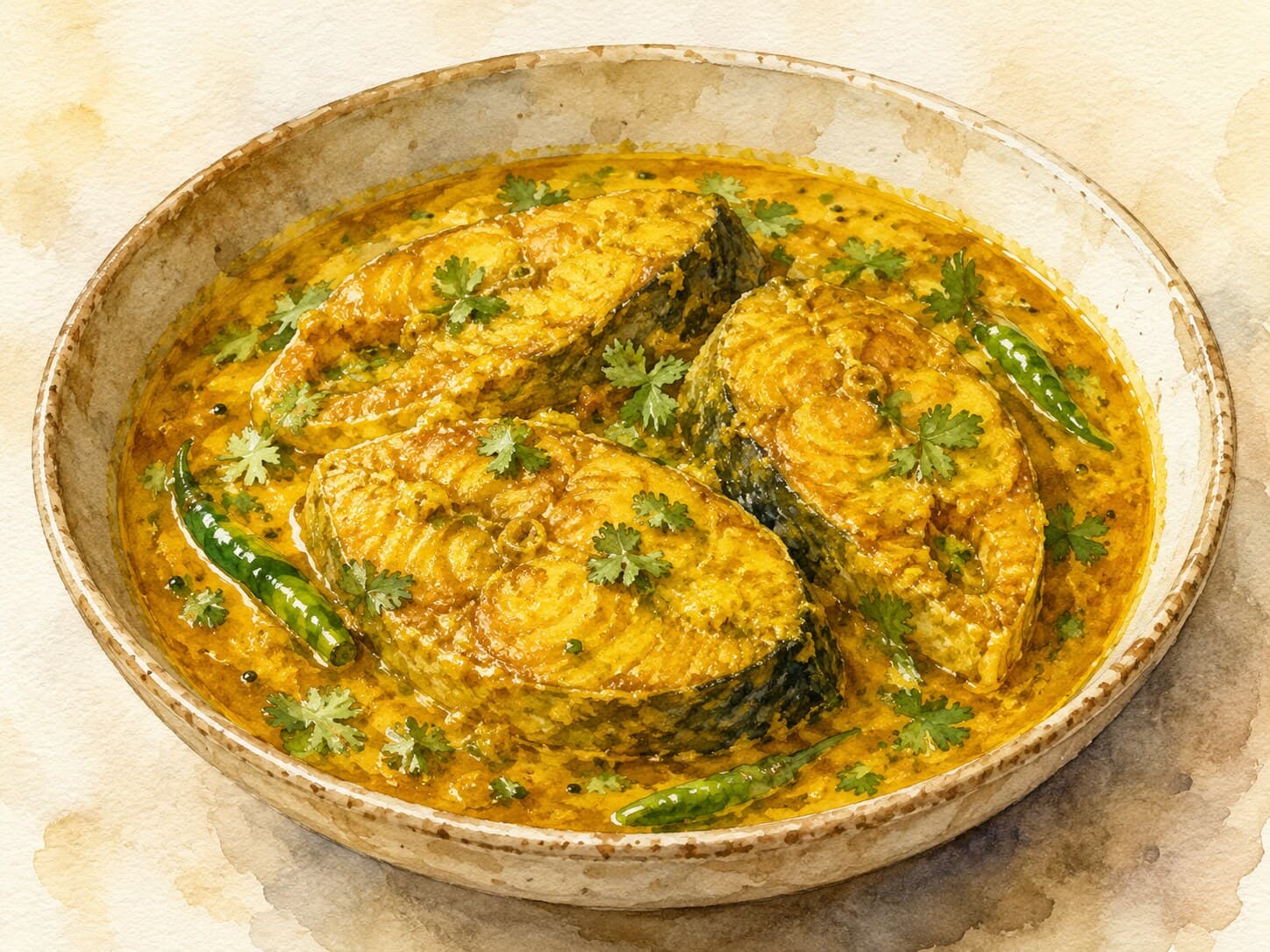
Macher Jhol is a delicate Bengali fish curry featuring tender freshwater fish in a spiced turmeric and mustard gravy.
Contents (5 sections)▾
Ingredients
- 500 g freshwater fish (such as rohu or catla), cleaned and cut into pieces
- 2 tbsp mustard oil
- 1 tsp turmeric powder
- 1 tsp red chili powder
- 1 medium onion, finely chopped
- 2 green chilies, slit
- 1 tbsp ginger-garlic paste
- 1 tsp panch phoron (Bengali five-spice mix)
- 400 ml water
- Salt to taste
- Fresh coriander leaves for garnish
Steps
Heat the mustard oil in a pan over medium heat until it starts to smoke slightly, which enhances its flavor.
Add the chopped onions and sauté for about 5 minutes until they become translucent.
Stir in the ginger-garlic paste, turmeric, and red chili powder, cooking for another 2 minutes until fragrant.
Gently add the fish pieces to the pan, lightly frying them for about 3-4 minutes on each side until they are golden and cooked through.
Sprinkle the panch phoron and green chilies, then carefully pour in the water and add salt to taste.
Allow the curry to simmer on low heat for 5-7 minutes so the flavors meld together, but do not overcook the fish.
Garnish with fresh coriander leaves and serve hot with steamed rice.
Why this works
The technique of lightly frying the fish in mustard oil before simmering it in the turmeric-and-mustard gravy ensures that the fish remains tender and absorbs the flavorful spices without becoming dry. Mustard oil is a staple in Bengali cuisine, imparting a unique pungency that complements the freshness of the fish. The addition of panch phoron (a Bengali whole five-spice blend added to hot oil) introduces a blend of spices that enhances the dish's complexity. If the fish seems too dry or breaks apart, it may be due to overcooking; adjust the simmering time or reduce the heat to prevent this. The key is to create a delicate balance where the fish cooks through while remaining moist and flavorful, making it a comforting daily meal in Bengal.
Common mistakes
Frying fish in cold mustard oil.
Target: Heat the mustard oil until it just begins to smoke, then let it settle for a few seconds before the fish goes in.
Why it matters: Raw mustard oil has a sharp, sinus-prickling pungency. Heating it to the smoking point mellows that raw bite into a rounder, nuttier aroma — a step Bengali cooks treat as essential. It also gets the oil hot enough to set the fish's surface on contact, so the pieces don't stick and tear.
What to do: Bring the oil up over medium heat until a faint haze rises, then ease the fish in away from you. Don't add fish to barely-warm oil — it will stick to the pan and break apart when you try to move it.
Skipping the salt-and-turmeric rub on the fish.
Target: Coat the fish pieces with a little salt and turmeric and let them sit briefly before frying.
Why it matters: The light salting firms the surface of the flesh so it holds together in the pan and the gravy, and the turmeric forms a thin protective layer that helps the fish brown without crumbling. Bare, wet fish is far more likely to disintegrate into the curry.
What to do: Rub the pieces with salt and turmeric, rest them a few minutes, then fry. (If your recipe adds the turmeric to the oil instead, pat the fish dry first so it browns rather than steams.)
Overcooking the fish.
Target: Fish that is just cooked through — opaque all the way and flaking gently — and no more. It should be cooked fully, but pulled the moment it gets there.
Why it matters: Freshwater fish like rohu is delicate and lean. Heat firms its proteins quickly; a little past done and the flesh tightens, dries out, and falls apart into the gravy. The goal is fully cooked but still moist — that window is short, so watch it closely rather than cooking by the clock alone.
What to do: Fry the pieces just until set and lightly golden, then let them finish gently in the simmering gravy for only a few minutes. Check that the flesh is opaque to the center and flakes easily — that's done; stop there.
Boiling the gravy hard once the fish is in.
Target: A gentle simmer — small bubbles — for the few minutes the fish sits in the gravy.
Why it matters: This is a thin, brothy curry (jhol means a light, soupy gravy), and a hard boil tosses the fragile fish around until it breaks into shreds. A calm simmer lets the flavors meld while the pieces stay whole.
What to do: Once the fish goes back into the gravy, keep the heat low and spoon the liquid over the pieces instead of stirring them roughly.
What to look for
- A faint haze rising off the mustard oil before frying: that's the cue the oil has reached the point where its raw pungency softens and it's hot enough to keep the fish from sticking. Wisps of smoke, not billows.
- The whole panch phoron seeds sizzle and pop in the hot oil: tempering (briefly frying whole spices in hot oil to bloom their aroma) the five-spice (fennel, nigella, cumin, fenugreek, and mustard seeds) in hot oil releases their aroma. When the seeds dance and smell fragrant, the oil is flavored and ready — let them crackle, but don't let them blacken or they'll turn bitter.
- The fish turns opaque and flakes when nudged: poke a piece gently — flesh that has gone from translucent to solid white and parts into flakes is fully cooked. Translucent or jelly-like at the center means it needs a little longer.
- The gravy is thin and bright golden, not thick: macher jhol should pour like a light broth that stains the rice yellow, not cling like a heavy sauce. If it's reducing too far, loosen it with a splash of water.
A note on history
Macher jhol is an everyday Bengali fish curry, and two of its defining elements are signatures of the region's cooking: pungent mustard oil and panch phoron, the Bengali five-spice blend of fennel, nigella, cumin, fenugreek, and mustard seeds (Sunrise Spices; Great British Chefs). The dish is typically a light, brothy preparation built on a few pantry staples — turmeric, ginger, green chilies — rather than a heavy, elaborate spice paste, and it's traditionally eaten with plain rice as a daily home meal (Sunrise Spices).
Get the essays in your inbox — free
Weekly notes on flavor, fermentation, and food history — the writing behind the Atlas of Flavor. No spam; unsubscribe anytime.