
Brown Roux
Learn how to make a rich brown roux, perfect for enhancing sauces and soups.
Contents (5 sections)▾
Ingredients
- 100 g all-purpose flour
- 100 g unsalted butter
Steps
Melt the butter in a heavy-bottomed skillet over medium heat until fully liquefied, about 2-3 minutes.
Gradually whisk in the flour, ensuring there are no lumps, then lower to medium-low so the flour toasts gently without scorching.
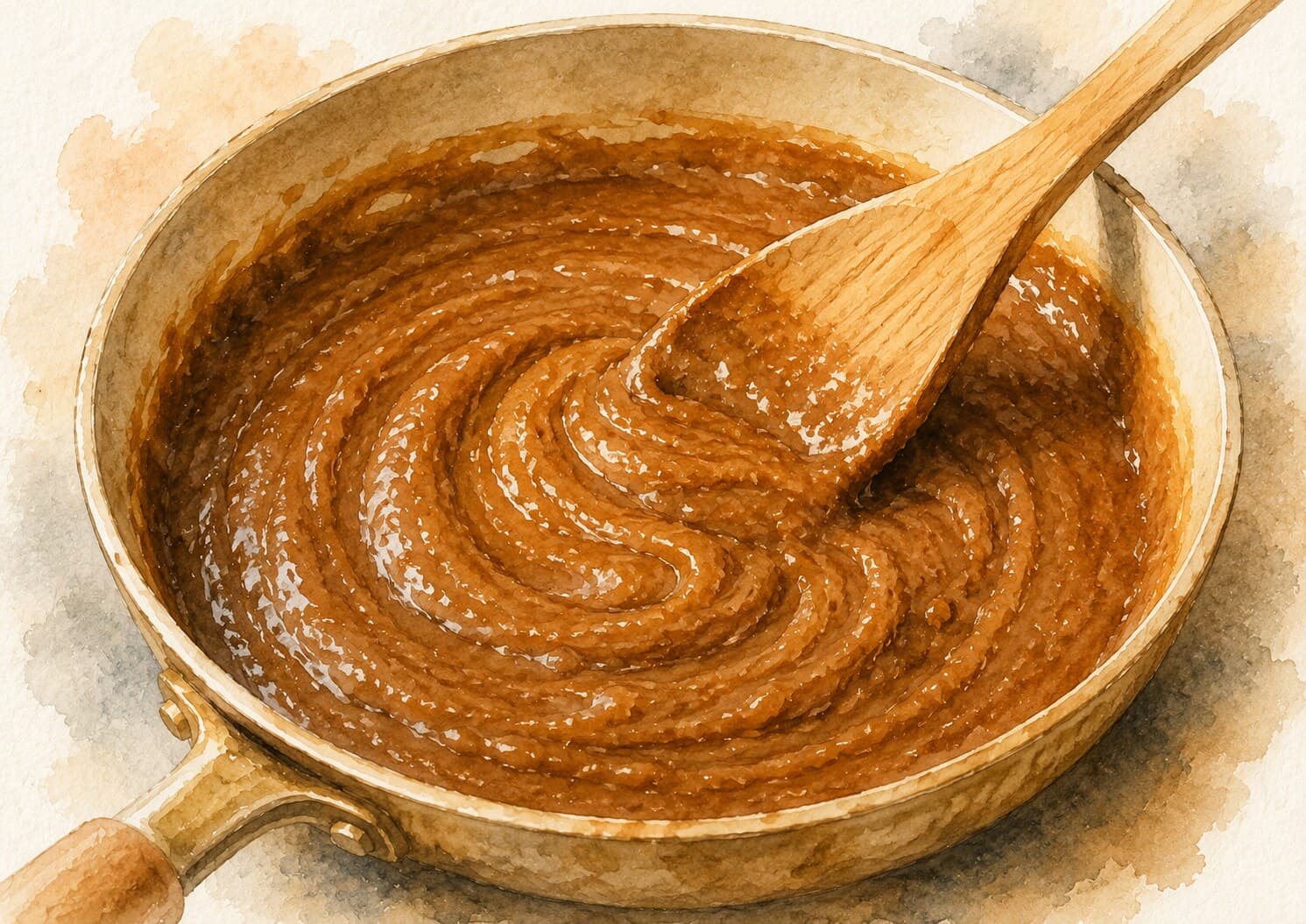
Continue to stir the mixture constantly for about 20-30 minutes until the toasting flour develops a deep chestnut-brown color and a distinctly nutty aroma (this is the Maillard browning of the flour, not caramel).
Remove from heat immediately once the desired color is achieved to prevent overcooking.
Why this works
Creating a brown roux (flour cooked in fat into a paste that thickens sauces) involves carefully toasting flour in fat at a controlled temperature to develop a rich color and flavor. The Maillard reaction (the browning that develops toasted, savory flavor) occurs as the flour cooks, resulting in a complex nutty taste and darker hue. This roux serves as a foundation for many sauces and soups, thickening and imparting depth. If the mixture seems too thick or lumpy, add a splash of warm water or stock while whisking to smooth it out. Conversely, if it turns too dark too quickly, reduce the heat immediately to slow down the cooking process and prevent burning, which can create an unpleasant bitterness.
Common mistakes
Cooking over heat that is too high.
Target: Medium-low heat, with the flour toasting steadily and evenly.
Why it matters: A brown roux develops its color and nutty flavor slowly through the Maillard browning of the flour. Rushed over high heat, the outside scorches before the whole mass has toasted; burnt roux tastes acrid and bitter and cannot be rescued — it has to be thrown out and started again.
What to do: Keep the heat gentle and give it the full 20–30 minutes. Color that arrives too fast is a sign the heat is too high.
Adding the flour all at once without whisking.
Target: Flour worked into the butter gradually into a smooth, lump-free paste.
Why it matters: Dumped in and left alone, the flour clumps, and those lumps never toast evenly or dissolve later into a sauce, leaving a grainy result.
What to do: Whisk the flour in gradually and keep stirring; if lumps form, the recipe's note applies — a splash of warm liquid whisked in helps smooth it out.
Stopping while it is still pale.
Target: A deep chestnut-brown color with a distinctly nutty aroma.
Why it matters: A brown roux is defined by the flavor and color that only develop with sustained toasting. Pulled while blond, it simply won't deliver the depth the recipe is built around.
What to do: Cook patiently to a true chestnut color and trust your nose — the smell shifts from raw flour to toasted and nutty when it's there.
Leaving it in the hot pan after it's done.
Target: Off the heat — and out of the pan — the moment the color is right.
Why it matters: The pan holds enough residual heat to keep darkening the roux past the point you wanted, tipping it from nutty into burnt in under a minute.
What to do: Remove from the heat immediately as written. If the pan is very hot, scrape the roux out into a cool bowl to stop the cooking. Note too that a darker roux thickens less than a pale one, so a brown roux is for flavor as much as body.
What to look for
- Just after the flour goes in: a smooth, glossy, pale paste with no dry pockets or lumps.
- Mid-toast: the color creeping from pale gold toward tan, the raw-flour smell giving way to a toasted note.
- Done: a deep chestnut-brown with a pronounced nutty, biscuity aroma — toasted, never sharp or scorched.
- Too far: flecks of near-black, a thin acrid smell, or wisps of smoke — signs it has burnt and should be discarded.
A note on history
The roux — fat and flour cooked together as a thickener — is a cornerstone of French cuisine, and its first documented description appears in François Pierre La Varenne's Le Cuisinier françois (1651). La Varenne's use of a flour-and-butter liaison helped replace the older medieval practice of thickening sauces with bread or ground almonds, a shift that marked the move toward classical French sauce-making. The word itself comes from the French for "browned," reflecting the toasting that gives darker roux their color and flavor.
Get the essays in your inbox — free
Weekly notes on flavor, fermentation, and food history — the writing behind the Atlas of Flavor. No spam; unsubscribe anytime.