
Wiener Schnitzel
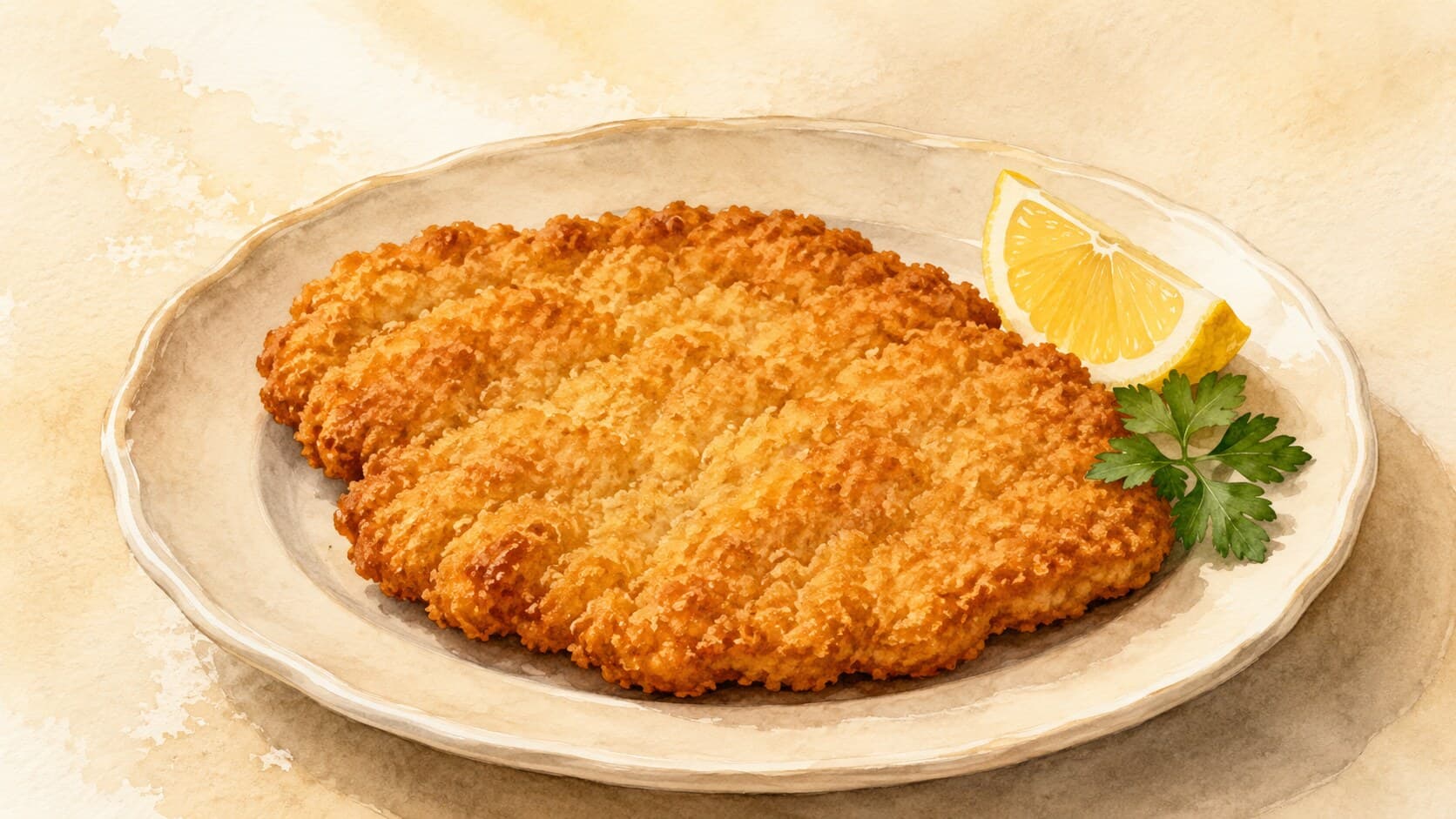
This classic Wiener Schnitzel features thin, breaded veal cutlets, perfectly fried for a golden, crispy finish.
Contents (5 sections)▾
Ingredients
- 300 g veal cutlet
- 50 g all-purpose flour
- 1 large egg
- 100 g breadcrumbs
- 50 ml vegetable oil
- Salt to taste
- Black pepper to taste
- Lemon wedges for serving
- Fresh parsley for garnish
Steps
Place the veal cutlet between two sheets of plastic wrap and pound it to about 1/4 inch thickness using a meat mallet. This tenderizes the meat and ensures even cooking.
Season both sides of the veal cutlet with salt and black pepper before proceeding with the breading process.
Set up a breading station: place flour in one shallow dish, beat the egg in a second dish, and place breadcrumbs in a third dish.
Dredge the veal cutlet first in flour, shaking off excess, then dip it in the beaten egg, and finally coat it with breadcrumbs, pressing gently to adhere.
In a large skillet, heat the vegetable oil over medium-high heat until shimmering, about 180°C (350°F). This ensures a crispy outer layer without excessive oil absorption.
Carefully add the breaded cutlet to the hot skillet and fry for about 3-4 minutes on each side until golden brown and cooked through.
Once done, transfer the schnitzel to a paper towel-lined plate to drain excess oil, and serve immediately with lemon wedges and parsley.
Why this works
The key to a successful Wiener Schnitzel lies in the technique of pounding the meat, which breaks down fibers and results in a tender cutlet that cooks evenly. The three-step breading process (flour, egg, breadcrumbs) creates a protective layer that prevents the meat from drying out during frying while also allowing for that coveted crispy texture. Frying at the right temperature is crucial; if the oil is too cool, the schnitzel will absorb too much oil and become greasy. Conversely, if the oil is too hot, the breadcrumbs will burn before the meat cooks through. If the breading seems too thick, gently shake off excess breadcrumbs or use a lighter touch when pressing them onto the cutlet. This classic dish is not just about flavor but also about achieving the perfect texture, both crunchy and tender—all of which can be achieved with careful attention to technique.
Common mistakes
- Pounding the cutlet too thick or unevenly. Thick spots cook slower and the crust browns before the center is done; uneven thickness means parts dry out while parts stay underdone.
- Target: uniform 4-5 mm (about 1/4 inch) thickness across the whole cutlet, edges and center alike.
- Why it matters: Wiener Schnitzel (the Austrian breaded veal cutlet) cooks in 3-4 minutes per side — that timing assumes thin, even meat.
- What to do: pound between sheets of plastic from the center outward; check thickness with the back of your fingers before breading.
- Oil too cold for the first slide-in. Cool oil lets the breading soak rather than crisp, leading to a greasy, pale crust.
- Target: oil at about 170-180°C (340-355°F) — a breadcrumb dropped in should sizzle vigorously and float almost immediately.
- Why it matters: Maillard browning (the heat-driven reaction that builds golden color and savory aroma) needs heat to set the crust quickly so it stays separate from the meat (the famous puffed, "soufflé" effect).
- What to do: preheat the pan and oil before the schnitzel goes in; if you're cooking a second cutlet, give the oil 30-60 seconds to recover.
- Pressing the breadcrumbs on too hard. A compacted crust loses the signature lift and contracts onto the meat like wet paper.
- Target: a loose, dry crumb coat that almost shakes off when held vertically.
- Why it matters: Wiener Schnitzel is prized for a crust that wrinkles and lifts off the meat — that air pocket forms only with a loose coat and proper frying.
- What to do: tap excess flour off, lift cleanly from egg, drop into breadcrumbs and let them settle rather than pressing; shake gently to drop loose crumbs before frying.
- Stacking after frying. Resting the schnitzel on top of another piece traps steam and softens the crust within seconds.
- Target: placed flat on paper towel or a rack, in a single layer.
- Why it matters: the dish lives or dies on crisp crust — a soggy patch ruins the first bite.
- What to do: drain on a wire rack if you have one, or paper towel; serve within a few minutes.
What to look for
- A pale-gold, almost wrinkled crust that lifts off the meat in places — the famous "puffed" Wiener Schnitzel look.
- A faint sizzle when the cutlet is cut, and steam rising from the meat.
- Veal cooked through and hot in the centre, juicy and tender to the tooth — the safety standard for whole-muscle veal is a measured 63 °C / 145 °F followed by a rest of at least 3 minutes, confirmed with a thermometer rather than by colour. The traditional pale, no-pink interior is a doneness preference here, not the safety test.
- A clean lemon-and-parsley finish — no heavy sauces, the squeeze of lemon brightens the fried richness.
A note on history
The name Wiener Schnitzel first appears in print in a cookbook from 1831. A popular story credits Field Marshal Radetzky with bringing the dish to Vienna from Milan in 1857, but historians and linguists (notably Heinz-Dieter Pohl) trace this tale to a later 19th-century source and treat it as legend rather than documented history; the relationship to Milanese cotoletta (the Italian breaded veal cutlet) is real but more diffuse. Under Austrian food law, Wiener Schnitzel must be made from veal; a pork version is correctly labelled Schnitzel Wiener Art (Vienna-style schnitzel).
Get the essays in your inbox — free
Weekly notes on flavor, fermentation, and food history — the writing behind the Atlas of Flavor. No spam; unsubscribe anytime.