
Vietnamese Nuoc Cham
Vietnamese Nuoc Cham is a tangy dipping sauce made from lime juice, fish sauce, sugar, and chili, used to enhance the flavor of various dishes.
Contents (5 sections)▾
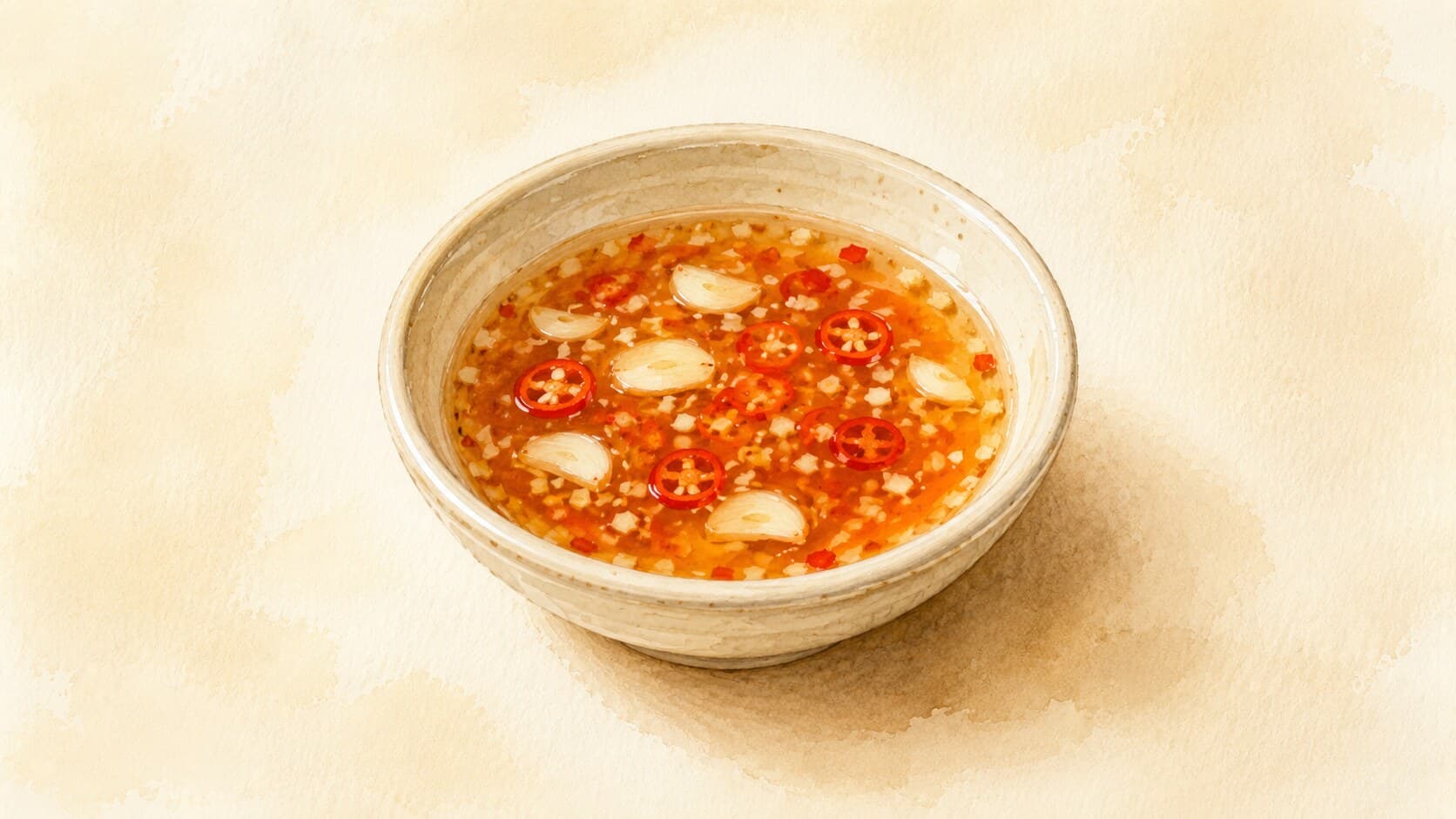
Ingredients
- 120 ml fish sauce
- 60 ml lime juice
- 60 ml water
- 30 g sugar
- 2 cloves garlic, minced
- 1-2 red chili peppers, finely chopped
- 1 tbsp grated carrot (optional)
- fresh herbs (mint or cilantro) to taste
Steps
In a mixing bowl, combine the fish sauce, lime juice, and water to create the base of the sauce.
Add the sugar and stir until fully dissolved, which should take about 2-3 minutes. This balances the salty and sour flavors.
Incorporate the minced garlic and chopped chili peppers, adjusting the heat level to your preference.
If using, add the grated carrot for color and sweetness. Let the mixture sit for at least 5 minutes to allow flavors to meld.
Taste the sauce; if it seems too salty, add a bit more lime juice or water to balance it out.
Why this works
Nuoc Cham is essential in Vietnamese cuisine due to its harmony of salty, sour, and spicy flavors. The use of fish sauce provides a rich umami base, while lime juice adds brightness and acidity that cuts through richer dishes. Sugar is crucial in balancing these flavors, and its complete dissolution ensures a smooth texture. If the sauce seems too salty, adding more lime juice or water can help to adjust the flavor balance without losing the intended taste. Allowing the sauce to sit for a few minutes is key; this resting time lets the flavors meld together, enhancing the overall complexity. Additionally, the optional carrot adds visual appeal and a subtle sweetness, enhancing the sauce’s depth. This makes Nuoc Cham versatile enough to accompany grilled meats, fresh spring rolls, or even as a salad dressing.
Common mistakes
- Not dissolving the sugar fully. Granular sugar at the bottom leaves the sauce sharp and salty at the top, sweet only at the last spoonful.
- Target: clear, uniformly amber liquid with no visible sugar crystals when held to the light.
- Why it matters: sugar is the bridge between fish-sauce salt and lime acid — undissolved, it can't do that work, and the balance reads wrong on the tongue.
- What to do: stir for the full 2-3 minutes, or warm the water-fish-sauce-sugar base briefly off-heat before adding lime and aromatics.
- Adding the lime before the sugar has dissolved. Acid in the mix slows sugar dissolution and locks in an imbalanced base.
- Target: sugar fully dissolved in fish sauce and water first, lime juice added after.
- Why it matters: building the salt-sweet base first lets you taste it before brightening, so you can adjust acid to your preferred edge.
- What to do: dissolve sugar in fish sauce + water, taste, then squeeze lime in to your preferred tartness.
- Using bottled lime juice or older limes. Bottled juice is flatter and slightly bitter; old limes give a muted, less floral acid.
- Target: fresh limes that feel heavy for their size, with thin skin and a clear citrus aroma when scratched.
- Why it matters: the brightness of fresh lime is what lifts the sauce out of being merely salty-sweet.
- What to do: juice the limes the moment before mixing; roll them on the counter under your palm first to release more juice.
- Skipping the rest. Pouring the sauce immediately leaves garlic and chili as discrete hits rather than a melded flavor.
- Target: at least 5 minutes of rest at room temperature before serving.
- Why it matters: the rest lets aromatics infuse into the liquid and lets the salty-sour-sweet-spicy axes round off against each other.
- What to do: mix, cover loosely, walk away for 5-10 minutes, then taste and adjust.
What to look for
- A clear, light-amber liquid — never cloudy or murky.
- Aromatics suspended evenly: minced garlic and chili pieces drifting freely, not all sunk at the bottom.
- A taste profile where no single axis (the basic flavor directions: salt, sour, sweet, heat) dominates — salt, sour, sweet, and heat all register within the first second.
- A clean finish that doesn't coat the tongue heavily — the sauce should brighten, not weigh down.
A note on history
Nước chấm — literally "dipping sauce" — is the everyday table condiment of Vietnamese cooking, built on the country's much older fish-sauce tradition (nước mắm — the salty, deeply savory fermented-anchovy liquid that is the cornerstone of Vietnamese seasoning). Fish sauce itself is one of Southeast Asia's foundational ferments (foods preserved and transformed by controlled microbial action over weeks or months), with deep roots in Vietnamese cuisine and identity; nước chấm extends it into a balanced sweet-sour-salty-spicy mixer used on countless dishes, especially in the south. Precise origin dating for the prepared sauce in its modern form is not well documented, but it has long been a near-universal presence on Vietnamese tables.
Get the essays in your inbox — free
Weekly notes on flavor, fermentation, and food history — the writing behind the Atlas of Flavor. No spam; unsubscribe anytime.