
Chinese Tea Eggs (Chayedan)
Enjoy flavorful Taiwanese tea-marinated eggs with this simple recipe that captures the essence of street food.
Contents (5 sections)▾
Ingredients
- 6 large eggs
- 2 tbsp soy sauce
- 1 tbsp black tea leaves
- 1 tsp five-spice powder
- 1 tbsp rice vinegar
- 1 tsp salt
- 500 ml water
Steps
In a pot, place the eggs and cover with water. Bring to a boil over medium heat and cook for 8-10 minutes for fully hard-boiled eggs — the yolk completely set, with no soft, jammy, or runny center. Tea eggs then sit for hours in the marinade, so the yolk must be fully cooked, not soft.
Once cooked, transfer eggs to an ice bath for 5 minutes to stop the cooking process and make peeling easier.
Gently tap the eggs all over to create cracks in the shell, then return them to the pot.
In a separate bowl, mix soy sauce, black tea leaves, five-spice powder, rice vinegar, salt, and water.
Pour the marinade over the cracked eggs and bring to a simmer. Cover and let it simmer for 15 minutes.
After simmering, remove the pot from heat. Once the marinade has cooled to room temperature, transfer the eggs and liquid to a clean covered container and refrigerate. Let the eggs soak in the refrigerator for at least 2 hours, or overnight for deeper flavor. Do not leave the eggs at room temperature to brine — eggs should always be kept refrigerated. Consume within 3–4 days; reheat in the marinade before eating, and do not judge spoilage by smell or color alone.
Why this works
The technique of simmering eggs in a soy sauce and tea marinade infuses them with a complex flavor, characteristic of traditional Taiwanese street food. The initial boiling step ensures the eggs are cooked to the desired firmness, while the subsequent cracking of the shells allows the marinade to penetrate, creating the iconic marbled effect. If the eggs seem too bland after soaking, consider simmering them for an additional 10 minutes to enhance flavor absorption. The combination of five-spice powder adds warmth and depth, making each bite a delightful experience. Brining in the refrigerator overnight significantly improves the umami flavor, deepening the color and taste of the eggs. A note on safety: although street vendors traditionally hold tea eggs warm in their marinade pots throughout the day, the soy-tea brine does not make eggs safe at room temperature. At home, always cool the marinade first, then brine and store the eggs in the refrigerator in a clean covered container, and finish them within 3–4 days. Do not rely on smell, color, or taste alone to judge whether the eggs are still safe — when in doubt, discard.
Common mistakes
- Under-boiling the eggs before they go in the marinade. Tea eggs should be fully hard-boiled, not soft-yolk.
- Target: 8–10 minutes of full boiling for a large egg, yolk completely set and dry-feeling when pressed; no soft, jammy, or runny centre.
- Why it matters: the eggs spend hours in a low-acidity soy and tea brine after cracking, so any uncooked yolk is sitting at a temperature that is bacterially risky. A soft yolk also turns greyish and unpleasant once the brine seeps in.
- What to do: Lower eggs into already-boiling water, set a timer for 8 minutes, then ice-bath for 5 minutes. Crack and brine only after the yolk is set.
- Holding the eggs in the marinade at room temperature for hours. This is the most common safety mistake — street vendors do it; home cooks should not.
- Target: cool the marinade and the cracked eggs together, then refrigerate at or below 4°C / 40°F for the long brine; eat within 3–4 days.
- Why it matters: the warm, low-salinity soy-and-tea brine (a seasoned liquid the eggs steep in to take on color and flavor) is not a true preservation pickle. Sitting on a counter for hours puts the eggs in the food-safety danger zone (4–60°C / 40–140°F — the temperature band where harmful bacteria multiply fastest). Refrigeration is non-negotiable for a long marination.
- What to do: Let the pot come down to room temperature, transfer eggs and brine to a clean covered container, and refrigerate. Reheat individual eggs in the marinade before serving if you want them warm.
- Cracking the shells too aggressively or in the wrong pattern. Big shards let the brine flood the white instead of feathering through it.
- Target: light, all-over taps with the back of a spoon, so each egg has a fine network of cracks but no piece of shell has come loose.
- Why it matters: the marbled "tea-leaf" pattern is what makes the dish visually distinctive, and it comes from brine seeping through thin cracks. Heavy hits flood the white in patches and break the pattern; intact shells show no marbling at all.
- What to do: Hold the egg in your palm and roll it under a gentle press with the back of a spoon — you want the sound of a crackle, not a snap. Inspect; if some areas have no cracks, add a few light taps.
- Skimping on time. A short brine reads as bland and pale.
- Target: at least 2 hours in the fridge for surface flavour, ideally 8–24 hours for the marbled pattern and the deeper savory taste.
- Why it matters: colour and flavour penetrate slowly through the cracks, and the tannins (the natural plant compounds in tea that give it its bracing astringency and brown stain) in the tea darken the white over hours. Cutting the brine short gives a faint, watercolour pattern and a hint of soy with no depth.
- What to do: Plan for an overnight rest. Eggs brine cleanly for 24 hours; past that they can start to firm up too much and taste over-salted, so pull them and store in a smaller jar of brine to slow further absorption.
What to look for
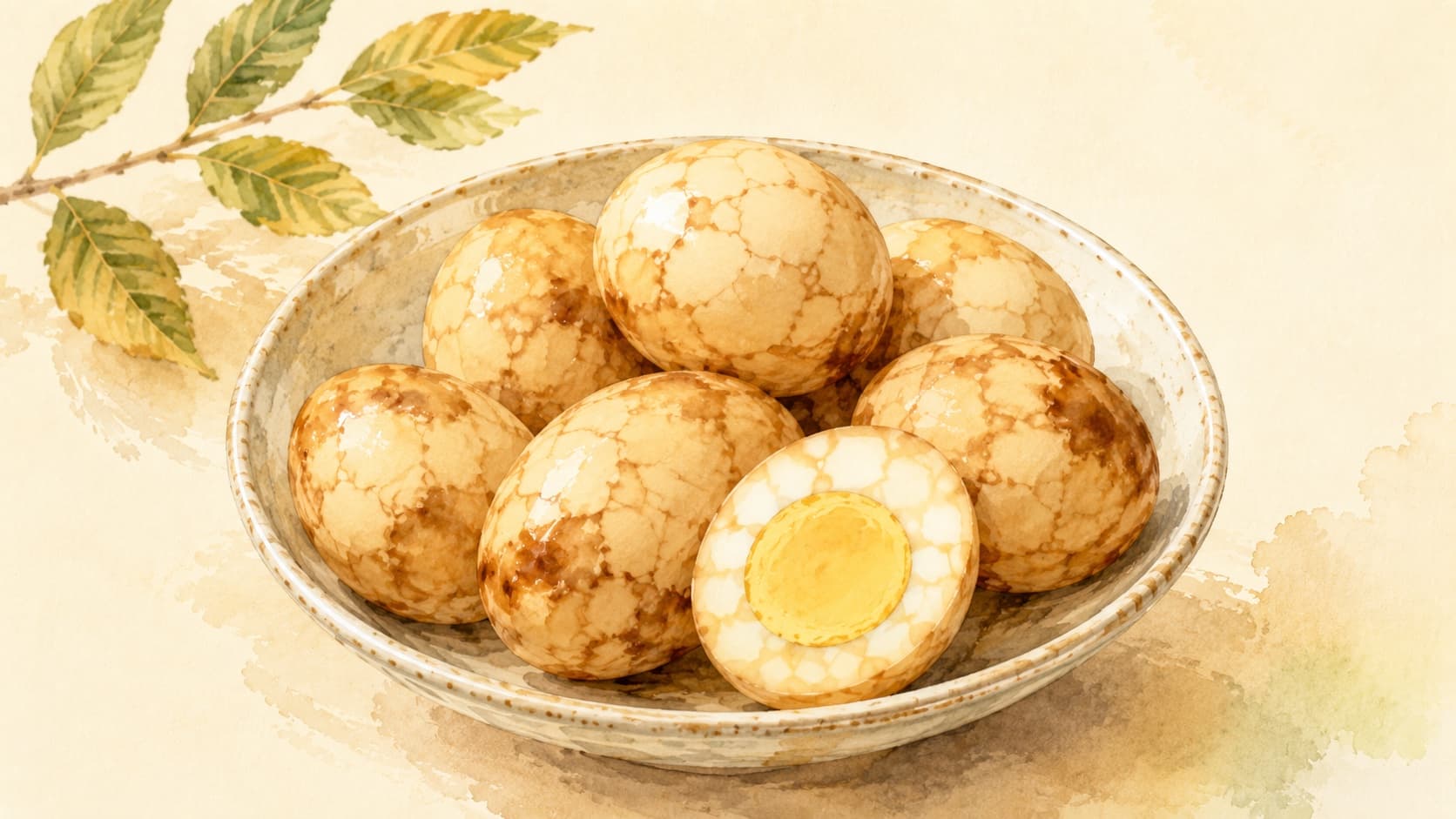
- A fine, leaf-like marbled pattern on the peeled white, deep brown against pale cream — not big blotches.
- A glossy, almost lacquered surface on the egg once peeled, with the brine clinging in a thin shine rather than dripping off.
- A fully set yolk with a slightly waxy, dense texture when cut, no softness in the centre.
- A warm, layered aroma of black tea, soy, star anise and cinnamon as you crack the shell — if it just smells of soy, the tea ratio is low or it brined too briefly.
A note on history
Tea eggs — chayedan, 茶葉蛋 — are a classic Chinese snack with roots usually placed in eastern China (Zhejiang) and references that go back to the Qing dynasty, although exact dating varies by source. They became one of the most widely sold street and night-market foods across China and Taiwan, traditionally kept warm in the same pot for hours by vendors who refresh the brine through the day. The recipe is regional and personal — black tea is most common, but pu-erh (an earthy, aged Chinese fermented tea), oolong (a partially-oxidised Chinese tea sitting between green and black in style), and varying spice mixes are all traditional — and the marbled pattern made by re-boiling cracked shells in spiced brine is the dish's signature.
Get the essays in your inbox — free
Weekly notes on flavor, fermentation, and food history — the writing behind the Atlas of Flavor. No spam; unsubscribe anytime.