
Tafelspitz
Tafelspitz is an Austrian dish of poached beef served with broth and root vegetables, showcasing techniques in poaching and broth-making.
Contents (5 sections)▾
Ingredients
- 1 kg beef rump or brisket
- 2 liters water
- 2 medium carrots, sliced
- 1 large onion, quartered
- 1 celery stalk, chopped
- 1 bay leaf
- 5-6 black peppercorns
- Salt, to taste
- Fresh horseradish, for serving
Steps
In a large pot, place the beef and cover with 2 liters of water. Add the quartered onion, sliced carrots, celery, bay leaf, and peppercorns.
Bring the water to a boil over medium-high heat, then reduce to a gentle simmer. Skim off any foam that forms on the surface for a clear broth.
Cover the pot and simmer for about 90 minutes, or until the beef is tender. Check for doneness by piercing the meat; it should be soft but not falling apart.
Once cooked, remove the beef from the pot and let it rest for about 10 minutes before slicing against the grain.
Strain the broth to remove the vegetables and spices. Taste and season with salt as necessary.
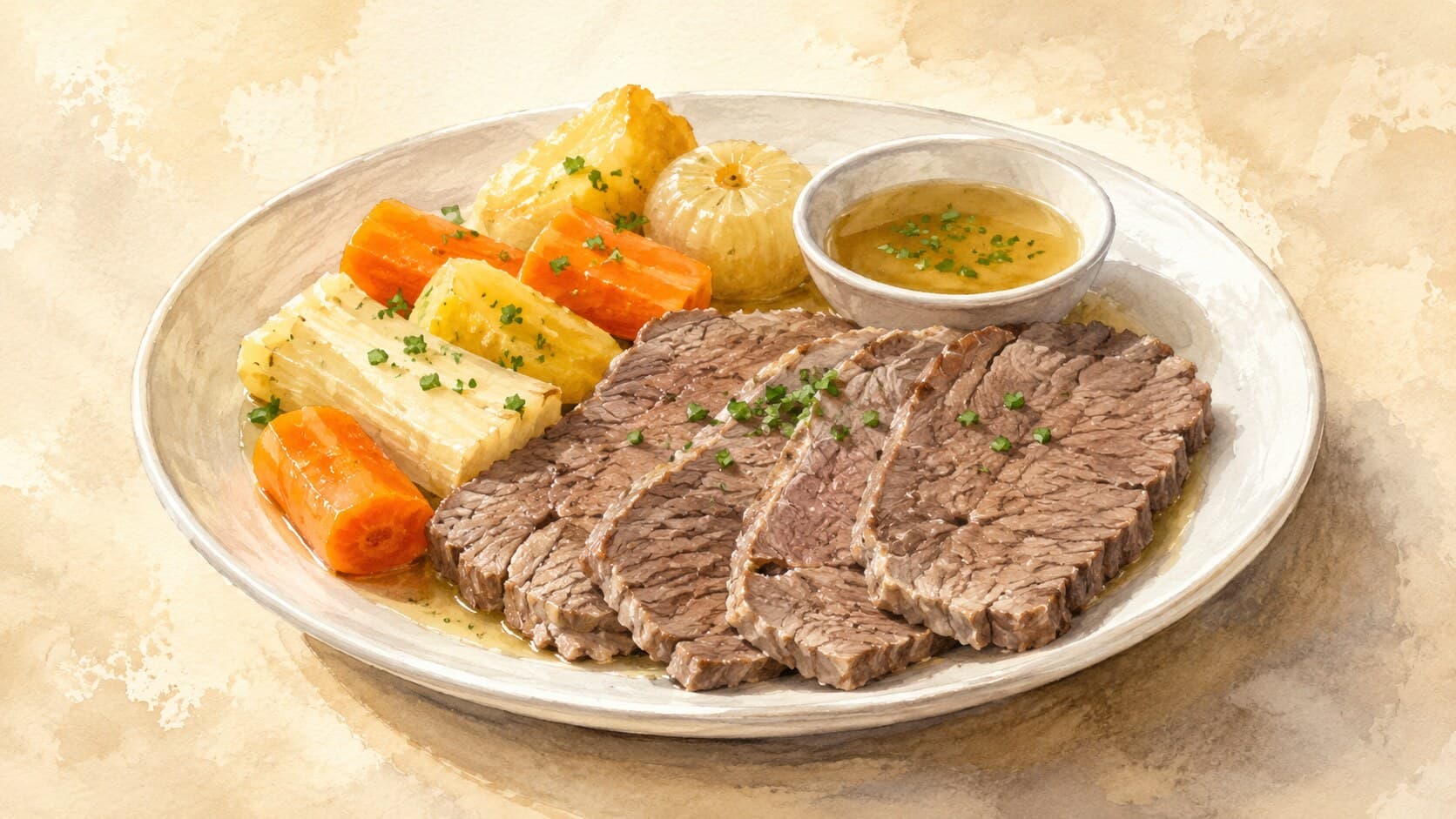
Serve the sliced beef with a small cup of the broth for dipping and freshly grated horseradish on the side.
Why this works
Tafelspitz relies on the poaching technique, which gently cooks the beef in simmering water, allowing it to remain tender and moist. The slow simmering extracts flavors from both the meat and the added vegetables, resulting in a rich broth that enhances the dish. When poaching, it's crucial to maintain a low temperature; if the broth boils too vigorously, the meat can become tough and lose its desirable texture. If you find the broth too bland, adding a dash of salt or a splash of vinegar can brighten the flavors. This dish exemplifies the elegance of Austrian cuisine, where the simplicity of poached beef comes from the quality of the ingredients and the care taken in preparation.
Common mistakes
-
Boiling the pot instead of holding it at a bare simmer.
- Target: small bubbles breaking the surface at the edges only — roughly 85-90°C (185-195°F) — never a rolling boil.
- Why it matters: an aggressive boil shears the muscle fibres apart, clouds the broth, and toughens the cut. The whole point of tafelspitz is silken, fork-cuttable meat in clear broth.
- What to do: bring the pot up to a boil once to release the first foam, skim, then drop the heat. Hold a steady, lazy simmer for 2-3 hours. A heavy lid slightly ajar is your friend.
-
Skipping the foam-skimming.
- Target: broth that is clear or only faintly golden by the time the meat is tender.
- Why it matters: the grey-brown foam that rises in the first 15-20 minutes is coagulated blood and protein. Stirred back in, it dulls the broth, gives a metallic edge, and ruins the appearance.
- What to do: skim patiently for the first 20 minutes with a flat spoon, drop the heat, then add the aromatics (onion, root vegetables, herbs, and spices used to flavour a broth). Don't stir the pot while it simmers — it lifts particles back into suspension.
-
Adding the root vegetables at the start.
- Target: carrots, celery root, leek, and onion go in around the last 45 minutes; serving vegetables only need to be tender, not exhausted.
- Why it matters: vegetables boiled for two hours collapse into mush and give the broth a sweet-flat baby-food note. You lose the sweet-clean Viennese profile.
- What to do: simmer the beef alone with a charred onion half and peppercorns first, then add the root vegetables late so they're tender but still hold their shape on the plate.
-
Slicing with the grain instead of against it.
- Target: slices about 1 cm thick, knife perpendicular to the muscle fibres.
- Why it matters: rump cap (Tafelspitz proper) has a clearly visible grain. Cut along it, and even perfectly cooked beef chews like rope.
- What to do: let the meat rest for 5-10 minutes, then look at the surface — fibres run in clear lines. Slice across them with a long, smooth motion.
What to look for
- A broth that is clear and pale gold, with no grey haze and no oily slick on the surface.
- Beef that yields cleanly to a fork at the table, but still holds its slice — falling apart means overcooked, resisting means undercooked.
- A faint, clean beef-and-sweet-vegetable perfume — never a heavy roasted note — because nothing in this pot was browned.
- Freshly grated horseradish that punches into the nose on the first bite, providing the heat and lift the gentle broth deliberately leaves out.
A note on history
Tafelspitz takes its name from a specific cut — the pointed top of the beef rump cap — and is closely tied to imperial Vienna. The name first appeared in print in Babette Franner's 1893 cookbook Die exquisite Wiener Küche. Habsburg (the imperial dynasty that ruled Austria and much of Central Europe for centuries) cookery accounts are unusually clear on one point: Emperor Franz Joseph I (1830-1916) was famously fond of tafelspitz, and the 1912 official cookery textbook used in the Austro-Hungarian domestic science schools noted that "His Majesty's private table is never without a fine piece of boiled beef." That imperial association, plus the careful Viennese ritual of clear broth, root vegetables, and a sharp horseradish-apple condiment (Apfelkren), is what turned a humble boiled cut into a national dish. Apfelkren is the classic Austrian sauce of grated horseradish folded with grated raw apple.
Get the essays in your inbox — free
Weekly notes on flavor, fermentation, and food history — the writing behind the Atlas of Flavor. No spam; unsubscribe anytime.