
Swedish Meatballs
Delight in the comfort of homemade Swedish meatballs served with creamy gravy and lingonberry jam.
Contents (5 sections)▾
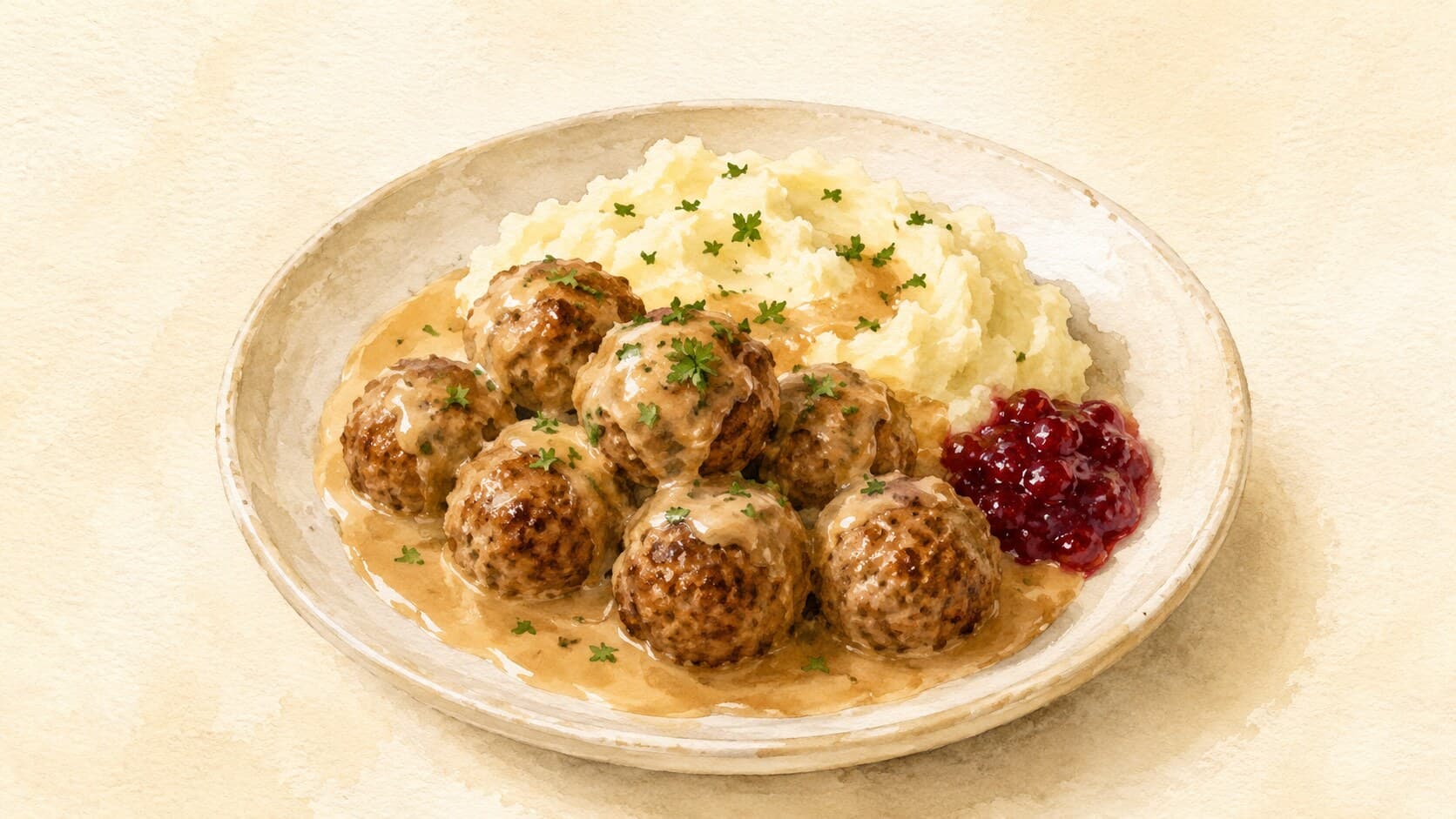
Ingredients
- 500 g ground beef
- 250 g ground pork
- 1 small onion, finely chopped
- 2 cloves garlic, minced
- 100 g breadcrumbs
- 1/2 cup milk
- 1 large egg
- 1 tsp salt
- 1/2 tsp black pepper
- 1/4 tsp ground allspice
- 1/4 tsp ground nutmeg
- 2 tbsp butter
- 2 tbsp all-purpose flour
- 400 ml beef broth
- 200 ml heavy cream
- Lingonberry jam, to taste
Steps
In a large bowl, combine the ground beef, ground pork, finely chopped onion, minced garlic, breadcrumbs, milk, egg, salt, pepper, allspice, and nutmeg. Mix until well blended.
Shape the mixture into small meatballs, about 2.5 cm in diameter. Ensure they are compact to avoid breaking during cooking.
In a large skillet, melt the butter over medium heat. Add the meatballs, cooking for 8-10 minutes or until browned on all sides. Ensure the skillet is not overcrowded to allow even browning.
Once browned, remove the meatballs and set aside. In the same skillet, add flour and cook for 1-2 minutes, stirring constantly to form a roux.
Gradually whisk in the beef broth and bring to a simmer, allowing it to thicken for about 3-5 minutes.
Stir in the heavy cream and return the meatballs to the skillet. Simmer for an additional 5 minutes until the meatballs are cooked through. Cook the ground meat until it reaches 71 °C / 160 °F on an instant-read thermometer (no longer pink throughout) — colour, float and time are guides, not the safety test.
Serve the meatballs hot, garnished with a dollop of lingonberry jam on the side.
Why this works
The success of Swedish meatballs lies in the balance of flavors and the technique of cooking them properly. The combination of ground beef and pork provides a rich flavor and desirable texture, while the breadcrumbs and milk help bind the mixture together, ensuring moist meatballs. Cooking the meatballs in a skillet allows for a nice browning, which adds depth to their flavor. When making the gravy, it's essential to cook the flour long enough to eliminate the raw taste but not too long to prevent it from losing thickening ability. If the sauce seems too thick, you can add a bit more beef broth or cream to achieve the desired consistency. The aromatic spices of allspice and nutmeg provide a warmth that complements the dish, while the tangy lingonberry jam adds a refreshing contrast that brightens the flavors. This combination is what makes Swedish meatballs a true comfort food that resonates with many.
Common mistakes
-
Skipping the milk-and-breadcrumb soak (the panade).
- Target: breadcrumbs fully hydrated in the milk, sitting at least 5 minutes before they meet the meat.
- Why it matters: the soaked starch is what holds water inside the meatball during the cook. Skip it, and you get tight, dense, slightly dry köttbullar (the Swedish word for meatballs, pronounced roughly "shuht-bullar") instead of the soft, tender Swedish style.
- What to do: combine breadcrumbs and milk first. Let them sit and turn into a paste, then mix into the meat. Add the egg last.
-
Overworking the mince.
- Target: mix only until the binder, seasoning, and meat are evenly distributed — about 30-45 seconds by hand.
- Why it matters: mince + salt + heavy mixing develops a tight, springy, almost sausage-like protein matrix. Köttbullar should feel delicate, not bouncy.
- What to do: mix with cool hands or a spatula in short strokes. Stop the moment streaks of breadcrumb disappear into the meat.
-
Crowding the pan.
- Target: meatballs spaced with at least 1 cm of clear pan around each, so they sear rather than steam.
- Why it matters: a crowded pan drops in temperature, releases liquid, and turns the surface grey instead of brown. You lose the Maillard browning (the high-heat chemistry that turns meat surfaces deep brown and savory) that the cream gravy is built on.
- What to do: brown in batches over medium-high heat in butter. Move them to a plate as they colour, deglaze for the gravy after, then return them all to finish.
-
Pulling them off the heat too early "to keep them juicy."
- Target: internal temperature 70-74°C (160-165°F) at the centre of the largest meatball, with no pink streaks.
- Why it matters: mixed beef and pork mince must be cooked through — that's a food-safety requirement, not a preference. The juiciness comes from the panade and the gravy finish, not from undercooking.
- What to do: brown first, then finish the meatballs in the cream sauce at a low simmer for 5 minutes. Probe one to confirm temperature before serving.
What to look for
- A round, deeply browned crust on every side — coffee-coloured, not grey — with a soft, springy interior that gives easily under fork pressure.
- A cream gravy the colour of milk-coffee, glossy enough to coat the back of a wooden spoon, with no white flour streaks or oily separation.
- A warm, nutmeg-and-allspice perfume — present but not dominant — and a faint sweetness that the lingonberry jam picks up on the plate.
- Lingonberry jam left in a small, separate spoonful on the rim — its sharp acidity should hit each forkful as you choose, not pre-mix into the gravy.
A note on history
Swedish meatballs (köttbullar) are, by Sweden's own admission, more transnational than they look. In 2018 the country's official Twitter account stated that "Swedish meatballs are actually based on a recipe King Charles XII brought home from Turkey in the early 18th century." Charles XII spent five years (1709-1714) in exile in the Ottoman Empire after his defeat at Poltava in 1709, and the small spiced fried meatball — found across Ottoman cuisines as köfte (the Turkish-Middle Eastern family of seasoned ground-meat patties or balls) — is widely credited as the ancestor of the dish that, with cream gravy and lingonberry, became one of the most internationally recognisable Swedish foods.
Get the essays in your inbox — free
Weekly notes on flavor, fermentation, and food history — the writing behind the Atlas of Flavor. No spam; unsubscribe anytime.