
Sirnica
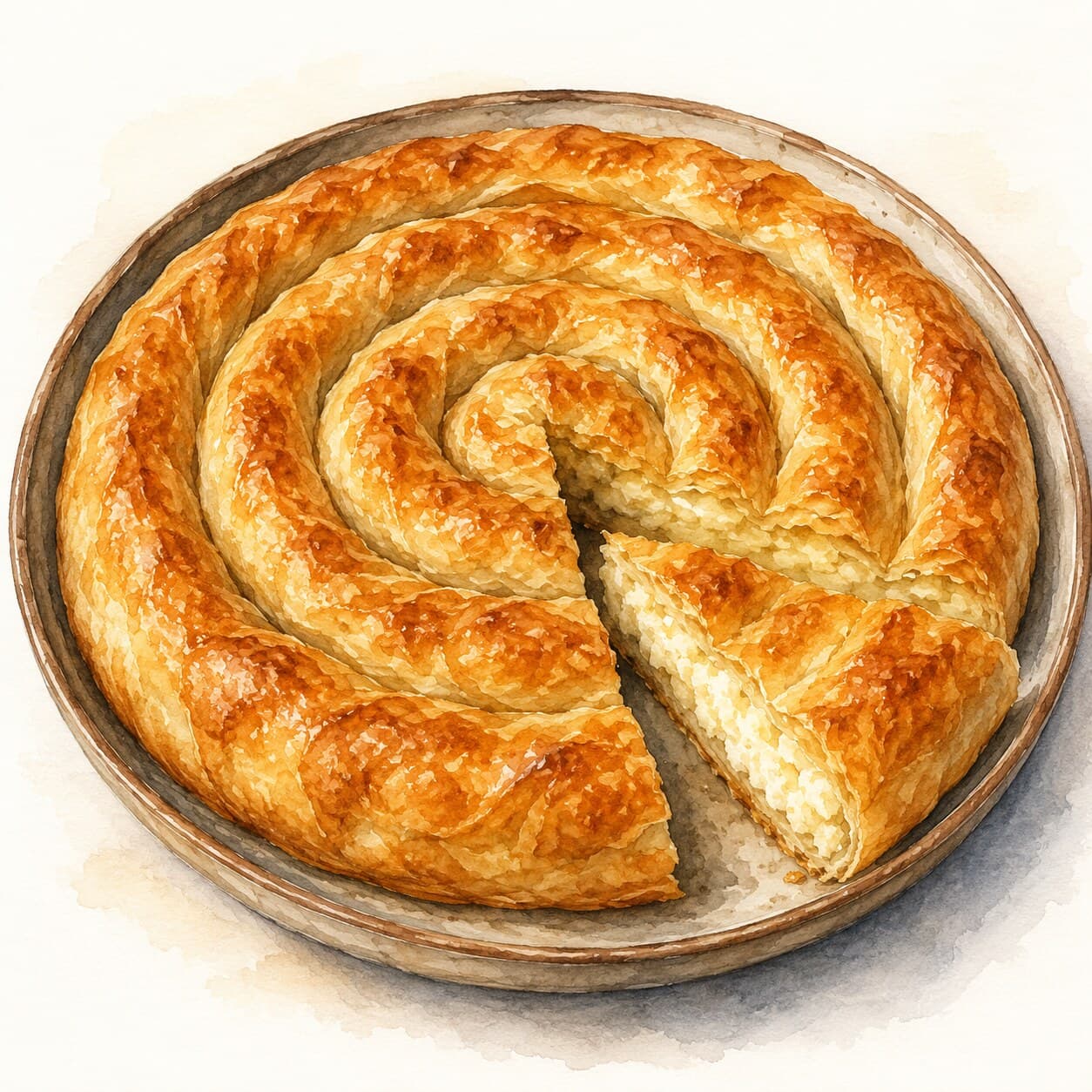
Sirnica is a delightful Bosnian-Balkan cheese pie made with layered phyllo pastry and a creamy cheese filling.
Contents (5 sections)▾
Ingredients
- 500 g phyllo pastry (jufka)
- 300 g fresh cheese (sirenje or brindza)
- 2 large eggs
- 100 g butter, melted
- 200 g sour cream for serving
- Salt to taste
Steps
Preheat the oven to 200°C (392°F). This ensures even baking and a golden color.
In a bowl, mix the fresh cheese, eggs, and salt until smooth. This will be your filling.
Lay out one sheet of phyllo pastry and brush it with melted butter. Repeat this with 3 more sheets, layering them.
Spread a portion of the cheese filling evenly over the layered pastry, leaving some space at the edges.
Roll the pastry tightly into a log shape, then coil it around itself to form a spiral. Place it in a greased baking dish.
Brush the top with more melted butter. Bake in the preheated oven for 15 minutes or until golden brown.
Let the sirnica cool for a few minutes before serving with sour cream.
Why this works
The key to a successful sirnica is in the layering and preparation of the phyllo pastry. By brushing each sheet with melted butter, you create a flaky, crispy texture that contrasts beautifully with the creamy cheese filling. The rolling and coiling technique allows for even distribution of the filling and ensures that every bite is packed with flavor. If the pastry seems too dry while rolling, you can lightly mist it with water or additional melted butter to keep it pliable. Cook it until it's golden brown, as this enhances the flavor and provides a satisfying crunch. If it breaks during the rolling process, simply patch it with an extra piece of phyllo pastry and continue; the layers will still create a delicious result.
Common mistakes
Leaving the phyllo sheets uncovered while you work.
Target: Keep the stack of phyllo (a paper-thin pastry dough) covered with a damp cloth, uncovering only the single sheet you're actively buttering.
Why it matters: Phyllo is rolled so thin that it loses moisture to open air within minutes. Once it dries out, it turns brittle and shatters instead of folding, leaving gaps that let the filling leak through during baking.
What to do: Work quickly on one sheet at a time and keep the rest of the stack covered until you need it.
Skimping on the butter between layers.
Target: Brush every sheet with melted butter edge to edge, not just a stripe down the middle.
Why it matters: The butter is what separates the paper-thin sheets into distinct, flaky layers as they bake, since steam and fat push the layers apart in the oven's heat. A dry patch fuses to its neighbor and bakes up tough and pale instead of crisp.
What to do: Brush all the way to the edges each time, working fast enough that the sheet underneath doesn't dry out first.
Judging doneness by the clock instead of by how the pie looks and feels.
Target: Bake until the top is a deep golden-brown and the center feels firm with no wobble when the dish is gently shaken — regardless of whether that takes exactly the time given.
Why it matters: The egg-and-cheese filling behaves like a savory custard: it needs to reach a temperature where the egg proteins fully set. A pastry that looks golden on top can still hide a loose, undercooked, runny center if the coil is thick or your oven runs cool, and that is not safe to eat.
What to do: If the center still jiggles or looks wet when you cut in, return the dish to the oven in five-minute increments until the filling is fully set and no longer glossy-wet.
Overfilling or rolling the log too tightly.
Target: Spread the cheese filling in a thin, even layer with a clear border at the edges, then roll into a log that is snug but not packed tight.
Why it matters: An overfilled or over-tightened roll bursts its seams as the filling expands and steams in the oven's heat, exposing raw pastry to the leaking filling and making a mess in the baking dish.
What to do: Leave the border, spread the filling thinly, and roll firmly but gently, tucking the ends under before you coil it.
What to look for
- A deep golden-brown top, not pale or blistered-white. Color is the first sign that both the pastry and the filling underneath have had enough time in the oven.
- No wobble or wet sheen when the pie is gently shaken or pressed in the center. A jiggling or glossy-wet middle means the egg-and-cheese filling has not fully set; give it more time before serving.
- Layers that shatter into distinct flakes when cut, rather than a dense, gummy cross-section. That crispness signals the butter did its job separating the sheets.
- Filling that holds together as a firm, sliceable curd rather than running out when the pie is cut. A fully baked filling stays put on the plate; if it pools or looks runny, it needs more time in the oven.
A note on history
Sirnica belongs to Bosnia's pita family, a group of coiled or layered phyllo pastries that also includes burek (filled with meat), zeljanica (spinach and cheese), and krompiruša (potato). In Bosnian usage, the word "burek" refers strictly to the meat-filled version, while this cheese-filled coil is properly called sirnica — even though many people outside the region use "burek" loosely as a catch-all name for the whole family.
The technique behind it — stretching dough into thin sheets and rolling it around a filling — traces back to Central Asian and Middle Eastern traditions that spread widely under the Ottoman Empire, which controlled Bosnia from the mid-15th century into the late 19th century. Dedicated pastry bakeries selling these pies became fixtures of Bosnian towns during that period, and the coiled, layered style has remained a fixture of everyday Bosnian food culture ever since.
Get the essays in your inbox — free
Weekly notes on flavor, fermentation, and food history — the writing behind the Atlas of Flavor. No spam; unsubscribe anytime.