
Sate Ayam
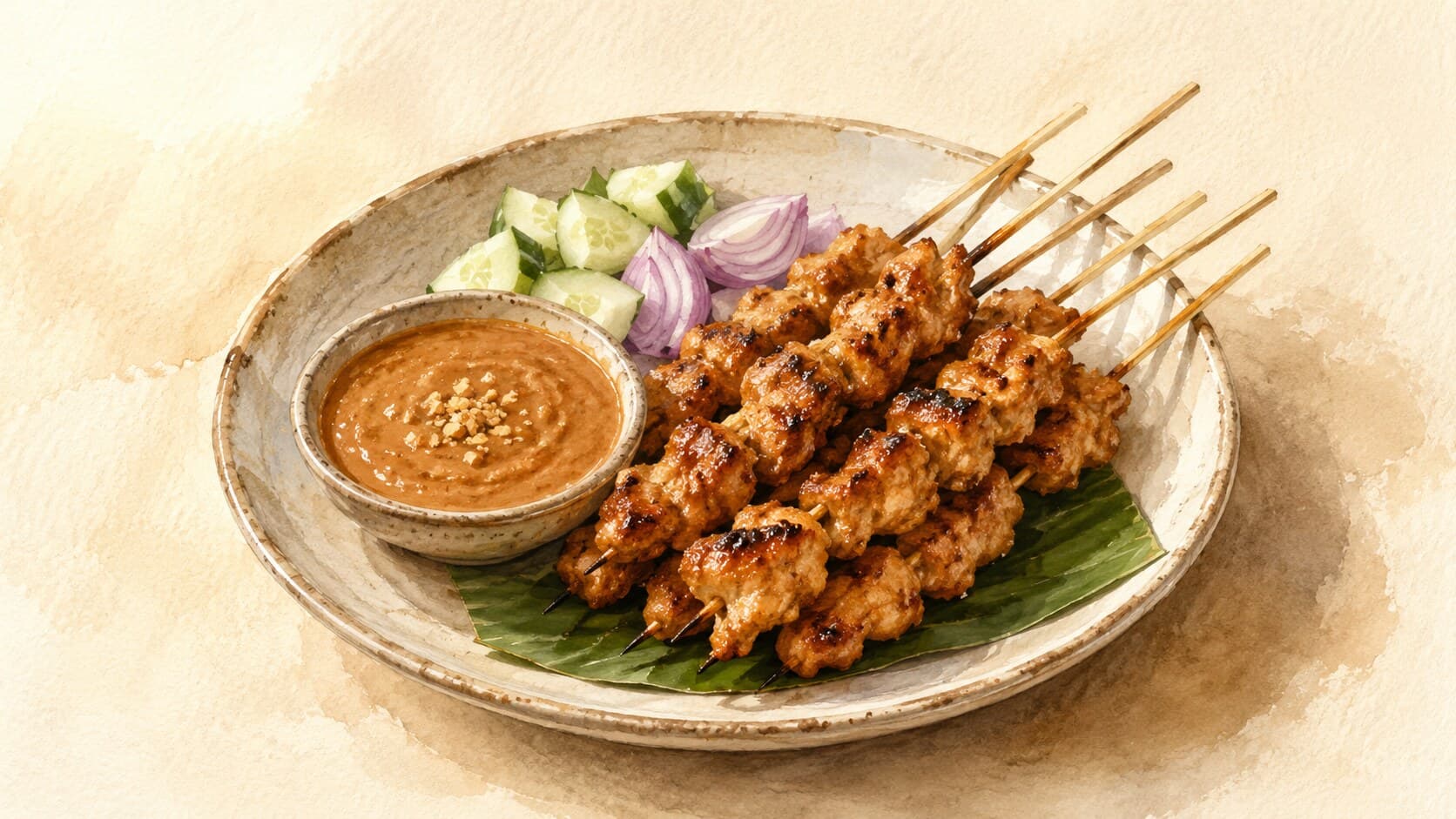
Sate Ayam features marinated chicken skewers grilled to perfection, served with a rich peanut sauce.
Contents (5 sections)▾
Ingredients
- 500 g chicken thighs, boneless and skinless
- 2 tbsp kecap manis
- 2 tbsp soy sauce
- 1 tbsp vegetable oil
- 2 cloves garlic, minced
- 1 tsp ground coriander
- 1 tsp ground cumin
- 1/2 tsp turmeric powder
- 1/2 tsp salt
- 200 g peanut butter
- 150 ml coconut milk
- 2 tbsp brown sugar
- 2 tbsp lime juice
- to taste, chopped fresh cilantro for garnish
- to taste, fried shallots for garnish
Steps
Cut the chicken thighs into 2 cm cubes and place them in a bowl.
In a separate bowl, mix the kecap manis, soy sauce, vegetable oil, minced garlic, ground coriander, cumin, turmeric, and salt to create the marinade.
Pour the marinade over the chicken, toss to coat, and let it marinate for at least 30 minutes in the refrigerator to enhance flavor.
While the chicken marinates, prepare the peanut sauce by combining peanut butter, coconut milk, brown sugar, and lime juice in a saucepan over medium heat.
Stir the sauce continuously until it thickens, about 5-7 minutes. Adjust the thickness by adding more coconut milk if it becomes too thick.
Preheat your grill or charcoal to high heat. Thread the marinated chicken onto skewers.
Grill the skewers for about 3-4 minutes on each side until cooked through and charred, ensuring they reach an internal temperature of 75°C.
Serve the skewers on a banana leaf or plate, drizzled with peanut sauce and garnished with cilantro and fried shallots.
Why this works
The success of Sate Ayam lies in the marinating process and the balance of flavors in the peanut sauce. The marinade not only infuses the chicken with a rich umami flavor from the kecap manis and soy sauce but also tenderizes the meat, ensuring a juicy texture when grilled. Grilling over high heat achieves the perfect char and deepens the flavor. If the peanut sauce seems too thick, you can easily rescue it by adding a little more coconut milk to achieve the desired consistency. This technique enhances the sauce's creaminess without compromising flavor. The contrast of flavors from sweet, savory, and slightly tangy elements makes every bite of the skewers exciting.
Common mistakes
Under-cooked chicken
- Target: an internal temperature of 75°C / 165°F at the thickest point of every piece, with juices running clear, not pink.
- Why it matters: the marinade and the char do not pasteurize the inside; chicken needs to be fully cooked through for food safety.
- What to do: cut the thigh meat into 2 cm cubes so heat reaches the center quickly, grill 3-4 minutes per side, and probe the largest piece with a thermometer before pulling the skewer off.
Burnt outside, raw inside
- Target: even mahogany char on the surface and opaque, juicy meat all the way through.
- Why it matters: kecap manis (Indonesian sweet soy sauce thickened with palm sugar — much sweeter and syrupier than regular soy) and the marinade sugars caramelize fast, so a too-hot grill blackens the outside before the center has cooked.
- What to do: build a two-zone fire — a hotter side for color and a cooler side for finishing — and move the skewers across as the surface darkens, so the inside has time to reach 75°C.
Peanut sauce splits or seizes
- Target: a glossy, pourable sauce that coats the back of a spoon and falls in a smooth ribbon.
- Why it matters: peanut butter is a fragile emulsion (a stable mix of fat and water that can break apart if mishandled) of fat, solids, and a little water; high heat or a sudden temperature shock can break it.
- What to do: keep the saucepan over medium heat, whisk constantly, and loosen with warm coconut milk a tablespoon at a time if it tightens — never add cold liquid to a hot sauce.
Skewers stuck to the grate
- Target: skewers that release with a clean lift, with all the char staying on the chicken rather than the grill bars.
- Why it matters: wet bamboo, cold meat, or a cold grate makes the proteins glue to the metal and tear when flipped.
- What to do: soak bamboo skewers in water for 30 minutes, let the chicken come close to room temperature for 10 minutes before grilling, and preheat the grill fully so the surface seals immediately on contact.
What to look for
- Deep mahogany char marks on the surface — not pale tan, not pure black.
- Clear juice beading where you cut the largest cube to check, with no pink in the center.
- A glossy peanut sauce that ribbons off the spoon and slowly settles back into itself, with no oil pooling on the surface.
- The smell of toasted garlic and caramelized kecap manis rising from the grill in the last minute of cooking.
A note on history
Satay is widely understood to have originated on the Indonesian island of Java, where Javanese street vendors are credited with adapting the concept of skewered, grilled meat — likely influenced by Arab and Indian Muslim traders who brought kebab traditions to the archipelago — and shaping it into a distinctly local dish using bamboo skewers, kecap manis, and a peanut-based sauce. From Java, satay spread across the Malay world and into Singapore, Malaysia, and beyond. Sate ayam — the chicken version — is among the most popular of the many regional variations.
Get the essays in your inbox — free
Weekly notes on flavor, fermentation, and food history — the writing behind the Atlas of Flavor. No spam; unsubscribe anytime.