
Salade Niçoise
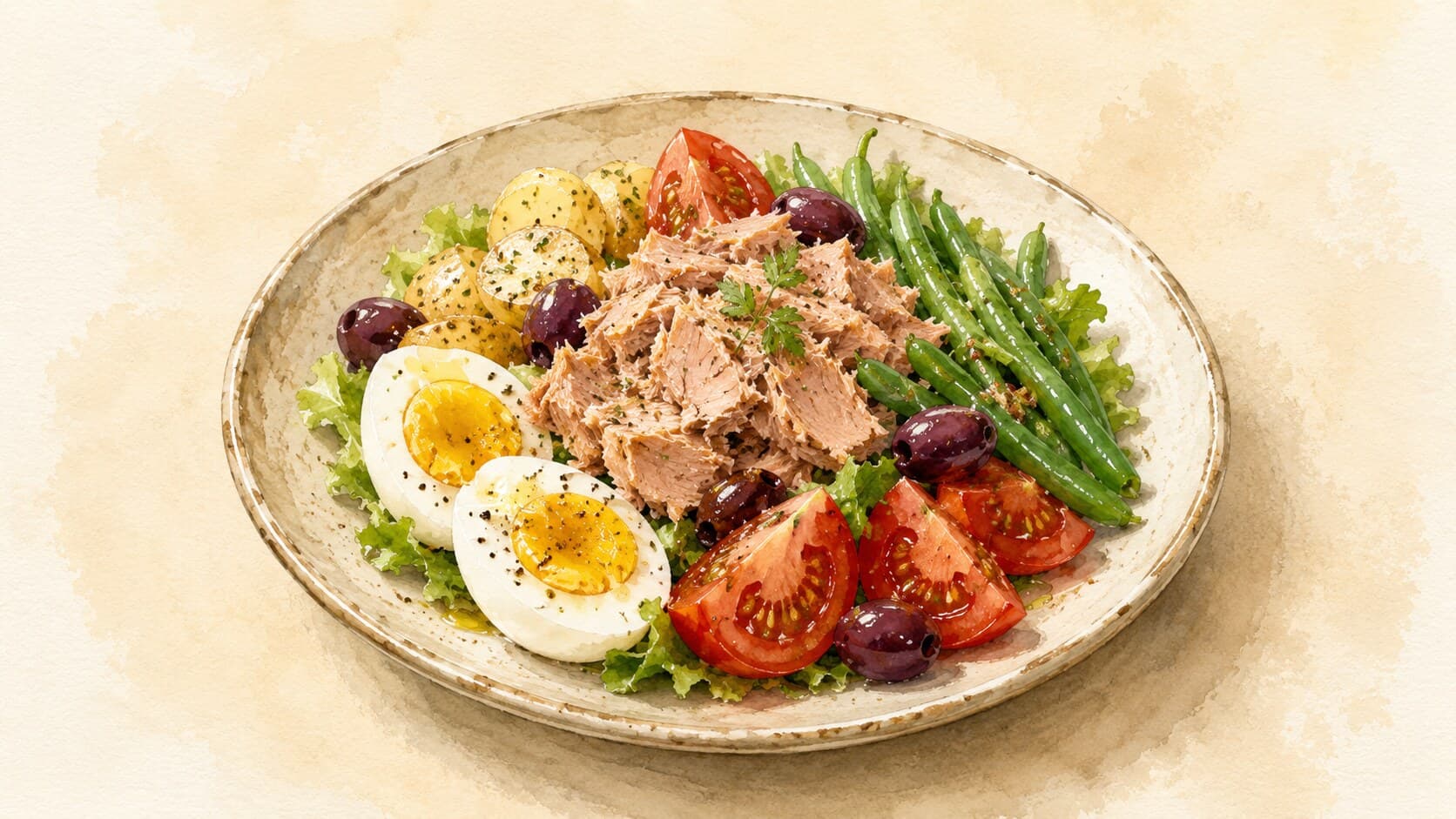
Salade Niçoise is a French salad featuring tuna, green beans, potatoes, olives, and hard-boiled eggs, showcasing balanced flavors and ingredient layering.
Contents (5 sections)▾
Ingredients
- 200 g fresh tuna steak (see safety note)
- 4 medium potatoes, diced
- 200 g green beans, trimmed
- 4 large eggs
- 100 g cherry tomatoes, halved
- 50 g black olives, pitted
- 4 tbsp olive oil
- 2 tbsp red wine vinegar
- 1 tsp Dijon mustard
- Salt and pepper to taste
- Fresh basil leaves for garnish
Steps
In a pot of boiling salted water, cook the diced potatoes for about 10 minutes until tender, then drain and set aside.
In the same pot, blanch the green beans for 3-4 minutes until bright green, then immediately transfer to ice water to stop the cooking.
Cook the eggs. For a fully set yolk with ordinary (non-pasteurized) eggs, boil about 9-10 minutes. For a soft-boiled yolk (6-7 minutes), use eggs pasteurized in the shell (through to the contents) — for everyone, not only high-risk diners. Then plunge them into ice water, peel, and set aside.
While the vegetables are cooking, heat a skillet over medium-high heat and sear the tuna steak. For a fully cooked steak, cook it through to 63°C/145°F in the center; searing about 2-3 minutes per side leaves the center rare — a deliberately undercooked choice (see the safety note). Let it rest.
In a bowl, whisk together the olive oil, red wine vinegar, Dijon mustard, and season with salt and pepper to create the vinaigrette.
To assemble the salad, on a large platter, arrange the potatoes, green beans, cherry tomatoes, olives, and sliced tuna. Halve the eggs and place them on top.
Drizzle the vinaigrette over the salad and garnish with fresh basil leaves before serving.
Why this works
The Salade Niçoise is a remarkable showcase of fresh ingredients, embodying summer's essence with vibrant colors and flavors. Each component plays a vital role: the tender tuna provides protein, while the potatoes and green beans add substance and texture. Cooking the eggs just right ensures a creamy yolk that enhances the dish's richness. If the eggs break while boiling, you can simply use them as a salad dressing ingredient by mixing the yolks with vinaigrette. Using a mix of textures—from the crunch of the green beans to the softness of the potatoes—creates a balanced experience. The vinaigrette, with its acidity from vinegar and depth from mustard, brightens the dish, bringing all the flavors to life. The assembly is visually appealing, making it a beautiful centerpiece for any summer meal. The key is to use the freshest ingredients available to capture the true essence of this classic French dish.
Safety — the tuna: A seared-rare tuna steak has a raw center — that is a deliberately undercooked choice, not the safe default, and hard-searing the outside does not make the inside safe. For a fully cooked steak, sear the tuna through to 63°C/145°F at the center. If you serve it rare, choose tuna from a supplier you trust for raw or lightly cooked use — "sushi-grade" is a marketing term, not a safety guarantee. Pregnant people, infants and young children, older adults, and anyone immunocompromised should use fully cooked tuna, or good-quality canned or jarred tuna instead.
Safety — the eggs: The eggs are soft-boiled (6–7 minutes), so the yolk is soft, not fully set — the timing and residual heat are not a validated Salmonella kill, and folding the yolk into the vinaigrette does not make it safe. To keep the soft yolk, use eggs pasteurized in the shell, through to the contents (fresh, clean, washed, or graded is not the same); otherwise boil them through to a firm yolk (about 10 minutes). High-risk diners (pregnancy, immunocompromised, very young or old) should use pasteurized eggs or fully cooked yolks.
Common mistakes
Skipping the ice bath for the green beans.
- Target: Beans blanched until just-tender (about 3–4 minutes), then immediately plunged into a bowl of iced water until cool to the touch.
- Why it matters: Beans carry residual heat; without a hard cold shock they keep cooking on the counter, the bright green dulls to army-green, and the snap collapses into a soft, vegetal mush.
- What to do: Have the ice bath ready before the beans go in. The second they hit your target tenderness, lift them straight from boiling water into the ice — and drain only once they're fully cool.
Dressing the salad too early.
- Target: Vinaigrette added at the last moment, when the salad is already plated and ready to go to the table.
- Why it matters: Vinegar wilts the leaves and tomatoes on contact and turns the boiled potatoes mealy. A salad that sits dressed for even 10 minutes loses both its colour and its structural definition.
- What to do: Compose the salad first, taste the vinaigrette and adjust salt and acid, then drizzle it over only just before serving.
Searing tuna in a cold pan.
- Target: A heavy skillet preheated until very hot, with a thin film of oil shimmering but not smoking violently, before the tuna goes in.
- Why it matters: A cold pan means the tuna releases water before the surface can colour — instead of a crisp seared crust you get grey, steamed fish that gives nothing back to the salad.
- What to do: Preheat the empty pan first, add a small splash of oil, wait until it shimmers, lay the tuna in confidently, and don't move it until a colour line forms at the edge.
Tearing the vinaigrette by under-whisking.
- Target: A stable emulsion (oil and vinegar held together as one creamy liquid instead of separating into two layers) that coats the back of a spoon and stays whisked together for at least a minute before separating.
- Why it matters: A broken vinaigrette pools on the bottom of the plate; the leaves up top stay dry while the potatoes drown in oil. Mustard is the emulsifier (the bridging ingredient that lets oil and vinegar combine) — without enough whisking, it never grabs the oil into the vinegar.
- What to do: Whisk vinegar, mustard, salt, and pepper first, then drizzle the oil in a slow steady thread while whisking constantly. Taste before it touches the salad.
What to look for
- Blanched green beans come out of the ice bath still vivid grass-green, with a clean snap when you bend one.
- A correctly seared tuna steak releases cleanly from the pan when it's ready — no tearing, no sticking.
- A finished vinaigrette has the body of light cream; it leaves a fleeting trail on the side of the bowl when whisked.
- The plated salad looks composed in distinct quadrants, not stirred together — each ingredient still readable on its own.
A note on history
Salade Niçoise originated in Nice in the 19th century — local fishermen and farmers built it from raw seasonal vegetables, tomatoes, salted anchovies (small cured fish fillets that bring concentrated salty umami), and good olive oil. Auguste Escoffier later popularised a Parisian version that added cooked potatoes and green beans and swapped anchovies for tuna, and that broadened form is what most kitchens outside Nice now serve. Niçois purists still resist the additions — Jacques Médecin famously begged readers in his 1970s cookbook never to put boiled potato in a salade niçoise — so the dish carries an ongoing tradition vs. evolution debate.
Get the essays in your inbox — free
Weekly notes on flavor, fermentation, and food history — the writing behind the Atlas of Flavor. No spam; unsubscribe anytime.