
Sake Chazuke
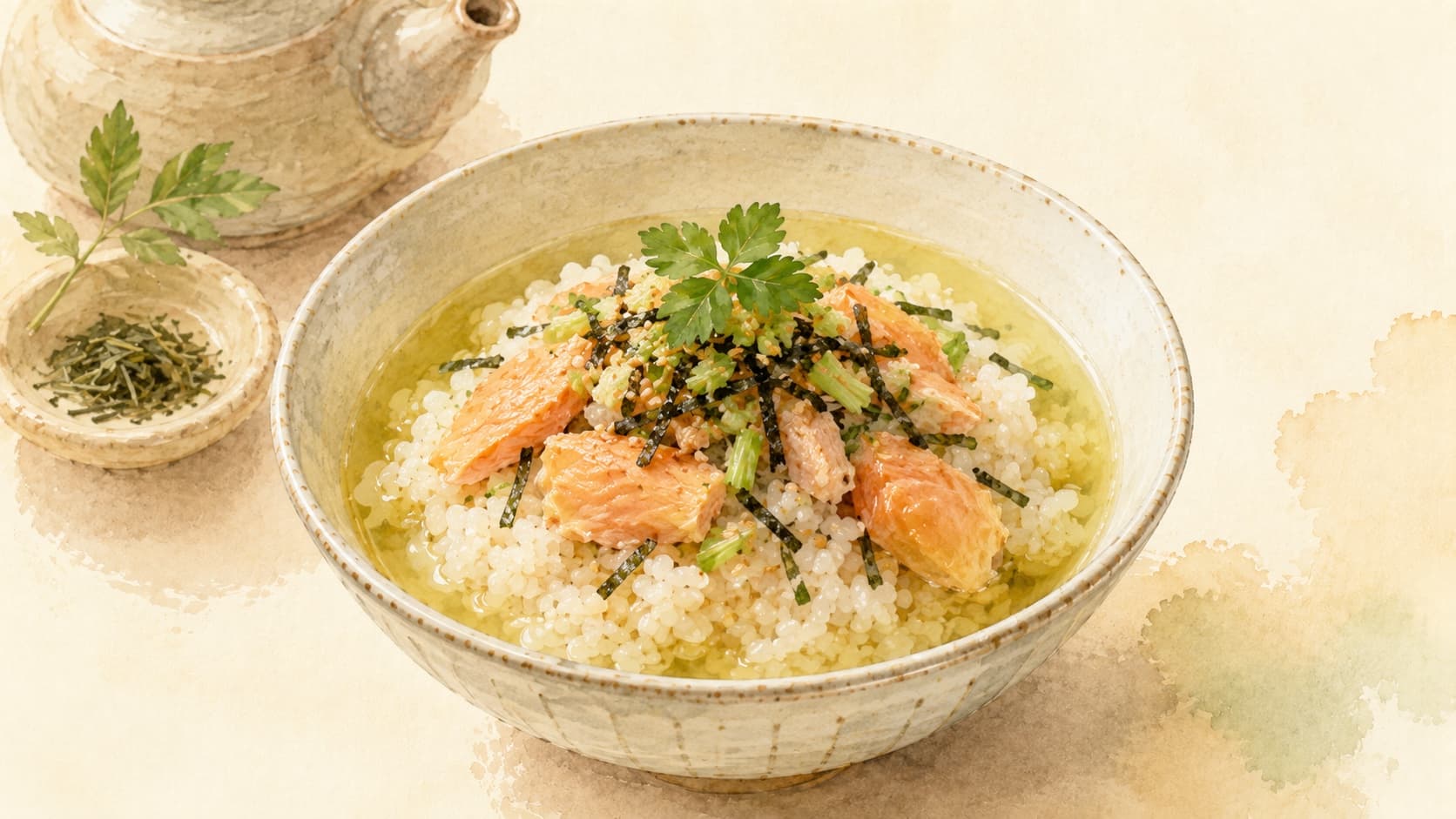
Sake Chazuke is a Japanese dish featuring cooked rice topped with dashi and sake-infused ingredients, providing a light meal option.
Contents (5 sections)▾
Ingredients
- 200 g cooked Japanese short-grain rice
- 500 ml dashi broth
- 100 ml sake
- 2 tbsp soy sauce
- 50 g salted salmon, shredded
- 2 green onions, finely chopped
- nori (seaweed), for garnish
- to taste salt
Steps
In a saucepan, heat the dashi broth over medium heat until it simmers, about 5 minutes. This base adds umami and depth to the dish.
Add the sake and soy sauce to the dashi, stirring well. Allow it to simmer for another 5 minutes to blend the flavors.
Place the cooked rice in bowls. Pour the hot dashi mixture over the rice, ensuring it is well-covered, about 1-2 cups of broth per serving.
Top with shredded salted salmon and chopped green onions. Garnish with nori strips before serving.
Why this works
Sake Chazuke (literally "salmon tea-soaked rice," a Japanese light meal of rice with cooked salmon flakes and a hot pour of dashi or tea) is a simple yet satisfying dish that utilizes leftover rice and transforms it into a light meal. The technique of pouring hot dashi (a Japanese stock made from kombu kelp and dried bonito flakes, the savory base of Japanese cooking) over rice allows the grains to absorb the flavorful broth, enhancing the overall taste with umami (a deep savory taste, the "fifth taste" beyond sweet/salty/sour/bitter) notes from the dashi and the sake. When using salted salmon, its rich flavors meld beautifully with the broth, adding a protein element without overwhelming the dish. If the broth seems too salty, you can dilute it with a bit of water to taste. The visual appeal also plays a role; the vibrant green onions and nori contrast beautifully with the rice and salmon, making it as pleasing to the eye as it is to the palate.
Common mistakes
Flaking salmon that isn't fully cooked.
- Target: Salmon grilled until the flesh is uniformly opaque pink-orange from edge to centre and pulls apart cleanly into firm flakes.
- Why it matters: Chazuke isn't a sashimi dish — the salmon must be cooked through before it goes near rice and hot broth. Underdone salmon stays soft and pasty when you try to flake it, and is unsafe besides.
- What to do: Salt-grill or broil the salmon until the thickest part is uniformly opaque, let it rest a minute, then pull it apart with a fork. If a strip in the middle still looks translucent, return it to the heat.
Using cold rice straight from the fridge.
- Target: Rice at least at room temperature, ideally re-warmed so it's just warm to the touch before the broth goes on.
- Why it matters: Cold rice grains shock the dashi, drop the broth temperature far below the right serving heat, and the whole bowl feels thin and tepid rather than reviving.
- What to do: If using leftover rice, briefly steam it or microwave it covered until it's loose and warm, then portion into bowls.
Boiling the dashi hard.
- Target: A gentle simmer with small bubbles around the edge — never a rolling boil.
- Why it matters: A hard boil drives off the delicate inosinate and glutamate aromas of the dashi and turns the broth flat and faintly bitter; this is exactly the layer that's supposed to carry the dish.
- What to do: Bring the broth just to the edge of a simmer, season with soy and a splash of sake, hold there only long enough for the flavors to settle, and pour straight over the rice.
Drowning the bowl in broth.
- Target: Broth that comes about two-thirds of the way up the rice — the top of the rice and the toppings should still show above the surface.
- Why it matters: Chazuke is a half-soup, half-rice dish. Too much broth dissolves the rice into porridge and washes the salmon's salt and the nori's aroma away into liquid.
- What to do: Pour slowly down one side of the bowl and stop when the rice mound is islanded by liquid rather than submerged.
What to look for
- The grilled salmon flakes into firm, opaque pieces with no translucent stripe through the middle.
- The hot dashi sits at a soft simmer — small lazy bubbles, no churning rolling boil.
- When the broth hits the bowl, the top of the rice mound stays above the surface and the nori curls slightly as steam rises around it.
- A faint, savoury smoked-kombu-and-bonito scent lifts off the bowl with no boiled, flat note.
A note on history
Pouring hot liquid over cooked rice is an old Japanese custom — references to it appear as far back as the Heian period (794–1185), including a passing mention in The Tale of Genji of nobility eating rice with hot water after a night of drinking. Once green tea spread through Japan in the Edo period, the liquid of choice shifted to tea, and chazuke (literally "tea-soaked") became the everyday name for the dish; restaurants specialising in it appeared in the late 17th century.
Get the essays in your inbox — free
Weekly notes on flavor, fermentation, and food history — the writing behind the Atlas of Flavor. No spam; unsubscribe anytime.