
Sachertorte
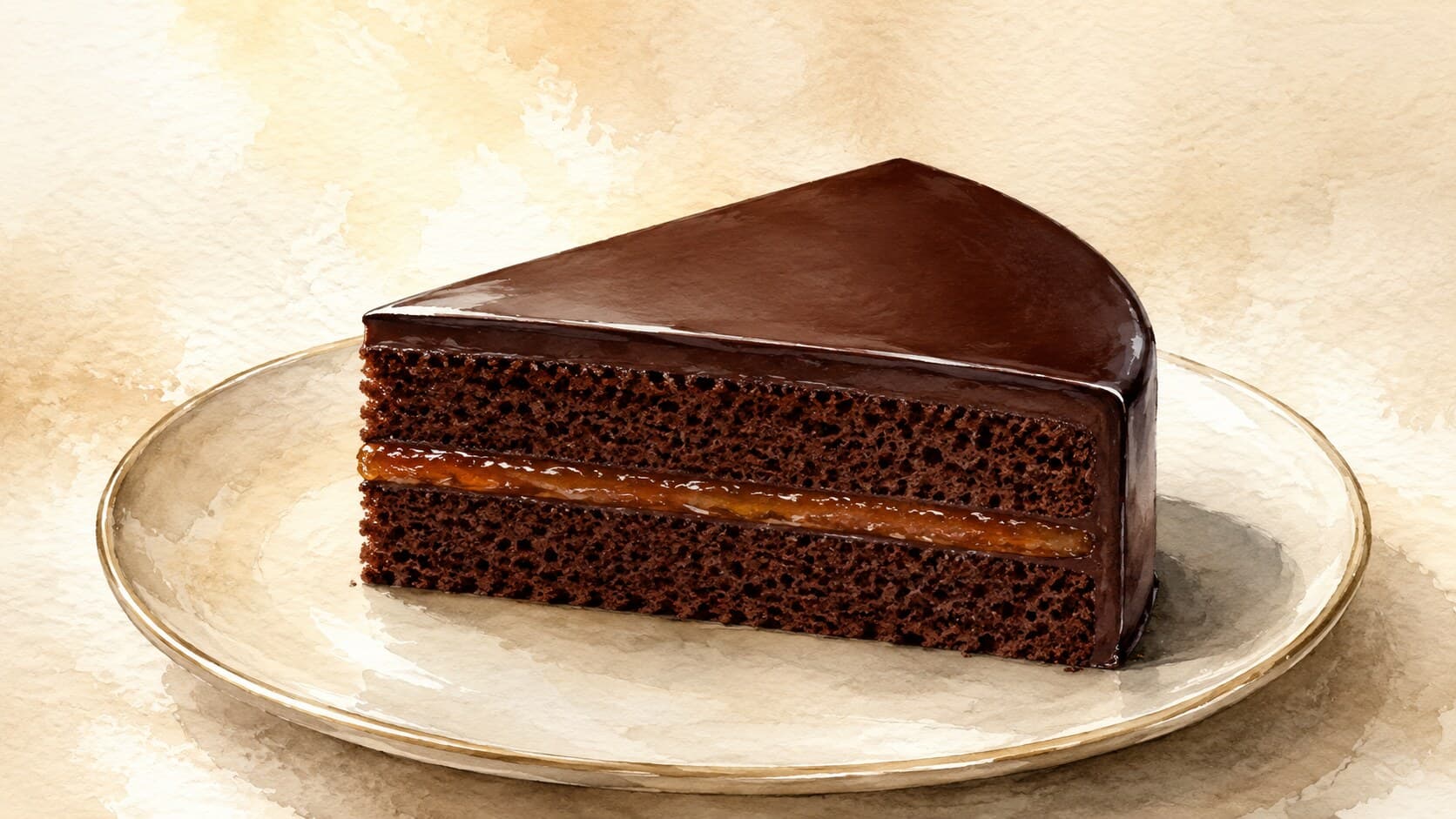
Indulge in the rich, chocolatey delight of Sachertorte, a classic Austrian dessert with a glossy chocolate glaze.
Contents (5 sections)▾
Ingredients
- 150 g dark chocolate
- 100 g unsalted butter, softened
- 100 g granulated sugar
- 5 large eggs, separated
- 120 g all-purpose flour
- 1 tsp vanilla extract
- 200 g apricot jam
- 200 g dark chocolate for glazing
- 100 ml heavy cream
Steps
Preheat your oven to 180°C (350°F). Grease and line a 9-inch round cake pan with parchment paper to prevent sticking.
Melt the 150 g of dark chocolate in a heatproof bowl over simmering water, stirring until smooth. Allow to cool slightly.
In a separate bowl, beat the 100 g of softened butter with 100 g of granulated sugar until light and fluffy. This incorporates air for a lighter texture.
Add the melted chocolate and 1 tsp of vanilla extract to the butter mixture, mixing well. Then, add the egg yolks one at a time, ensuring each is fully incorporated.
Fold in the 120 g of all-purpose flour gently until just combined, being careful not to over-mix.
In another bowl, beat the 5 egg whites until stiff peaks form. Gradually fold the egg whites into the chocolate batter. This step is crucial for achieving a light and airy cake.
Pour the batter into the prepared pan and bake for 30-35 minutes, or until a toothpick inserted comes out clean. Let it cool completely in the pan.
Once cooled, slice the cake in half horizontally and spread 100 g of apricot jam on the bottom layer, then place the top layer back on.
For the glaze, heat 200 g of dark chocolate and 100 ml of heavy cream in a bowl over simmering water until melted and smooth. Pour it over the cake, allowing it to drip down the sides.
Let the glaze set for about 30 minutes before slicing and serving.
Why this works
The Sachertorte's (a classic Viennese chocolate cake layered with apricot jam and finished with a chocolate glaze) rich and dense texture comes from the careful incorporation of ingredients. Melting the chocolate and cooling it slightly before mixing ensures it blends smoothly with the butter and sugar, creating a homogenous batter that is both rich and light when the whipped egg whites are folded in. This folding (a gentle scoop-and-turn motion with a spatula that preserves air in a delicate batter, used instead of stirring) technique is essential; it traps air within the batter, making the cake rise beautifully in the oven. If the cake seems too dense after baking, check that the egg whites were beaten to stiff peaks, as this is key to achieving the desired fluffy texture. Using high-quality chocolate also enhances the flavor, while the apricot jam adds a fruity contrast that balances the richness of the cake. The glossy chocolate glaze on top adds visual appeal and a satisfying texture contrast. Letting the glaze set before serving is crucial to maintain its shine and enhance the overall presentation.
Common mistakes
Stirring the egg whites in instead of folding.
- Target: Whites beaten to stiff, glossy peaks that hold their shape on the whisk, then folded into the chocolate batter in three additions using a spatula in a wide, lifting motion.
- Why it matters: The whites are the only lift in this cake. Stirring deflates the air bubbles you just spent five minutes building, and a deflated batter bakes into a dense brick instead of a tender crumb.
- What to do: Fold a quarter of the whites in first to lighten the batter, then add the rest in two more goes, cutting down through the centre and turning the bowl as you lift.
Pouring hot glaze onto a warm cake.
- Target: The cake fully cooled to room temperature (ideally a few hours, even overnight) before any glaze touches it.
- Why it matters: Warm cake melts the underside of the glaze on contact, which destroys the smooth mirror surface and creates streaky, dull patches as the glaze tries to set.
- What to do: Let the cake cool completely on a rack, then sit on its serving disc over a tray, and pour the warm glaze in a single confident pass over the centre so it flows out and down on its own.
Spreading the apricot layer cold and lumpy.
- Target: Apricot jam warmed and, if needed, sieved or briefly puréed, so it spreads as a thin, even, glossy layer.
- Why it matters: Cold, chunky jam tears the crumb and leaves dry patches; an uneven jam layer also makes the glaze coat unevenly because the surface underneath is bumpy.
- What to do: Warm the jam in a small saucepan until it loosens, push through a sieve if it has fruit chunks, and spread thinly with an offset spatula before the top layer goes back on.
Cutting before the glaze sets.
- Target: A glaze that has gone from glossy-wet to glossy-firm — about 30 minutes at room temperature, longer if the kitchen is warm.
- Why it matters: Slicing too early drags the half-set glaze with the knife, marring the surface and leaving fingerprints of chocolate on the cake board.
- What to do: Test by lightly touching the edge with the back of a finger; if no chocolate comes away, it's ready. Warm the knife in hot water and wipe between slices.
What to look for
- Folded batter looks streaky-marbled for a moment, then smooths into a uniform dark-chocolate brown with no white pockets and no deflated puddle.
- The baked cake springs back gently when pressed in the centre and a skewer comes out with only a few moist crumbs — no wet batter.
- The warmed apricot layer goes on as a thin, glassy film, not a thick band.
- Poured glaze flows in a smooth, even sheet across the top and runs down the sides in a single continuous curtain, leaving a mirror finish.
A note on history
The traditional story credits the Sachertorte to Franz Sacher, a 16-year-old apprentice working under Prince Metternich's household in Vienna in 1832; with the head chef out sick, Sacher reportedly improvised a chocolate cake with apricot jam for the prince's guests. Historians note the account was largely promoted decades later by Sacher's son Eduard — who opened the Hotel Sacher in 1876 — and Franz himself, in a later interview, said he created the cake in the 1840s. Either way, the chocolate-apricot-glaze structure became a defining Viennese patisserie classic.
Get the essays in your inbox — free
Weekly notes on flavor, fermentation, and food history — the writing behind the Atlas of Flavor. No spam; unsubscribe anytime.