
Roasted Cauliflower
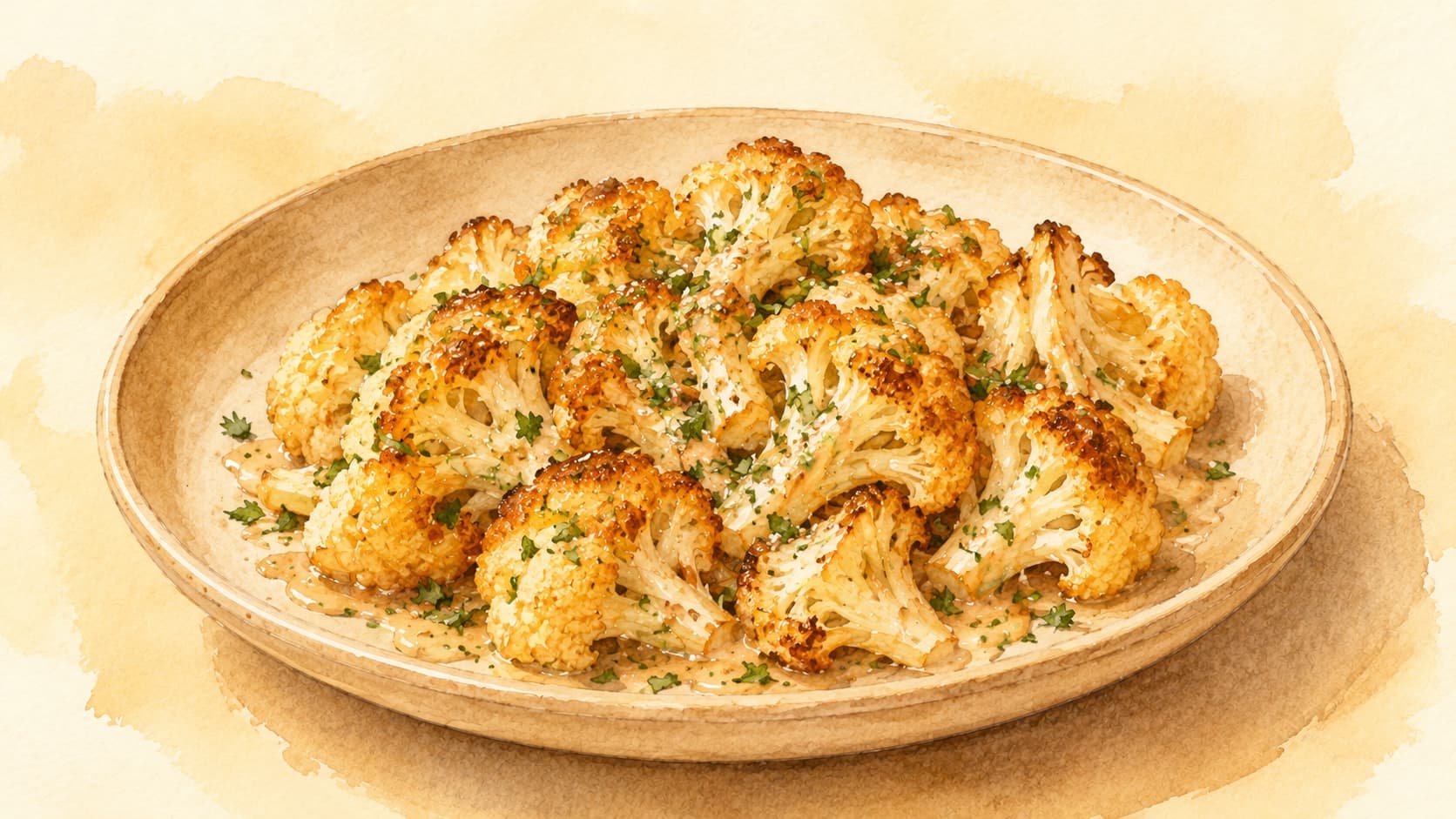
This high-heat roasted whole-head cauliflower is a simple yet elegant side dish, offering a deliciously caramelized exterior and tender interior.
Contents (5 sections)▾
Ingredients
- 1 whole cauliflower (about 1.5 kg)
- 60 ml olive oil
- 1 tsp salt
- 1/2 tsp black pepper
- 1/2 tsp paprika
- 2 cloves garlic, minced
- 1 tbsp lemon juice
- Fresh parsley for garnish (to taste)
Steps
Preheat your oven to 220°C (425°F). High heat is essential for creating the Maillard reaction, which gives the cauliflower its rich flavor and crispy texture.
Remove the leaves from the cauliflower and trim the stem slightly to create a flat base. This helps the cauliflower sit upright during roasting.
In a small bowl, mix olive oil, salt, black pepper, paprika, minced garlic, and lemon juice. Brush this mixture generously all over the cauliflower, ensuring it's well-coated.
Place the cauliflower in a roasting pan and cover it loosely with aluminum foil. Roast in the preheated oven for 25 minutes, then remove the foil for the last 5 minutes to allow the top to brown.
Check for doneness by piercing the base with a knife; it should be tender but still hold its shape. If it seems too firm, roast for an additional 5-10 minutes.
Once done, remove from the oven and let it rest for a few minutes before slicing. Garnish with fresh parsley before serving.
Why this works
Roasting cauliflower at high heat enhances its natural sweetness through caramelization and the Maillard reaction, which imparts complex flavors and a satisfying crunch. Olive oil helps to conduct heat into the vegetable, ensuring even cooking while also preventing dryness. The addition of spices and garlic adds flavor, making it a delightful side dish. However, if your cauliflower breaks apart during preparation, it may be overcooked or too large. If it breaks, simply reshape the pieces and continue roasting; they will still caramelize beautifully. Always check for tenderness but avoid overcooking, as that can lead to a mushy texture. A well-roasted cauliflower should have a firm yet tender bite, making each slice a treat.
Common mistakes
Roasting too low or under-roasting in the middle of the head. Target: 220°C / 425°F oven; total cook time ~25–30 minutes for a whole head, until a paring knife slides through the thickest part of the stem with no real resistance, and the surface is deep, mahogany-brown — not pale tan. Why it matters: cauliflower is built like a tight, half-hollow dome — the florets brown easily on the outside, but the dense stem at the centre needs real time to cook through. Dry heat above about 200°C / 400°F is what drives both browning reactions: caramelisation of the natural sugars on the surface and the Maillard reaction (where sugars and amino acids combine under high heat to create the deep nutty, savoury flavours we associate with proper roasting). Lower temperatures just steam — you get pale, soft, slightly sulphurous cauliflower with no developed flavour. Pulling it as soon as the top looks gold leaves a raw, chalky core hidden under a nice-looking crust. What to do: preheat the oven properly (full 15 minutes), and at the 25-minute mark test the centre of the stem with a knife or skewer. Only pull when there's no resistance. If the top is browning too fast before the centre is done, loosely tent with foil (as in step 4) and keep roasting; don't drop the temperature.
Crowding the pan when roasting florets, or not drying the head before oiling. Target: dry the head with a clean towel; sit it on a heavy roasting pan with space all around; if cutting into florets, single layer with breathing room between pieces. Why it matters: cauliflower is full of water. In a hot oven that water tries to escape as steam; if pieces are packed tight, or there's a wet film on the head, the surrounding air goes humid and the dry-heat reactions never start — instead of browning, you get pale steaming. A dry exterior plus open space means heat can flash the surface and Maillard browning begins within minutes. What to do: pat the head dry. Brush oil/seasoning generously on a dry surface so it bonds, not pools. If you do go floret-style, use a tray big enough for one layer with 2 cm between pieces, or use two trays.
Under-oiling, or oiling without rubbing it in. Target: ~60 ml / 4 tbsp olive oil per ~1.5 kg head, worked into the florets and down between the branches. Why it matters: oil conducts heat from the oven air into the surface of the vegetable. With too little oil, much of the surface stays dry and pale; with oil sitting only on the top crown, only the top crown browns. Olive oil also carries fat-soluble flavour from garlic and paprika into the cauliflower rather than leaving it as a separate top film. What to do: mix the oil with the salt, pepper, paprika, garlic, and lemon juice into a paste, then brush it on with a basting brush (or use clean hands), reaching into the gaps between florets, not just over the top.
Trying to "save it" with crowding aluminium foil for the entire cook. Target: cover loosely for the first 25 minutes only to let the dense interior cook through, then remove the foil for the last 5–10 minutes to develop a deep mahogany crust. Why it matters: foil traps steam — exactly what you need at the start so the centre softens at the same rate as the outside. But steam stops Maillard browning, so you must take the foil off in the final phase to let the surface dry, the natural sugars caramelise, and the colour reach deep, polished brown. Foil all the way through leaves you with cooked-through but pale, slightly bitter cauliflower; no foil at all gives you a black crust over a chalky middle. What to do: foil for the first 25 minutes, foil off for the last 5–10. Watch for the colour change — pale → straw → walnut → mahogany.
What to look for
- Deep mahogany — not chocolate-black — on the surface. Walnut-toned, glossy patches across the florets mean the Maillard reaction and caramelisation have both worked properly; flat black with sharp smoke means you've pushed past browning into burning.
- A knife sliding through the centre of the stem with zero squeak. Pierce the densest part of the core — if the blade meets no resistance and slides out clean, the inside has fully softened. Any sense of crunch and you still have steaming to do.
- A nutty, savoury smell with no sulphurous edge. A correctly roasted head smells like browned butter and toasted nuts; if you still smell raw cabbage / sulphur (cauliflower's sulphurous note that emerges when it's under-cooked or boiled), the oven isn't doing its job — push it higher or longer.
- Tiny crisp edges on the outermost florets, with the inner florets soft and tender. That two-textured contrast — crackled crust outside, melting inside — is the doneness signal, and the eating reward.
A note on history
Cauliflower (Brassica oleracea var. botrytis — the same wild-mustard species as cabbage, kale, and broccoli, bred to form a dense flower head) is a selectively bred descendant of wild cabbage native to the coastal Mediterranean. The two most often-cited centres of early development are the eastern Mediterranean — Cyprus in particular — and the Levant (probably Syria); twelfth-century Arab botanists left some of the earliest written references to cauliflower as a distinct vegetable (Wikipedia: Cauliflower, Specialty Produce). By the medieval period, Cyprus was particularly known for its cauliflower, and from there cultivation spread through Italy, France and on to England — where Henry Lyte's 1586 Niewe Herball (an early English herbalists' book on plants and their uses) refers to it as "Cyprus coleworts" (Project Gutenberg: The Cauliflower). The whole-head, high-heat roast is a modern restaurant-led idea that became widely popular in the 2010s, taking advantage of the dense head's ability to develop a deeply browned exterior while staying tender at the centre.
Get the essays in your inbox — free
Weekly notes on flavor, fermentation, and food history — the writing behind the Atlas of Flavor. No spam; unsubscribe anytime.