
Roasted Cabbage Wedge
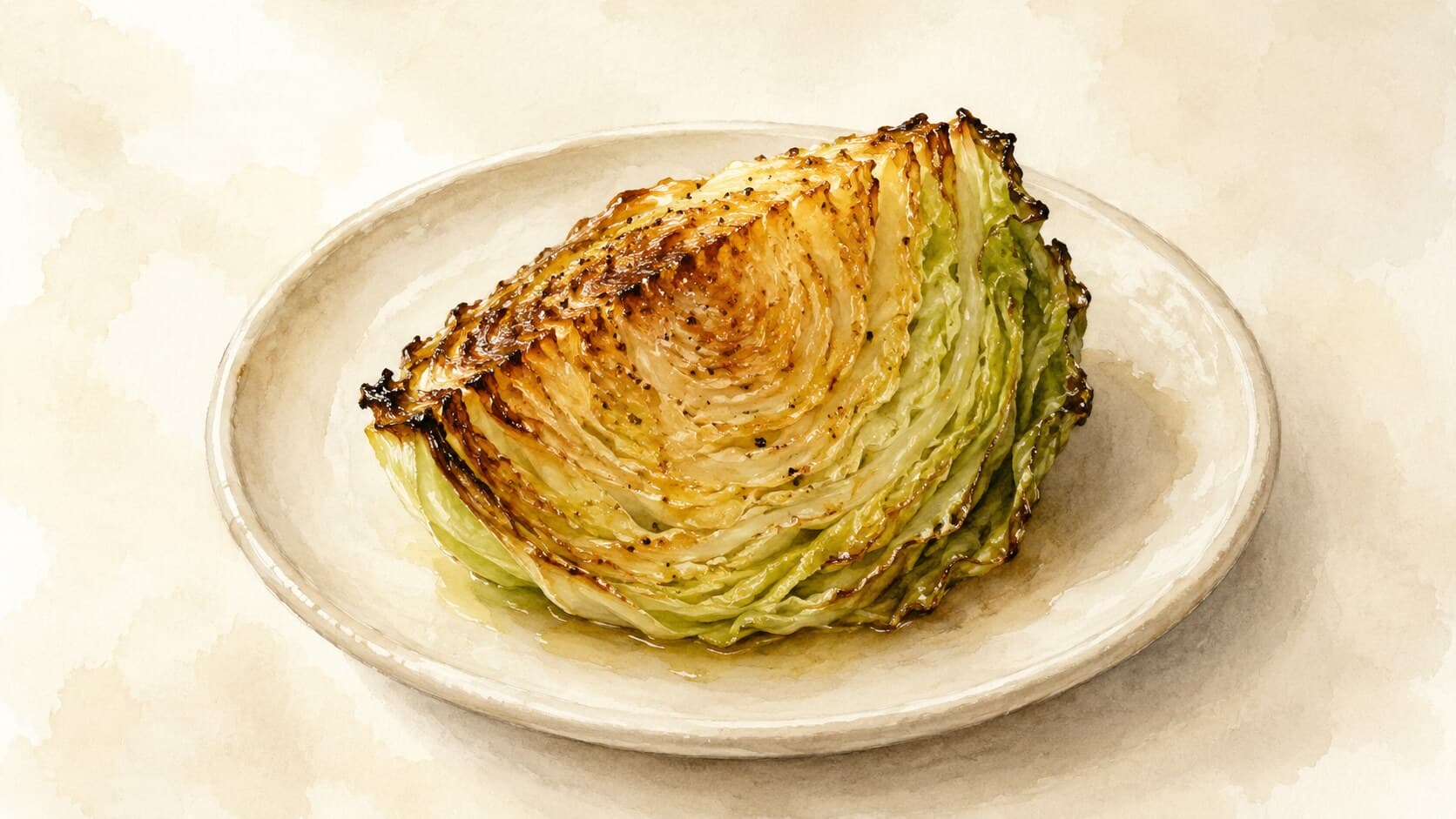
Roasted cabbage wedges are cut, seasoned, and roasted until caramelized. Serve as a side dish to complement various meals.
Contents (5 sections)▾
Ingredients
- 1 medium green cabbage, cut into 8 wedges
- 4 tbsp olive oil
- 1 tsp sea salt
- 1/2 tsp black pepper
- 1 tsp garlic powder
- 1 tsp smoked paprika
- 1/4 cup grated Parmesan cheese (optional)
- 1 tbsp balsamic vinegar (optional)
Steps
Preheat your oven to 425°F (220°C). This high temperature ensures that the cabbage gets nice and crispy.
In a large bowl, toss the cabbage wedges with olive oil, salt, pepper, garlic powder, and smoked paprika. Coating them evenly helps to achieve a rich flavor.
Place the seasoned cabbage wedges cut-side down on a baking sheet lined with parchment paper. This position will help them caramelize better.
Roast the cabbage in the preheated oven for 20-25 minutes, or until the edges are browned and crispy. Keep an eye on them to prevent burning.
If using, sprinkle the grated Parmesan cheese over the wedges during the last 5 minutes of roasting for added flavor and a cheesy crust.
Drizzle with balsamic vinegar before serving for a touch of acidity that balances the richness.
Why this works
Roasting cabbage wedges at a high temperature allows the natural sugars in the cabbage to caramelize, creating a crispy texture and deep flavor. The combination of olive oil and spices enhances the savory profile and helps the outer leaves crisp up beautifully. If the wedges seem too bitter, adding a drizzle of balsamic vinegar at the end helps to cut through the bitterness and add a delightful tang. If they break apart during roasting, simply rearrange them on the baking sheet and continue cooking. The high heat method is crucial; lower temperatures will result in a steamed texture rather than the desired roast. This technique is versatile, allowing for different seasonings while maintaining the fundamental essence of the cabbage.
Common mistakes
Cutting the wedges too thin or skipping the core, so the wedge collapses. Target: 8 wedges from one medium cabbage, each wedge 3–4 cm / 1.25–1.5 inches thick at the widest point, with a strip of the central core left intact along the spine of each piece. Why it matters: the core is the cabbage's natural skeleton. It's what holds all the leaves together so the wedge cooks as one piece — a unit that browns on its cut faces and stays sweet and tender in the middle, instead of a fan of leaves falling apart. Cut the core away or slice too thin, and the layers separate, char on the edges where they shouldn't, and the wedge no longer caramelises evenly because some leaves are exposed and some are buried. (Caramelisation is what happens when the cabbage's natural sugars meet dry, high heat and turn deep brown and sweet — different from burnt.) What to do: halve the cabbage through the stem, then quarter, then cut each quarter in half — always slicing through the stem end so a sliver of core anchors each wedge. The wedges should sit flat like little wooden doorstops.
Crowding the tray or roasting on a damp baking sheet. Target: wedges in a single layer, cut-face down, 2–3 cm of space between each, on a heavy preheated tray or roasting pan. Why it matters: cabbage is around 90% water. In a hot oven that water tries to leave as steam; if the wedges are packed tight, the steam can't escape and the air around them goes from dry to humid. Humid air doesn't caramelise — it steams, so you end up with pale, floppy, water-logged cabbage wearing a thin oil slick. A preheated tray gives the cut faces an immediate dry, hot surface, so the searing brown crust starts within seconds of contact. What to do: use a tray large enough for the wedges to breathe; if necessary use two trays. Put the trays in the oven empty while it preheats, then quickly lay the oiled wedges cut-side down, cut-face touching the hot metal. Don't move them again for at least 15 minutes.
Under-oiling, under-salting, or doing both right at the end. Target: about 1 tablespoon of olive oil per 2 wedges (roughly 4 tbsp for the whole cabbage), salt and seasoning rubbed in before they hit the oven. Why it matters: oil is what conducts heat into the cut surface of the wedge — without enough of it, the heat bounces and the surface dries out before it browns. Salt drawn into the cabbage during the early minutes of roasting pulls some water to the surface, then evaporates, leaving sweeter, denser leaves behind; salt sprinkled on at the end just sits on top and feels harsh. Salt rubbed in early also seasons the inner leaves as they steam from within. What to do: toss the wedges in oil, salt, pepper, garlic powder and smoked paprika in a wide bowl first; press the seasoning into the leaves with your fingers. Then arrange cut-side down on the hot tray.
Calling it done as soon as the top looks pretty. Target: roast 20–25 minutes at 220°C / 425°F until the cut face is a deep, mahogany brown — not pale gold, not black — and a paring knife slides through the core with no real resistance, into vegetables hot all the way through. Why it matters: cabbage needs to cook from wet-and-squeaky to soft-and-sweet on the inside and dry-brown on the outside. The two finish lines arrive together only when the heat is high and the wedge has had real, unmoved contact with the tray. Pulling it at "lightly golden" gives you cabbage that still tastes vegetal and raw in the centre; pushing past "deep mahogany" with rising acrid smoke means scorching, where Maillard browning has tipped into burning. What to do: at the 20-minute mark, slide a thin spatula under one wedge and check the bottom face — you want it to look like polished walnut. If it's still pale, give it another 5 minutes; if you smell sharp bitter smoke, pull it out at once. A drizzle of balsamic (Italian balsamic vinegar, dark and sweet-tart) or lemon at the end is for lift, not for rescue.
What to look for
- A loud sizzle the moment the cut face hits the tray. A dry hiss means the oil is hot and the dry-heat reactions are starting straight away; if the tray is silent when the wedge lands, the oven or the tray is too cool.
- The cut face going from translucent green to opaque brown over the first 8–10 minutes. That colour change is the Maillard reaction (amino acids and sugars in the cabbage browning under dry heat) and natural caramelisation working together — it's your "the seal is forming" cue.
- Outer leaves curling away from the wedge in dark, almost paper-thin frills. Those thin edges are the cabbage's natural "chips" — dark amber and crisp is good, charcoal-black is too far. They are a sensitive smoke alarm: when they start to go from amber to black, it's time to lower the heat or pull the tray.
- A knife that slides through the core without flexing the wedge. If the blade meets a hard, squeaky centre, the inside hasn't softened yet — leave it another 3–5 minutes, even if the top looks done.
A note on history
Cabbage (Brassica oleracea, the wild-mustard species that also gave us broccoli, kale, and cauliflower) was domesticated from wild varieties native to the coastal eastern Mediterranean and Asia Minor; cultivation appears in Sanskrit texts roughly 4,000 years old and in Greek writings from around the sixth century BCE (Specialty Produce, Wikipedia: Cabbage). Celtic peoples helped distribute it across central and western Europe — so deeply that the Latin name Brassica is thought to come from the Celtic bresic, meaning cabbage (Specialty Produce). The hard-headed white and green cabbages familiar today were further selected in northern Europe and the Low Countries over the medieval and early modern periods. Roasting whole or wedged cabbage as a stand-alone vegetable side is a more recent dry-heat application that has spread widely in modern restaurant cooking, taking advantage of the leaves' high sugar content and the way the core holds everything together under intense oven heat (PFAF: Brassicas).
Get the essays in your inbox — free
Weekly notes on flavor, fermentation, and food history — the writing behind the Atlas of Flavor. No spam; unsubscribe anytime.