
Risotto allo Zafferano
A creamy, aromatic Italian saffron risotto that embodies the essence of Milanese cuisine.
Contents (5 sections)▾
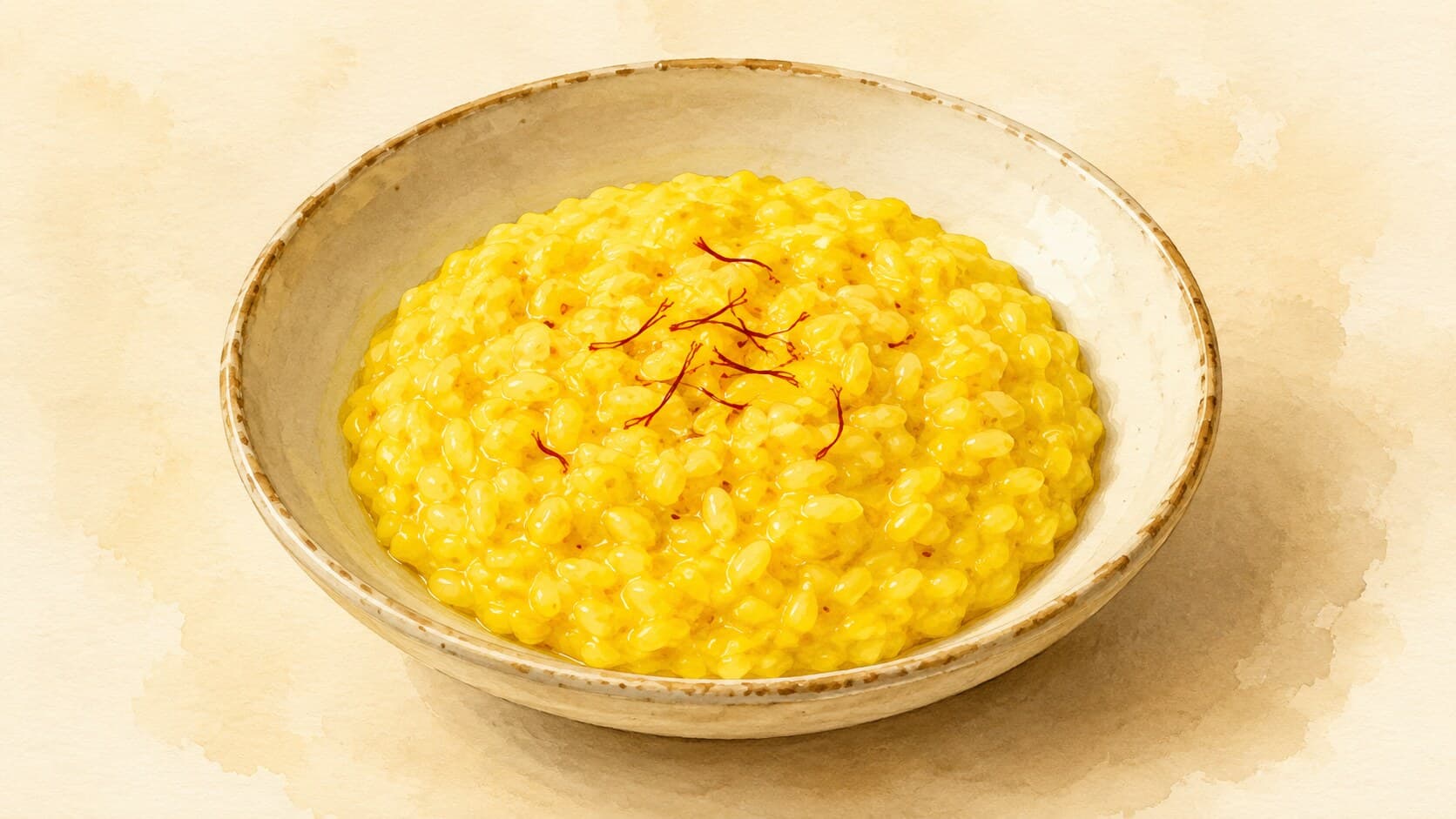
Ingredients
- 300 g Arborio rice
- 1 onion, finely chopped
- 1 clove garlic, minced
- 1 L chicken or vegetable broth
- 100 ml dry white wine
- 1 g saffron threads
- 50 g grated Parmigiano-Reggiano cheese
- 50 g unsalted butter
- 2 tbsp olive oil
- Salt to taste
- Black pepper to taste
Steps
In a saucepan, heat the broth over low heat and add the saffron to infuse its flavor.
In a separate large pan, heat olive oil and 25 g of butter over medium heat. Add the chopped onion and garlic, sauté until translucent (about 5 minutes).
Add the Arborio rice to the onion mixture, stirring for 2 minutes until the grains are coated and slightly toasted.
Pour in the white wine and cook until it evaporates, stirring continuously to release starch from the rice.
Begin adding the warm saffron-infused broth, one ladle at a time, stirring frequently. Allow the rice to absorb the liquid before adding more. This should take about 15 minutes.
Once the rice is al dente and creamy, remove from heat. Stir in the remaining butter and Parmigiano-Reggiano cheese until melted and smooth.
Season with salt and black pepper to taste. Serve hot, garnished with extra saffron threads if desired.
Tools you'll want
- · Microplane Premium Classic Zester (46020)
Why this works
Risotto allo Zafferano is a classic dish that relies on the creamy texture achieved through the careful release of starch from the Arborio rice (a short-grain Italian rice prized for releasing creamy starch as it cooks). The technique of adding broth gradually allows the rice to absorb flavors while maintaining a perfect al dente texture. Saffron (the dried crimson stigmas of the saffron crocus flower — the world's most expensive spice by weight, used in tiny amounts for its deep gold color and honey-hay aroma) imparts a beautiful golden hue and adds a unique aroma that defines this dish. If your risotto seems too thick, simply add a bit more broth, stirring to achieve the desired creaminess. Conversely, if it appears too runny, continue to cook it over low heat, allowing it to simmer and reduce until it reaches the right consistency. The final mantecatura (the off-the-heat beating-in of cold butter and grated Parmigiano-Reggiano — a hard, aged Italian cow's-milk cheese with a salty, nutty bite — that emulsifies the risotto into a glossy cream), or finishing process, where butter and cheese are incorporated, creates a silky texture that wraps around each grain, making it rich and satisfying. This careful balance of heat, timing, and ingredients ensures a delightful risotto experience.
Common mistakes
Pulling the rice off the heat while there's still a chalky white core inside the grain. Target: al dente — bite a grain in half and the centre shows only a tiny, faint dot, no opaque chalk; total cooking time from the first ladle of broth, roughly 16–18 minutes for Arborio. Why it matters: rice grains are mostly starch packed inside a tight structure. Heat plus the slow, ladle-by-ladle addition of hot broth lets the outer starch hydrate and gelatinise (the starch granules soak up water, swell, and burst — this is what gives risotto its body), while the inner kernel stays firm. Stop too early and the centre is still raw starch — chalky on the tooth, hard on the stomach, and the surrounding cream is thin because the grains haven't released enough starch yet. What to do: test one grain every minute from minute 14 onwards. When the chalk shrinks to a barely visible dot and the body feels creamy around it, take the pan off the heat. Remember that the rice keeps cooking from residual heat through the mantecatura, so stop a hair early rather than late.
Cold broth from the fridge or warm-but-not-hot broth. Target: broth held at a steady, very gentle simmer in a separate pan, ladled in hot. Why it matters: every time you add cold liquid, the pan drops below the temperature where starch gelatinises, the cooking effectively pauses, and the grains "shock" — they cook unevenly and the outside layer hardens. With hot broth, the heat stays in the comfort zone the whole time, the starch releases steadily, and the grains keep gently swelling. What to do: start the saffron broth in a small saucepan over the lowest possible flame at the same moment you start sweating the onion. Use a small ladle — the cooking liquid should never drop the pan off a gentle simmer. If your broth is unsalted, taste and adjust later, after the cheese.
Mantecatura (the final beating-in of cold butter and grated cheese) done over the flame. Target: pan off the heat, lid on for 1–2 minutes, then beat in very cold cubed butter and finely grated Parmigiano-Reggiano vigorously until the surface looks glossy. Why it matters: mantecatura is an emulsion (a stable mix of fat and liquid). Cold butter melts slowly into the hot risotto, and the cheese proteins help bind butterfat with the starchy broth into a glossy cream that coats every grain. Done over heat, the butter melts too fast and the cheese tightens into stringy clumps; the emulsion never forms and the risotto looks oily. What to do: keep the butter in the fridge until the second the pan comes off the heat. Drop it in cubed, scatter the cheese, and beat with a spoon, almost folding the pan onto itself, for 30–60 seconds. The risotto should "wave" when you shake the pan — the so-called all'onda test.
Blooming the saffron in cold water (or skipping the bloom and adding threads straight to the rice). Target: the saffron threads sit in a small amount of hot (not boiling) broth for at least 10 minutes before they go in. Why it matters: the colour and aroma compounds in saffron (crocin and safranal) are water-soluble; gentle heat coaxes them out and a longer bloom gives a deeper gold and a fuller aroma. Threads dropped straight onto rice never fully open up and the colour comes out patchy. What to do: lightly crush the threads between your fingers into a few tablespoons of broth taken from the simmering pan, leave 10 minutes, then add this saffron broth around the halfway mark of the rice cooking. Some cooks reserve a little to add at the very end for a fresher top note.
What to look for
- A risotto that "waves" (all'onda) when you tilt the pan. Shake or tilt the pan gently — correctly finished risotto should ripple in a slow wave, not stand stiff like rice pudding or run like soup. This is the classic Italian doneness cue.
- Tiny, glossy bubbles popping at the surface as you stir during the broth phase. That fine, almost lacy bubbling is starch and broth working together; if it goes from gloss to dull foam, your heat is too high.
- A deep, even gold colour, not a yellow stripe down one side. The saffron broth should colour the whole pan uniformly. Patchy yellow usually means you under-bloomed or under-stirred.
- A nutty, almost butter-toast smell as you toast (tostatura) the rice before the wine. Lean over after the 2-minute toast: a clean, warm cereal smell is right; if it smells sharp or acrid, the pan is too hot and you risk burnt onion notes through the whole dish.
A note on history
Risotto allo Zafferano (Risotto alla Milanese) is the signature dish of Milan, Lombardy. Its origins are most often traced to the 16th century, with the most quoted (if half-legendary) tale set in 1574, when a glass-painter nicknamed Zafferano — for his habit of mixing the spice into his pigments at the Duomo di Milano — supposedly had saffron added to a wedding-banquet rice dish as a prank, only to find the result delicious (Italy Magazine, Google Arts & Culture). Beyond the legend, saffron was already used in wealthier households of Northern Italy as a luxury colourant and aromatic, especially at celebratory tables (YesMilano). Over the following centuries the dish became part of Milan's everyday repertoire — often served as a primo on its own, or beneath ossobuco — and remains the city's emblematic rice course today.
Get the essays in your inbox — free
Weekly notes on flavor, fermentation, and food history — the writing behind the Atlas of Flavor. No spam; unsubscribe anytime.