
Pomme Puree
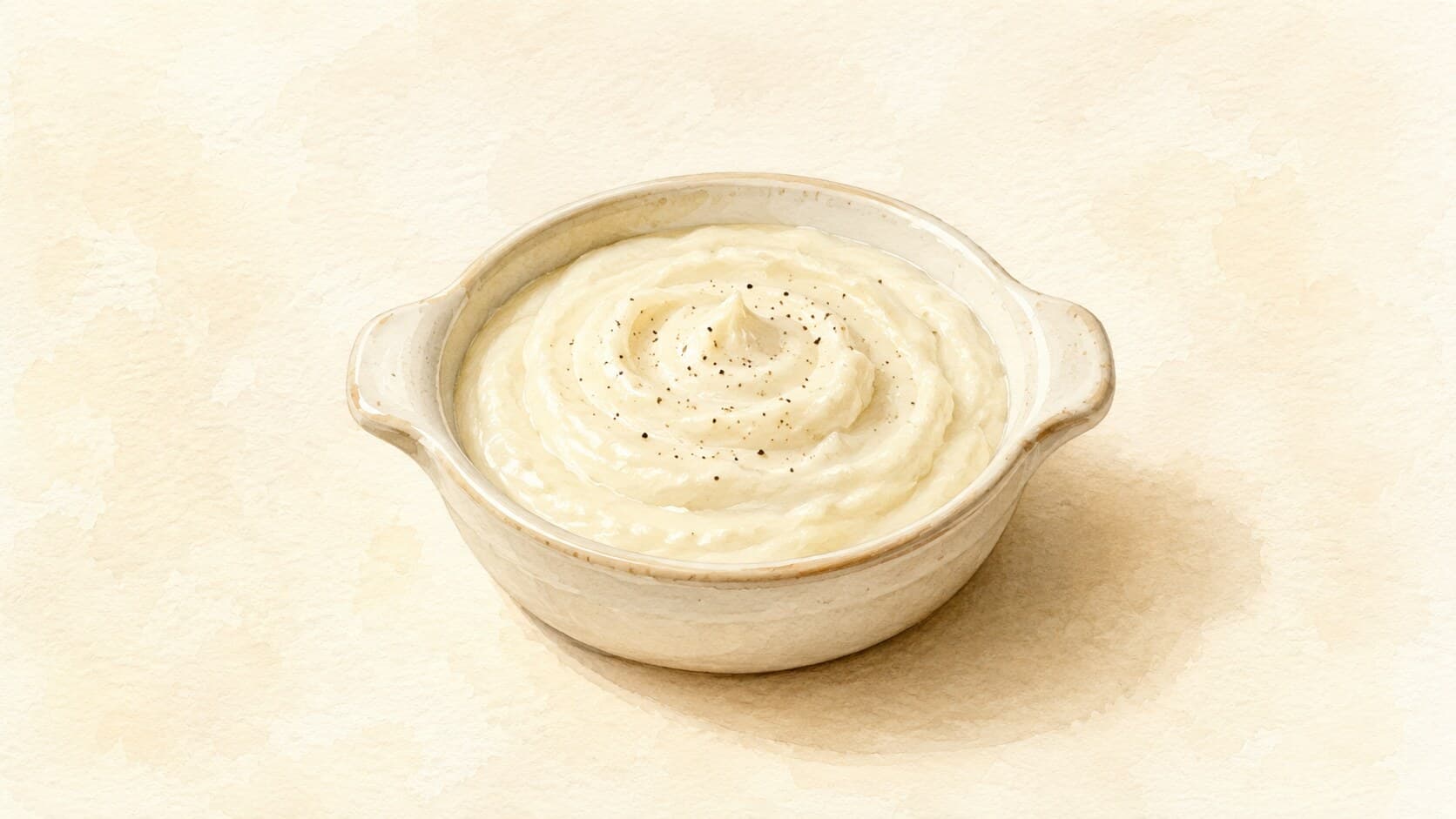
Pomme Purée is a classic French potato dish, known for its creamy texture and rich flavor, perfect as a side for various mains.
Contents (5 sections)▾
Ingredients
- 1 kg Yukon Gold potatoes
- 250 ml heavy cream
- 100 g unsalted butter
- Salt to taste
- White pepper to taste
Steps
1. Peel and cut the Yukon Gold potatoes into even pieces, about 5 cm in size, to ensure they cook uniformly.
2. Place the potatoes in a pot, cover them with cold water, and add a generous pinch of salt. Bring to a boil over medium-high heat, then reduce to a simmer for about 15 minutes, or until a fork easily pierces the potatoes.
3. While the potatoes are cooking, gently heat the heavy cream and butter in a small saucepan over low heat for about 5 minutes, until the butter has melted. This will help to incorporate the fat smoothly into the potatoes.
4. Once the potatoes are tender, drain them and return them to the pot. Mash the potatoes using a potato ricer or a fine potato masher until completely smooth.
5. Gradually add the warm cream and butter mixture to the mashed potatoes, stirring continuously for about 2-3 minutes until fully incorporated. Season with salt and white pepper to taste.
Why this works
Pomme Purée achieves its signature creamy texture through a meticulous process of cooking and mashing potatoes, ideally Yukon Gold for their natural buttery flavor. Cooking the potatoes in cold salted water allows for even cooking and prevents them from becoming waterlogged. The addition of warm cream and butter—rather than cold—ensures a seamless blend, preventing clumping. If the purée appears too thick, you can introduce a bit more warm cream to adjust the consistency. Additionally, using a ricer instead of a masher prevents the potatoes from becoming gluey, which can happen if overworked. This technique is essential for achieving the velvety mouthfeel characteristic of classic French cuisine. With attention to temperature control and the right tools, Pomme Purée transforms simple ingredients into a luxurious side dish. The careful timing of each step, such as simmering the potatoes for precisely 15 minutes, ensures they are tender without losing their structure. If you find your purée is not as smooth as desired, consider passing it through the ricer a second time for an even finer texture.
Common mistakes
Boiling the potatoes hard and underdone. Target: A gentle simmer (not a rolling boil) from cold salted water until a thin knife slides through the centre with zero resistance — about 15-20 minutes for evenly cut 5 cm pieces, longer if larger. Why it matters: A hard boil bashes the outside into mush before the inside is cooked through, which leaves you with patches of starchy resistance in the purée. Undercooked potato also doesn't pass cleanly through a ricer (a press that pushes cooked potato through tiny holes into rice-like strands); it shears into gluey strands instead. Both issues come from the same root: starch granules need full hydration (starch gelatinisation — granules swelling and softening from the absorbed water) all the way to the centre. What to do: Start in cold water with a good pinch of salt, bring to a simmer, then lower the heat so the surface barely trembles. Test the centre of the largest piece with a knife — if there's any resistance, give it a few more minutes.
Beating the potatoes with a whisk or food processor. Target: Pass once (twice for ultra-smooth) through a ricer or fine food mill while still hot, then fold liquids in by hand. Why it matters: Potato cells contain starch granules. When you whip or process them, you break the cells open and the starch pours out into long, sticky threads — the reason "gluey" potatoes happen. A ricer pushes the cells through tiny holes without rupturing them. What to do: Use a ricer or tamis (fine drum sieve). Fold in the warm butter and cream with a wooden spoon or silicone spatula. Stir just enough to combine — no longer.
Pouring in cold or boiling-hot cream and butter. Target: Cream and butter warmed together to about body temperature (around 50-60°C / 120-140°F), warm to the touch but not steaming. Why it matters: Pomme purée is an emulsion — water from the potato bound with butterfat and cream into one smooth body (cream emulsion — fat dispersed in tiny droplets through a starchy water phase). Cold dairy shocks the warm potato, stiffens, and stops the fat from dispersing evenly. Boiling-hot dairy can split the emulsion and make the purée greasy. What to do: Melt the butter into the cream over low heat until just warm. Add to the riced potato in stages — a third at a time — folding gently between each addition.
Holding the finished purée and letting it dry out. Target: Serve immediately. If holding, cover the surface flush with parchment or buttered foil and keep over a low water bath. Why it matters: An open bowl of warm purée loses steam, the surface skins over, and the inside tightens as starch sets. The texture you nailed in the pot turns pasty within minutes. What to do: Plate as soon as possible. If you must hold it, set the bowl over a barely simmering water bath, press parchment directly onto the surface, and loosen with a splash of warm cream just before serving.
What to look for
- A knife that drops through the potato with no twist. No resistance, no springback — that's full gelatinisation. Anything else, give it more time.
- A glossy, satin sheen after the dairy goes in. Not matte (too thick, undercooked, or under-buttered) and not slick or pooling fat (broken emulsion).
- A spoon that pulls a slow ribbon back into the bowl. When you lift a spoonful, it should fall in a smooth fold — not in clumps and not as a thin pour.
- A clean, sweet potato aroma — no raw-starch smell. If you smell something faintly chalky or papery, the centres weren't fully cooked.
A note on history
While layered, butter-rich potato purées exist throughout French cooking, the modern reference point is Joël Robuchon's purée de pomme — the dish that, more than any other, made his reputation when he opened Jamin in Paris in December 1981 (Michelin Guide). Robuchon's version uses just four ingredients (potato, butter, milk, salt), favours the La Ratte variety (a small, waxy French heirloom potato with a delicate, nutty flavour), and famously involves passing the cooked potatoes through a fine food mill while warm, then drying them briefly over low heat before mounting with butter and milk (Michelin Guide: feature). At a time when fine dining largely overlooked the potato, his quiet refusal to dress it up — relying instead on technique and ratios — became one of the defining gestures of late-20th-century French cooking.
Get the essays in your inbox — free
Weekly notes on flavor, fermentation, and food history — the writing behind the Atlas of Flavor. No spam; unsubscribe anytime.