
Poisson Sauce Vierge
Poisson Sauce Vierge consists of cooked fish served with a sauce made from emulsified olive oil, lemon juice, and infused herbs.
Contents (5 sections)▾
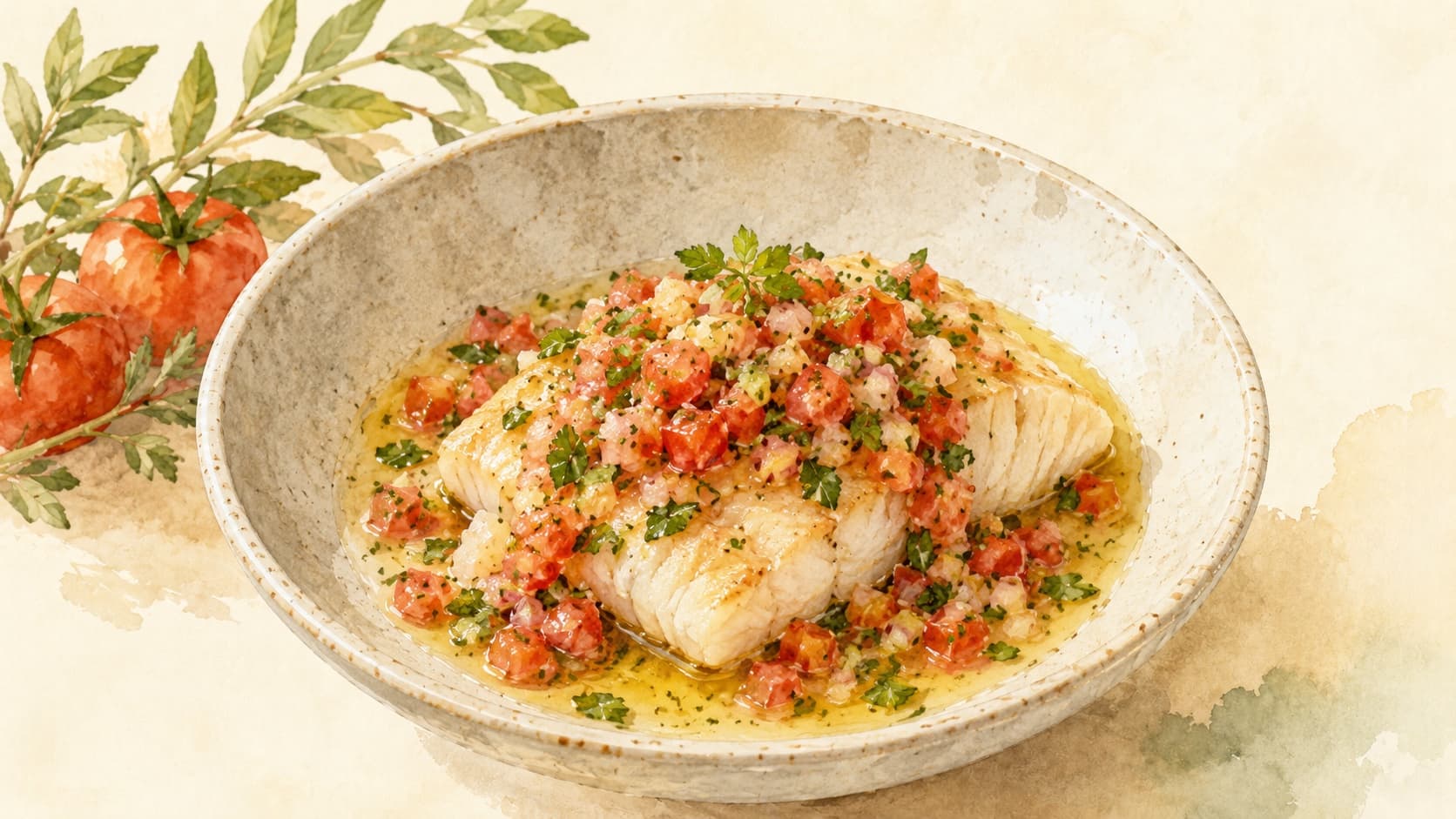
Ingredients
- 300 g white fish fillet (such as sole or cod)
- 2 tbsp olive oil
- 1 medium ripe tomato, diced
- 1 clove garlic, minced
- 2 tbsp fresh basil, chopped
- 2 tbsp fresh parsley, chopped
- 1 tbsp lemon juice
- Salt, to taste
- Freshly ground black pepper, to taste
Steps
Preheat a non-stick skillet over medium heat (about 180°C / 350°F). Add 1 tablespoon of olive oil.
Season the white fish fillet with salt and pepper, then cook in the skillet for about 4-5 minutes per side, or until the fish flakes easily with a fork and reaches an internal temperature of 63°C (145°F).
While the fish is cooking, prepare the sauce Vierge by combining the diced tomato, minced garlic, chopped basil, chopped parsley, lemon juice, and remaining olive oil in a bowl.
Mix the sauce gently and season with salt and pepper to taste. Let it sit for 5 minutes to allow the flavors to meld.
Once the fish is cooked, plate it and generously spoon the sauce Vierge over the top before serving.
Why this works
The essence of Poisson Sauce Vierge lies in the balance of flavors and textures. The delicate white fish, cooked gently to an internal temperature of 63°C (145°F), ensures it remains moist and tender. Cooking for precisely 4-5 minutes per side allows for perfect doneness; overcooking will lead to a dry texture. The sauce Vierge, made with fresh herbs and ripe tomatoes, adds a bright contrast that enhances the fish without overwhelming it. If the sauce seems too thin, letting it sit for an additional 5 minutes will help it thicken slightly, or you can add a pinch more olive oil to emulsify it. Using fresh herbs is crucial, as they bring a vibrant aroma and flavor that complements the subtleness of the fish. This recipe is a celebration of light ingredients, highlighting the beautiful simplicity of French cuisine while ensuring you achieve a dynamic and satisfying entrée. The key to success with this dish is the precise cooking time and temperature.
Common mistakes
Undercooking the fish for the sake of "tenderness." Target: Cook the fillet through completely — flesh opaque all the way to the centre, flakes parting cleanly with a fork, internal temperature 63°C / 145°F as written. Why it matters: The sauce vierge (literally "virgin sauce" — a cold, room-temperature dressing of raw tomato, herbs, oil, and lemon spooned over warm fish) sitting on top is a raw condiment — uncooked tomato, oil, herbs, lemon, garlic — and the fish itself is the only cooked element on the plate. Pale or translucent flesh at the centre means the fish protein hasn't fully set (the protein "denaturation" stage, where the strands have unwound and re-tightened into firm, opaque fibres). Translucent fish under raw sauce is not the look you want. What to do: Use an instant-read thermometer at the thickest part. If you don't have one, lift a flake at the thickest point with the tip of a knife — if it still looks glassy or grey-translucent, give it another minute. A skinned fillet around 2 cm thick usually needs 4-5 minutes per side at the temperature given.
Building the sauce hours ahead. Target: Combine tomato, oil, garlic, herbs, and lemon no more than about 30 minutes before serving; spoon it over the fish at the table or just before plating. Why it matters: Sauce vierge is built on raw tomato and uncooked oil. Tomato juices break down and turn watery if they sit too long with salt, raw garlic gets harsh, and the herbs darken. The dish wants a fresh, almost-just-mixed character. What to do: Dice the tomato, mince the garlic, and chop the herbs in advance, but combine and season at the last moment. Let the bowl sit 5-10 minutes for the flavours to meet, then spoon over the fish.
Drowning the plate in sauce. Target: A generous spoonful per portion, not a soup — you should still see and taste the fish underneath. Why it matters: The whole point of sauce vierge is to frame the fish — bright acid, oil, herbs, raw tomato bite — not replace it. Over-sauced fillets go limp and the dish loses its quiet structure. What to do: Spoon the sauce on at the table or last second on the plate so the fish stays warm and the sauce stays bright. Serve any extra in a small bowl on the side.
Using hard, watery, or out-of-season tomato. Target: Ripe, fragrant tomato with deep colour and full aroma at the stem end. Why it matters: In a sauce that hardly cooks, the tomato can't hide. Hard, pale, refrigerated tomato will taste like sour water and lift no flavour into the oil. What to do: Keep tomatoes at room temperature, peel and seed if the skins are tough, and if good tomato isn't available, swap to halved cherry tomatoes (they tend to ripen better year-round). Dress in the oil while you finish the fish so the juices have a moment to mingle.
What to look for
- Opaque, white-pearl flesh that flakes cleanly. Slip a knife into the thickest part: the flesh should part in distinct flakes with no glassy or translucent core.
- Sauce that glistens but doesn't pool. Tilt the bowl — the oil should coat the tomato and herbs without a separate watery layer settling at the bottom.
- A green, bright aroma at the bowl. Fresh basil and parsley should smell sharp and grassy, not bruised or dark.
- A sauce that lifts the fish, not floods it. When you cut a bite, the fish leads and the sauce follows — savoury, acidic, and warm-cool against the fillet.
A note on history
Sauce vierge was created by Michel Guérard in 1976, with his first published recipe (using crushed coriander seeds and diced tomatoes, served over sea bass) appearing in 1977 (Wikipedia: Cuisine minceur, Cooks Without Borders). Guérard was one of the founding figures of French nouvelle cuisine (the 1970s movement toward lighter, fresher, simpler French cooking) — the movement, alongside Paul Bocuse and the Troisgros brothers, that pushed back against the heavy butter-and-flour sauces of cuisine classique (the older, formal grand-restaurant tradition) in favour of lighter, brighter, more ingredient-led cooking (Wikipedia: Michel Guérard). A raw, room-temperature emulsion of tomato, olive oil, lemon, and herbs poured over cooked fish was, at the time, a small declaration of independence from the old order.
Get the essays in your inbox — free
Weekly notes on flavor, fermentation, and food history — the writing behind the Atlas of Flavor. No spam; unsubscribe anytime.