
Pastitsio
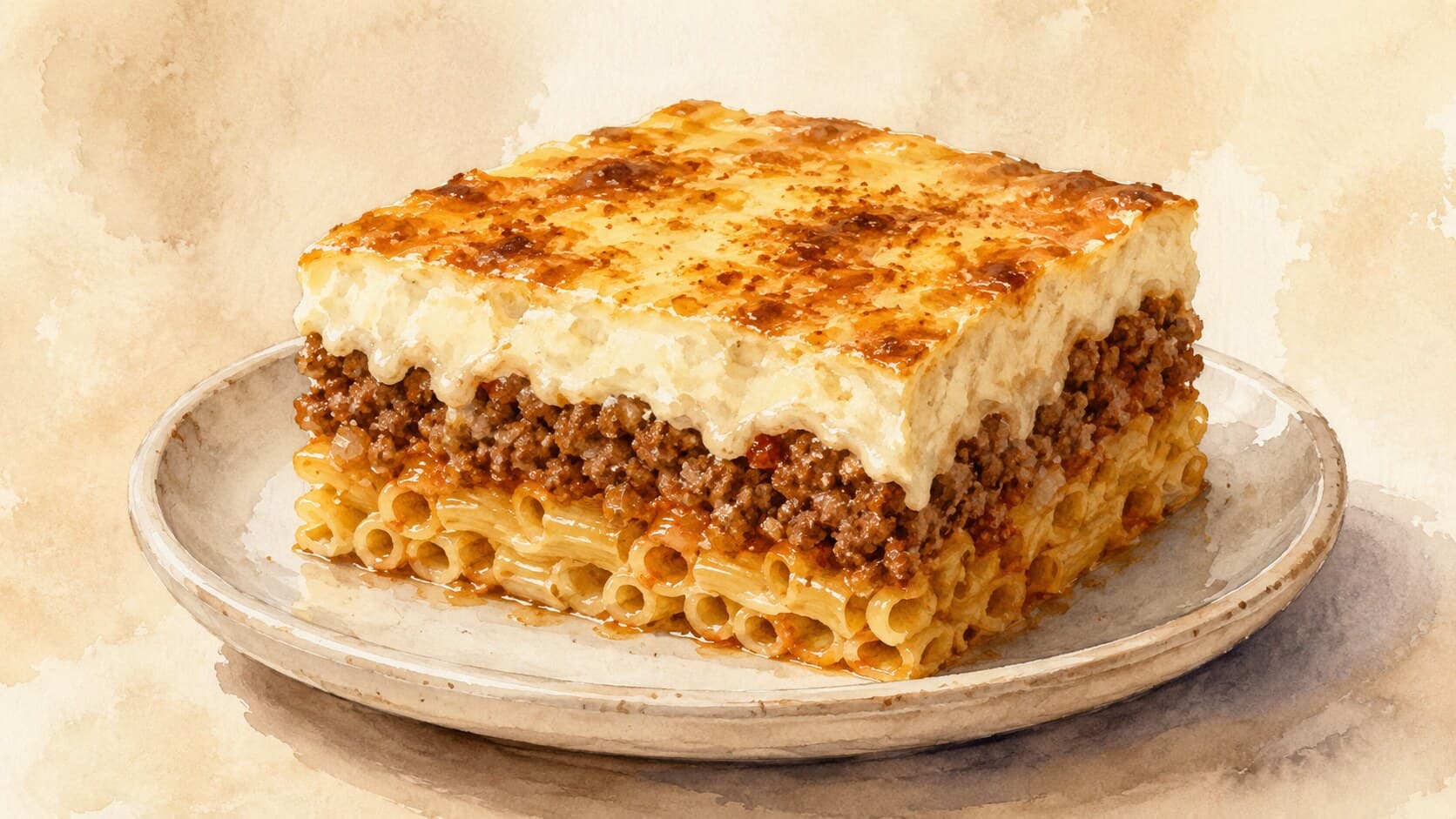
Pastitsio is a Greek baked pasta dish with layers of spiced lamb ragù, tubular pasta, and a creamy béchamel sauce on top.
Contents (5 sections)▾
Ingredients
- 400 g pasta tubes
- 500 g ground lamb
- 1 onion, diced
- 2 cloves garlic, minced
- 1 can (400 g) crushed tomatoes
- 2 tbsp tomato paste
- 1 tsp cinnamon
- 1 tsp allspice
- 1 tsp oregano
- Salt to taste
- Black pepper to taste
- 50 ml olive oil
- 500 ml whole milk
- 50 g unsalted butter
- 50 g all-purpose flour
- 2 large eggs
- 100 g grated Parmesan cheese
Steps
Preheat your oven to 180°C (350°F). This ensures even cooking and helps achieve a beautiful golden top on the bechamel.
In a large skillet, heat olive oil over medium heat. Add diced onion and garlic, sauté until softened, about 5 minutes.
Add ground lamb to the skillet, breaking it apart with a spatula. Cook until browned, around 7-10 minutes.
Stir in crushed tomatoes, tomato paste, cinnamon, allspice, oregano, salt, and pepper. Simmer for 20 minutes to develop flavors.
Meanwhile, cook pasta tubes according to package instructions until al dente. Drain and set aside.
Prepare the bechamel sauce by melting butter in a saucepan over medium heat. Whisk in flour and cook for 2 minutes until golden.
Gradually add milk to the roux, whisking constantly until thickened, about 5-7 minutes. Remove from heat and stir in eggs and Parmesan.
In a baking dish, layer half of the pasta, followed by the lamb ragù, and then the remaining pasta. Top with the bechamel sauce.
Bake in the preheated oven for 30 minutes or until the top is golden and bubbly. Let it rest for 10 minutes before serving.
Why this works
Pastitsio's layered structure provides a delightful mix of textures and flavors. The al dente pasta holds its shape while the spiced lamb ragù infuses the dish with warmth and depth. The bechamel, made with a roux and milk, creates a creamy topping that contrasts beautifully with the hearty filling. It's crucial to allow the bechamel to thicken adequately; if it seems too runny, continue cooking on low heat while whisking, allowing it to reach the right consistency. Baking the pastitsio ensures that the flavors meld together, and the top achieves a golden-brown crust. This method enhances the presentation and improves the overall taste, making each slice a satisfying experience.
Common mistakes
- Ground lamb (or beef) that isn't fully cooked through (food-safety BLOCK). Browning ground meat too fast leaves pink, undercooked pockets in the centre of clumps — and a 20-minute simmer doesn't always finish what searing started. Target: ground meat fully cooked, no pink visible, internal temperature about 70°C (160°F) before it goes into the layered bake. Why it matters: ground meat has surface bacteria distributed throughout (unlike a steak). The pastitsio bake at 180°C is too gentle to compensate for under-cooked ragù; the bechamel insulates the meat layer. What to do: break the meat into small pieces with a wooden spoon while browning so no pink lumps remain. Simmer for the full 20 minutes — that's not just for flavour development, it's the safety margin too. Test a spoonful from the centre of the pan before layering.
- A grainy or split bechamel (a French white sauce made by whisking milk into a butter-flour paste). Bechamel splits when the milk is added too cold to a hot roux (the cooked butter-and-flour paste that thickens the sauce), or when the eggs are added to a too-hot sauce — the egg proteins seize into curds instead of folding in smoothly. Target: a glossy, pourable sauce that coats the back of a spoon. The egg should make it richer, not lumpier. Why it matters: bechamel topping isn't just a topping; it's a custard-set crust that holds the whole bake together. A broken bechamel weeps, separates and slides off the ragù. What to do: warm the milk before adding it to the roux (cold milk shocks the flour); whisk constantly; remove from heat for at least 2 minutes before whisking in the beaten eggs and Parmesan, so the residual heat is below ~70°C — hot enough to enrich, not hot enough to scramble.
- Pasta that's already fully cooked when it goes into the bake. Pasta tubes still cook for 30+ minutes in the oven. Boiling them all the way to al dente first means they emerge from the bake mushy. Target: pasta drained 1–2 minutes BEFORE al dente (Italian for "to the tooth" — cooked just to firm-tender, with a slight bite at the centre), with the bake finishing the cook. Why it matters: pasta starch keeps gelatinising at any temperature above ~80°C, including the bake. A correctly under-cooked pasta arrives in the oven still firm and emerges with the perfect bite. What to do: cook pasta a couple of minutes shy of package time, drain, toss in a little olive oil to prevent sticking, and layer.
- Slicing straight from the oven. Cutting into a piping-hot pastitsio causes the bechamel layer to slide off the ragù and the pasta to collapse into a sloppy mess on the plate. Target: rest 10 minutes minimum before slicing, ideally 15. Why it matters: as the bake cools slightly, the egg proteins in the bechamel finish setting and the pasta starch firms up, holding the slice together. Hot out of the oven, that structure is still soft. What to do: pull the dish, set on the stovetop, and walk away for 10–15 minutes. The first slice should hold its layers cleanly.
What to look for
- A deeply golden, slightly puffed bechamel top — not pale, not just melted cheese, but a custard-baked crust with Maillard browning (the savoury dry-heat reaction between protein and sugars that produces roast-meat colour). Small surface cracks are a good sign.
- Pasta tubes still discrete in the slice — when you cut, the tubes should look like tubes, not collapsed strands. That tells you the pre-boil was correctly under-cooked.
- Three clear visible layers in cross-section — pasta base, deep-red spiced meat ragù in the middle, custard-set bechamel on top. Indistinct layers usually mean rushed assembly or no rest.
- Cinnamon and allspice aromatics that read warm, not sharp — the Greek "glykadia" spicing should feel like a quiet undertone, not a hit of pumpkin spice. If you can smell only cinnamon, you've over-spiced; back off next time.
A note on history
Pastitsio is the Greek-codified form of an older Italian Renaissance-era baked-pasta tradition, pasticcio di maccheroni, which travelled from the Grand Duchy of Ferrara into the Balkans and Greek-speaking territories during the Venetian occupation period (roughly 13th–18th centuries) (Wikipedia, Philosokitchen). The modern Greek version — tubular pasta, spiced ground-meat sauce and a bechamel top — was standardised in the early 20th century by the French-trained Greek chef Nikolaos Tselementes in his cookbook Odigos tes Mageirikis (1932), who replaced the older pastry crust with layered pasta and added the bechamel finish under French culinary influence (Aglaia's Table). Tselementes also gave moussaka its modern bechamel-topped form during the same period.
Get the essays in your inbox — free
Weekly notes on flavor, fermentation, and food history — the writing behind the Atlas of Flavor. No spam; unsubscribe anytime.