
Pastel de Choclo
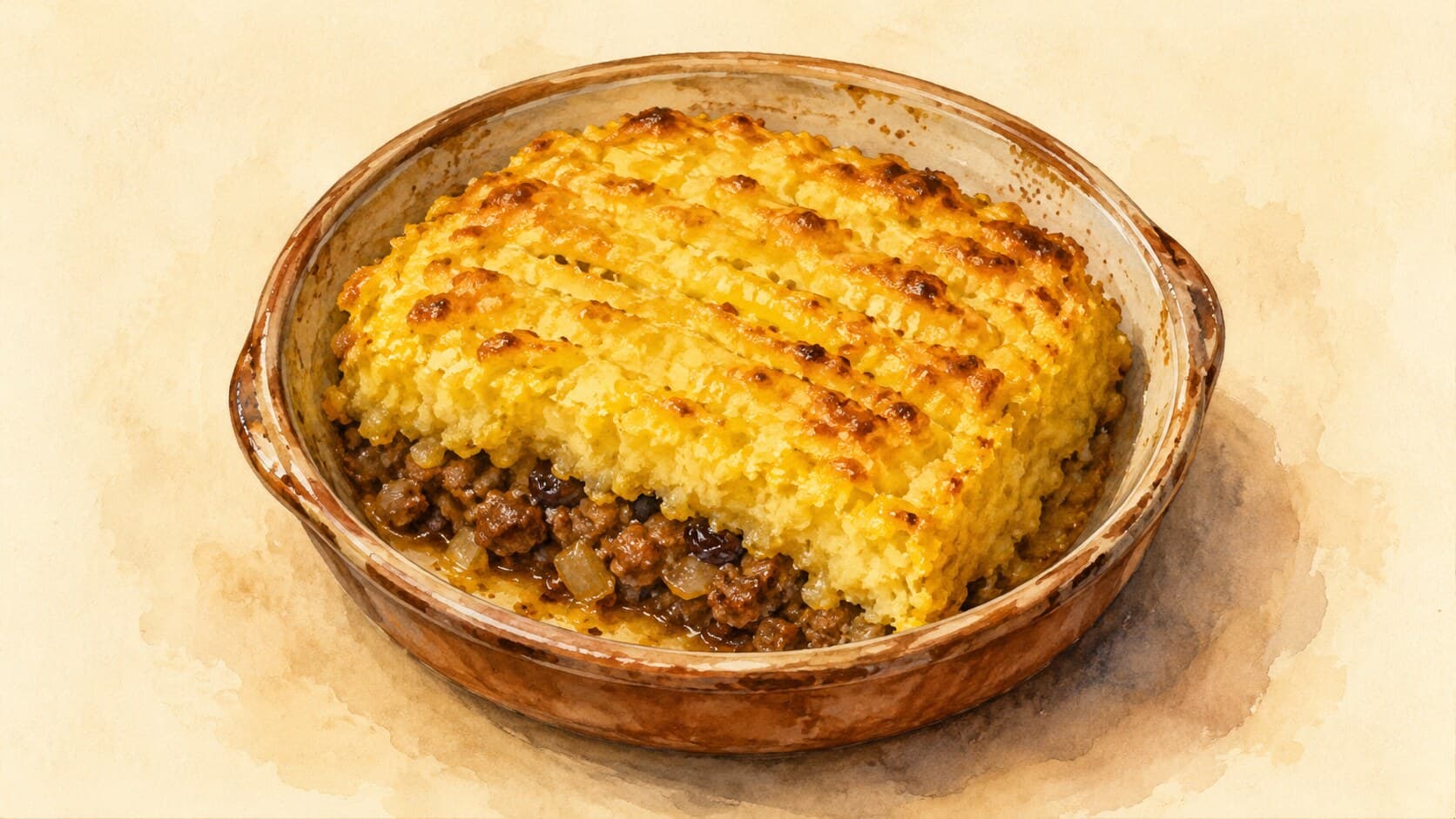
Pastel de Choclo is a Chilean baked corn casserole with layers of creamy corn purée and savory braised beef pino.
Contents (5 sections)▾
Ingredients
- 500 g beef, diced
- 2 onions, finely chopped
- 3 cloves garlic, minced
- 1 tbsp paprika
- 1 tsp cumin
- 200 ml beef broth
- 2 tbsp vegetable oil
- 400 g sweet corn, fresh or canned
- 100 ml milk
- 2 tbsp butter
- 1 tsp salt
- 1/2 tsp black pepper
- 2 tbsp sugar
- 2 eggs
Steps
In a large skillet, heat 2 tbsp of vegetable oil over medium heat. Add the diced beef and brown on all sides, about 10 minutes.
Add the chopped onions and garlic to the skillet. Sauté until the onions are translucent, about 5 minutes.
Stir in the paprika and cumin, then pour in the beef broth. Reduce heat to low, cover, and let it braise for 30 minutes.
While the beef is braising, combine the sweet corn, milk, butter, salt, black pepper, sugar, and eggs in a blender. Blend until smooth to create the corn purée.
Preheat the oven to 180°C (350°F). Once the beef is tender, transfer it to a greased earthenware dish, spreading it evenly.
Pour the corn purée over the beef, smoothing the top with a spatula. Bake for 30 minutes or until the corn topping is golden brown.
Remove from the oven and let the dish cool for 10 minutes before serving. This resting time helps the ingredients set.
Why this works
The technique of braising the beef ensures it becomes tender while absorbing the flavors of the spices and onion, forming a robust base for the casserole. The sweet corn purée, blended until smooth, creates a creamy layer that contrasts with the savory filling beneath. The addition of sugar balances the dish, enhancing the natural sweetness of the corn. Baking allows the top to develop a golden crust, which adds texture. If the corn purée seems too thick, you can add a little more milk to achieve the desired consistency. Alternatively, if it breaks or separates during blending, simply re-blend it with a splash of milk to restore its creamy nature.
Common mistakes
- Beef pino that's still pink or undercooked in the centre (food-safety BLOCK). Diced or ground beef (pino is the Chilean name for the seasoned meat-and-onion filling used in empanadas and this pie) can look browned on the outside while bits at the centre are still raw, especially in a deep pan layered with onions on top. Target: every piece of beef fully cooked through — no pink, internal temperature about 70°C (160°F) or higher BEFORE the pie goes into the oven. Why it matters: ground or diced beef has surface bacteria distributed throughout the mass (unlike a steak, where bacteria stay on the outside). It needs a true through-cook to be safe, and the brief oven bake at 180°C isn't enough to compensate for an under-cooked starting filling. What to do: brown the beef in a wide pan in a single layer (don't crowd), give it 10 full minutes including the braise, and check by cutting open a thicker piece. If you used chicken pieces in your pino (some traditional versions do), poultry must reach about 74°C (165°F).
- A grainy, weeping corn purée. Raw corn blended with egg goes into the oven; if you over-process or pour it onto a hot filling too quickly, it can split — the starch and protein matrix separates from the water, leaving a watery puddle and a grainy crust. Target: a smooth, glossy, pourable purée that holds its line on top of the beef without immediately sinking. Why it matters: corn purée thickens through egg coagulation and starch gelatinisation as it bakes. If the egg has been over-beaten or the purée is poured onto food that's piping hot, the egg sets unevenly and you get a broken topping. What to do: pulse the corn rather than blend on high, fold the egg in gently at the end, and let the braised beef cool for 5 minutes before pouring the purée over.
- Forgetting that hard-boiled eggs and olives need to be fully set/safe. Traditional pastel de choclo often includes slices of hard-boiled egg and black olives over the pino. Soft-set yolks here are NOT the right choice. Target: hard-boiled eggs cooked fully through (yolk fully set), olives drained from brine. Why it matters: the dish bakes only briefly. If the eggs go in soft-cooked, they don't pasteurise during the bake, and a sliced soft yolk in a baked pie is a food-safety risk. What to do: boil eggs 10 full minutes from a cold start, cool, peel, slice. Use pitted olives and pat them dry so they don't bleed brine into the corn topping.
- Skipping the rest after baking. Slicing immediately collapses the layers — corn topping slides off the pino, juices flood the plate, and the architecture you worked for is lost. Target: 10-minute rest before serving so the egg-set corn topping firms up and the pino juices reabsorb. Why it matters: as the dish cools slightly, the egg proteins in the corn purée finish setting, locking the layers in place. Straight out of the oven, that matrix is still soft. What to do: pull the pie out, let it rest on the stovetop uncovered for 10 minutes, then slice. The first cut should hold its shape.
What to look for
- A bronzed, slightly cracked corn top — not pale yellow, but a deep gold with Maillard browning (the savoury reaction between corn proteins/sugars and dry oven heat) and small surface cracks where the egg-set topping has firmed.
- A visible layer line in the cut piece — savoury beef pino on the bottom, hard-egg and olive layer in the middle, golden corn topping on top, all distinct.
- A soft sweet-savoury aroma — corn caramelisation should hit the nose first, with cumin and onion underneath. No raw-corn smell, no scorched note.
- Juices that stay around the pino, not flooding the plate — the cooled-and-set version slices cleanly; a soupy pool means it was either under-baked or not rested.
A note on history
Pastel de choclo is a textbook case of culinary fusion. The base is Mapuche (the largest indigenous nation of southern Chile and Argentina) — the indigenous people of southern Chile cultivated choclo (large-kernel starchy corn) and used it in dishes like humitas (steamed corn-husk parcels of fresh-corn dough, similar to Mexican tamales) long before European contact. The pino filling — diced or ground beef with onions and spices, often including chicken pieces, hard-boiled egg and olives — reflects Spanish colonial introductions (Teck, Amigo Foods). The earliest documented mention comes from French botanist Claudio Gay, who described a Chilean meat pie covered with sugared, ground corn in the 1830s. The dish rose to broad national prominence during the late-19th-century population boom in Santiago, when rural cooks brought it into the urban food landscape (Eating Chile).
Get the essays in your inbox — free
Weekly notes on flavor, fermentation, and food history — the writing behind the Atlas of Flavor. No spam; unsubscribe anytime.