
Oeufs Florentine
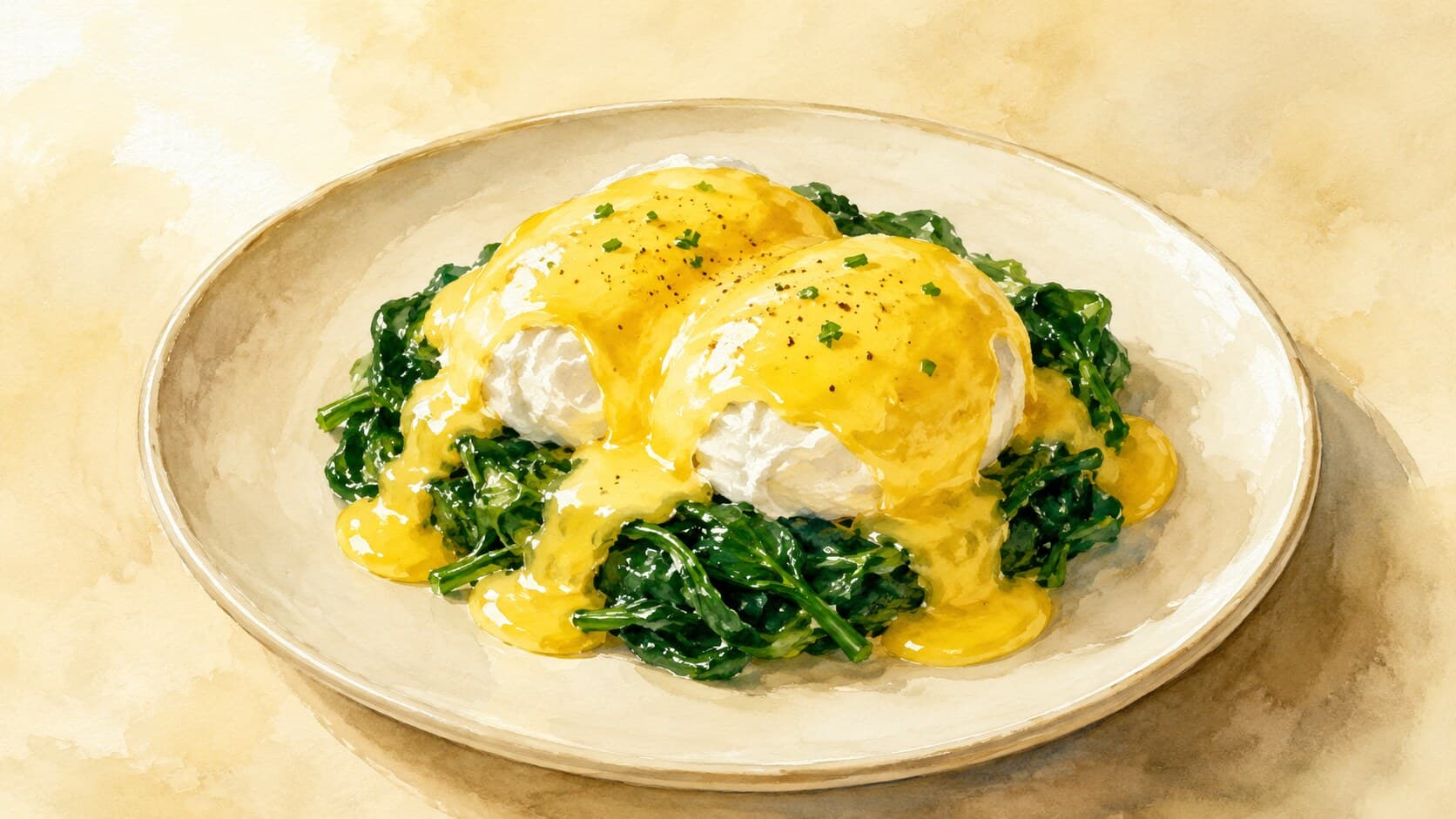
Oeufs Florentine features poached eggs atop buttery spinach, finished with a rich sauce for a delightful brunch.
Contents (5 sections)▾
Ingredients
- 2 large eggs
- 150 g fresh spinach
- 30 g unsalted butter
- 50 ml Mornay sauce or Hollandaise sauce
- Salt to taste
- Black pepper to taste
- 1 tsp grated Parmesan cheese
Steps
In a saucepan, melt 30 g of butter over medium heat. Add 150 g of spinach, season with salt and pepper, and cook until just wilted, about 2-3 minutes.
While the spinach cooks, bring a pot of water to a gentle simmer. Crack 2 large eggs into individual bowls.
Carefully slide the eggs into the simmering water and poach. With ordinary (non-pasteurized) eggs, poach until both the whites and the yolks are fully set (no longer runny) — that is the safe endpoint. For the classic runny yolk, use eggs pasteurized in the shell (through to the contents) — for everyone, not only high-risk diners; poach about 4–5 minutes.
Using a slotted spoon, remove the poached eggs and place them on a bed of wilted spinach in a shallow dish.
Preheat the broiler while you nap the poached eggs with 50 ml of Mornay or Hollandaise sauce.
Sprinkle grated Parmesan cheese on top and place the dish under the broiler for 1-2 minutes until the sauce is lightly browned.
Serve immediately while warm, garnished with additional black pepper if desired.
Why this works
The success of Oeufs Florentine lies in the gentle cooking techniques employed, particularly the poaching (cooking shell-less eggs by sliding them into barely-simmering water until the white sets) of the eggs and the preparation of the spinach. Poaching the eggs in a simmering water bath allows for a delicate setting of the whites while keeping the yolks perfectly runny, which creates a luxurious texture when broken. The addition of Mornay (a classic French béchamel — milk-thickened-with-butter-and-flour — enriched with cheese) or Hollandaise (a warm emulsion sauce of butter beaten into egg yolk with lemon) sauce enriches the dish with a creamy consistency that complements the sautéed spinach. If the eggs seem to break apart during poaching, adding a splash of vinegar to the water can help the whites coagulate more quickly. Additionally, ensuring not to overcrowd the pot while poaching maintains even cooking. The brief glazing under the broiler adds a delightful golden finish to the sauce, enhancing both flavor and visual appeal. Combining these elements ensures a sophisticated yet approachable dish that improves any brunch experience, showcasing classic French techniques.
Safety note. The canonical medium-poach yields whites that are set and yolks that are still creamy and just-flowing — a just-flowing yolk is undercooked egg with no validated Salmonella kill step. To keep it soft, use an egg pasteurized in the shell (through to the contents); otherwise poach through to a fully-set yolk. High-risk diners (pregnancy, immunocompromised, very young or old) should use a pasteurized egg, or poach the eggs through to fully-set yolks — extend the poaching time to 5 minutes or finish them under the broiler until firm.
Common mistakes
-
Lifting the eggs while the whites are still glassy and translucent. Target: Whites fully opaque, no glassy raw bands; yolks at minimum just-set on the outside. For vulnerable diners (pregnant, immunocompromised, very young or elderly), cook the yolk fully through (firm to gentle press, no liquid center) — at least 5 minutes poaching, or finish under the broiler until set. Why it matters: Glassy whites are still raw and can carry Salmonella; for non-vulnerable adults, a just-flowing yolk is the canonical French texture, but a raw yolk in a glassy white is undercooked, not "soft." Egg-coagulation (the proteins denaturing into a solid network) needs both enough heat and enough time — pulling early skips this. What to do: Hold the poached egg on a slotted spoon and look — every part of the white should be opaque. If you see a translucent band, lower it back into the water for another 30-60 seconds. When in doubt, cook longer.
-
Boiling the poaching water hard, which tears the egg apart. Target: A gentle simmer — small bubbles at the bottom, the surface barely trembling, around 80-85°C / 176-185°F. Why it matters: Hard-boiling water mechanically rips the egg apart before the white has time to set around the yolk. A bare simmer lets the white coagulate into a clean teardrop shape. A teaspoon of vinegar in the water lowers the protein-coagulation threshold slightly so the egg sets faster — useful for tired or older eggs whose whites are loose. What to do: Get the water to a rolling boil, then drop the heat until it just shimmers. Slide each egg in from a small bowl near the water's surface.
-
Holding the hollandaise (if used) at hot temperatures, or saving it for later in the day. Target: Hollandaise sits over warm — not hot — water (around 50-55°C / 122-131°F) for service, and is used within a few hours of making. Refrigerate any leftovers within 2 hours; if you reheat, do not let the temperature push past the gentle-warm range. Why it matters: Hollandaise is an egg-yolk-based emulsion (butter dispersed in a yolk-acid base, held together by the yolk's lecithin). At room temperature it's both a perfect bacterial habitat and prone to breaking when too cold or too hot. Heat past about 65°C / 149°F scrambles the yolk and breaks the sauce. What to do: Make it close to service. Hold gently. Don't try to "reheat" it on direct heat — refrigerate leftovers, use within hours, and discard if anything looks or smells off.
-
Drowning the spinach in butter and seasoning it like a finished dish. Target: Spinach just wilted — leaves collapsed, color still bright green — drained of free water, lightly salted. Why it matters: Spinach holds a lot of water (released as cells rupture during heating). If you don't drain it, the water leaches under the sauce and the dish puddles. Over-salting before draining concentrates the salt in the runoff, which is bitter. What to do: Wilt in butter, then tip into a strainer and press gently. Salt at the end, after the press.
What to look for
- A poached egg in a clean teardrop shape, white fully opaque and just slightly ruffled at the edges — visible proof the simmer was gentle enough and the cook time was long enough.
- A gold sauce that coats the back of a spoon and leaves a clean line when you drag a finger through it — both Mornay and hollandaise should be glossy and pourable but not runny; if it slides off the spoon like water, the emulsion or roux needs more time.
- A faint golden-brown blistering on the sauce after the broiler, never deep brown or charred — the broiler is for finishing color, not cooking. Watch through the glass.
- Bright-green spinach under the egg, not olive-gray — the wilting window stops the moment the color stays bright; gray means it overcooked and lost its mineral freshness.
A note on history
The "Florentine" in oeufs florentine refers not to any Florentine origin but to the French naming convention of calling spinach-bedded dishes "à la florentine," after Catherine de' Medici. Catherine — born in Florence in 1519 and married to the future Henry II of France in 1533 — is said to have brought Florentine cooks and a particular fondness for spinach with her to Paris; over time, spinach-incorporated dishes inherited her city's name in French kitchen vocabulary (Tasting Table, CulinaryLore). The dish, in other words, is French — order oeufs alla fiorentina in modern Florence and you will be met with bewilderment.
Get the essays in your inbox — free
Weekly notes on flavor, fermentation, and food history — the writing behind the Atlas of Flavor. No spam; unsubscribe anytime.