
Niku-doufu (Beef and Tofu Simmer)
Niku-doufu is a Japanese dish of beef and tofu simmered in a broth, focusing on flavor extraction and protein tenderization.
Contents (5 sections)▾
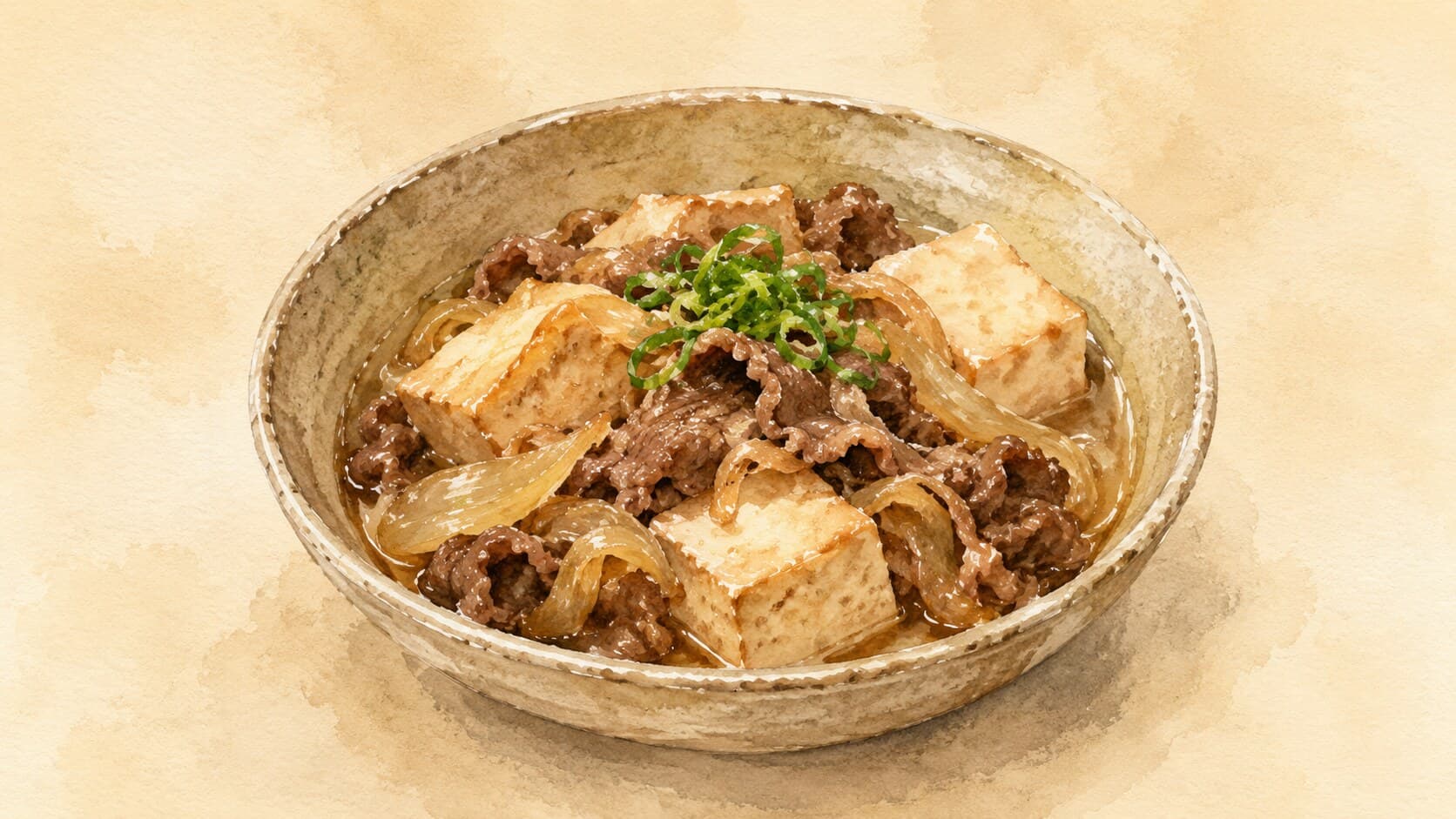
Ingredients
- 200 g beef (thinly sliced)
- 300 g firm tofu (cubed)
- 200 ml dashi (Japanese soup stock)
- 3 tbsp soy sauce
- 1 tbsp mirin
- 1 tbsp sake
- 2 scallions (sliced)
- 1 tsp sesame oil
- salt and pepper to taste
Steps
In a pot, heat the sesame oil over medium heat. Add the sliced beef and sauté until browned, about 3-4 minutes.
Pour in the dashi, soy sauce, mirin, and sake. Stir to combine and bring to a simmer over medium heat.
Carefully add the cubed tofu to the simmering broth. Allow it to cook for about 5 minutes, ensuring the tofu warms through without breaking apart.
Taste the broth and adjust seasoning with salt and pepper if necessary. Add the sliced scallions and simmer for an additional 2 minutes.
Serve hot, ensuring an even distribution of beef and tofu in each bowl.
Why this works
Niku-doufu achieves a harmonious balance of flavors through the combination of dashi (Japanese soup stock made from kombu and bonito flakes), soy sauce, and mirin (a sweet rice wine used to add gloss and gentle sweetness to Japanese cooking), which infuses the beef and tofu with a depth of umami (savory depth). The cooking technique of simmering is essential as it allows the flavors to meld without overcooking the ingredients. The key is to add the tofu gently to avoid breaking it apart; if it breaks, it may lose its texture and absorb too much liquid. By simmering for a short period, the tofu retains its shape while absorbing the savory broth, resulting in a satisfying meal. Adjusting seasoning is crucial; if the broth seems too salty, add a splash more dashi or water to balance it out. This dish is perfect for busy weeknights, as it comes together quickly and offers a comforting, hearty option that’s still light enough for a casual dinner.
Common mistakes
-
Pulling the beef while there's still pink in the slices. Target: Every slice fully cooked through — no pink. For whole-muscle slices, hold the broth above 63°C / 145°F long enough that the center turns opaque all the way through; aim for 75°C / 167°F at the thickest part to be safe in a home kitchen. If using ground beef instead of slices, cook to 71 °C / 160 °F throughout. Why it matters: Thinly sliced beef looks done in seconds, but the center can stay pink and underdone — and surface bacteria on raw beef live where the knife touched. Ground meat is even higher risk because surface bacteria get mixed throughout. Niku-doufu's gentle simmer is plenty for sliced beef to cook safely; the failure is pulling too early because the broth doesn't look like it's "really cooking." What to do: Watch the slice color, not the clock. Each slice should turn fully grey-brown across the cut surface before you trust it. If the broth ever stops simmering and just steams, raise the heat briefly.
-
Dumping cold tofu straight into hot broth and watching it crack and weep. Target: Tofu cut into even cubes (about 2.5-3 cm), drained briefly on paper towel, slid in gently when the broth is at a low simmer. Why it matters: Cold tofu shocked into hot broth contracts unevenly — the outside seizes, the inside expands, the structure cracks, and excess water leaks out and dilutes the seasoning. Gentle handling preserves the silky texture (protein-coagulation is fine, mechanical shattering is what we're avoiding). What to do: Let tofu sit at room temperature 10 minutes if straight from the fridge. Slide it in along the edge of the pan with the back of a spoon, not from a height.
-
Boiling the dashi hard to "speed it up." Target: Bare-to-low simmer the whole time (small bubbles at the edge only). Why it matters: A rolling boil drives off the aroma from dashi and turns the soy sauce sharp and salty. It also toughens the beef by overcooking the surface while the inside has barely warmed. What to do: Once the broth comes up, drop the heat. If you can't hear quiet bubbling, you're at the right temperature.
-
Over-seasoning before the tofu has had time to drink the broth. Target: Season normally at the start; let the tofu sit in the warm broth at least 5 minutes off heat before final taste-adjustment. Why it matters: Tofu absorbs slowly as it sits, and the broth shifts saltier as it reduces. Adjusting too early leads to "too salty" at the table. What to do: Cook, rest off heat, then taste and adjust at the very end — usually the answer is a splash of dashi or water, not more soy.
What to look for
- Beef slices that have turned uniformly grey-brown all the way through, the edges just curling — that's the safe doneness window; any remaining translucent pink at the center means more time.
- Tofu cubes that float gently, with a faint amber edge where they've started to drink the dashi — visual proof of seasoning penetration without structural breakdown.
- Broth that's clear and amber, with a layer of beef-fat droplets pooling on the surface — that fat ring is the dish's umami carrier, and a sign the simmer never got rough enough to emulsify it cloudy.
- A clean savory-sweet scent (soy, dashi, a hint of mirin) when you lift the lid — if you smell only "boiled," the heat went too high; if you smell only "raw soy," it needs another minute of marrying time.
A note on history
Niku-dōfu is a Kyoto local specialty whose roots are tangled with sukiyaki — most sources describe sukiyaki itself as having originated in Kyoto, with niku-dōfu sharing nearly the same building blocks (soy sauce, sake, mirin, sugar, beef, tofu, and traditionally Kyoto's kujō negi leek) but plated as a nimono (simmered dish) served in a bowl rather than cooked at the table (RecipeTin Japan, Food in Japan). It moved from a Kansai regional dish to a national home-cooking staple in the postwar period and is now standard weeknight food across Japan.
Get the essays in your inbox — free
Weekly notes on flavor, fermentation, and food history — the writing behind the Atlas of Flavor. No spam; unsubscribe anytime.