
Mushroom Polenta
Mushroom Polenta combines creamy cornmeal with sautéed mushrooms, focusing on umami extraction and texture layering for a rich Italian main dish.
Contents (5 sections)▾
Ingredients
- 200 g polenta
- 800 ml vegetable broth
- 150 g mixed mushrooms (such as porcini and cremini), sliced
- 2 tbsp olive oil
- 1 clove garlic, minced
- 50 g grated Parmesan cheese
- Salt to taste
- Black pepper to taste
- Fresh parsley, chopped for garnish
Steps
In a saucepan, bring the vegetable broth to a boil over medium heat. This ensures a quick cooking time for the polenta.
Gradually whisk in the polenta, reducing the heat to low. Stir continuously for about 5-7 minutes until it thickens. This prevents lumps and ensures a creamy texture.
In a separate skillet, heat the olive oil over medium heat. Add the minced garlic and sliced mushrooms, sautéing for about 5 minutes until the mushrooms are tender and golden.
Season the mushrooms with salt and black pepper, then stir in the grated Parmesan cheese. Allow it to melt slightly into the mixture.
Once the polenta is thick and creamy, remove it from heat and stir in additional cheese if desired. If it seems too thick, add a bit more broth to reach your preferred consistency.
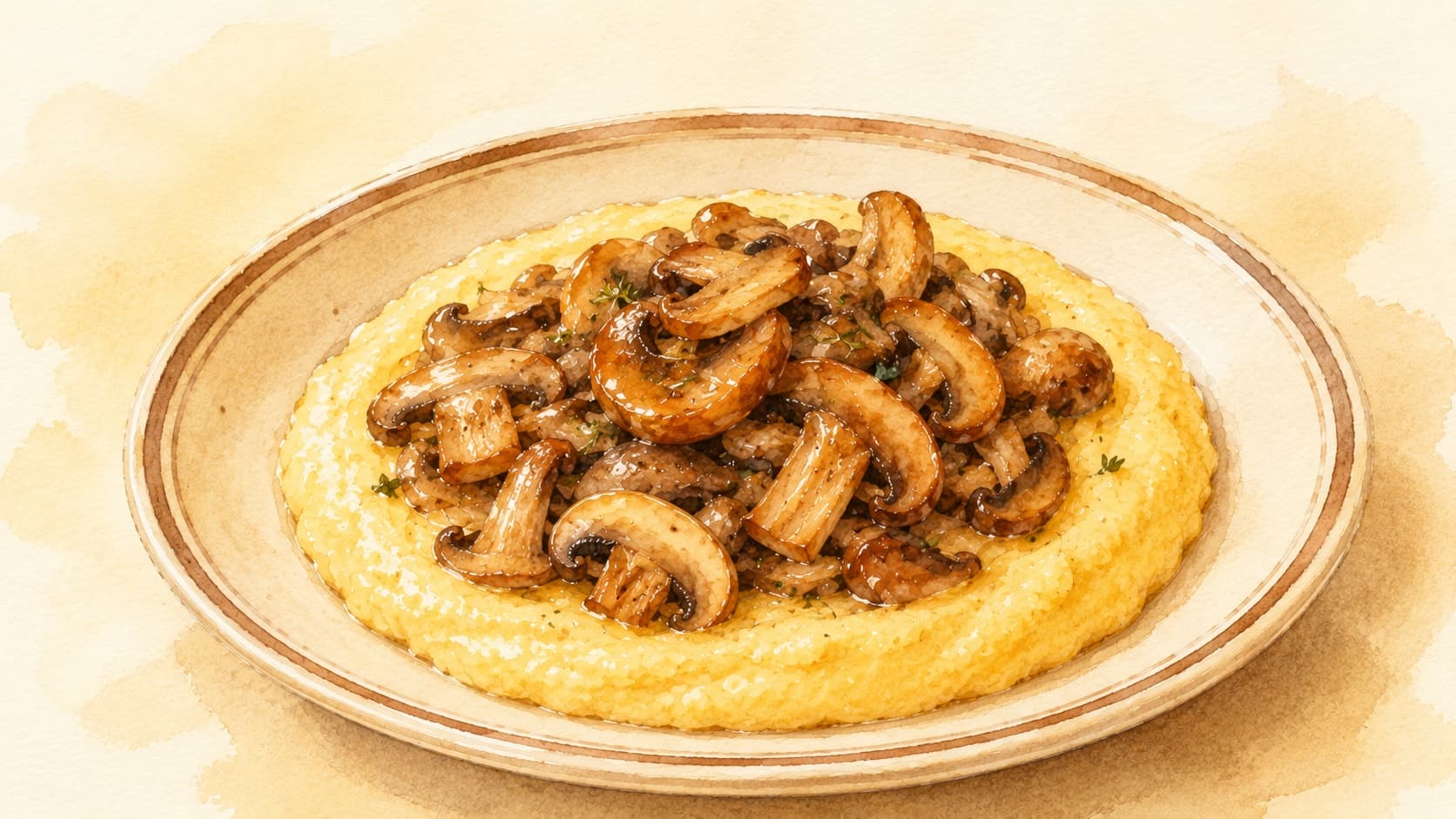
Serve the polenta in bowls, topped with the sautéed mushrooms and freshly chopped parsley for garnish.
Why this works
Mushroom Polenta is a dish that beautifully marries the creamy texture of polenta with the deep umami (the fifth basic taste — the savoury, mouth-filling quality found in mushrooms, aged cheese, soy sauce, and slow-cooked meat) flavors of sautéed (cooked quickly in a small amount of fat over fairly high heat) mushrooms. Polenta, made from ground cornmeal, requires careful attention to ensure it remains smooth and creamy. Stirring continuously while adding the polenta to boiling broth helps prevent lumps and promotes even cooking. The use of mixed mushrooms, particularly porcini, enhances the umami profile, making each bite rich and satisfying. If the polenta becomes too thick, simply stir in a little extra broth to achieve the desired creaminess. This adaptability ensures that the dish meets personal preference without compromising on flavor. Additionally, sautéing the mushrooms with garlic in olive oil adds depth and creates a fragrant base that complements the dish perfectly. The inclusion of Parmesan cheese adds a salty, savory finish, making this dish a true comfort food. Whether served as a main course or a side, Mushroom Polenta is a versatile and delicious choice that highlights the essence of Italian cuisine.
Common mistakes
Dumping the polenta into the broth all at once. Target: broth at a gentle bubble, polenta added in a thin steady stream while whisking — the rain not the dump. Why it matters: polenta is coarsely ground cornmeal; each granule needs a moment of contact with hot water to hydrate before its neighbour does. Dumped all at once, the outer granules gelatinise (their starch swelling and locking up) into a paste that traps the inner ones dry — that is the lump core you find in the middle of an otherwise smooth pan. What to do: keep one hand whisking the broth in a slow vortex while the other pours polenta in a thin rain. Once everything is in, drop the heat to a slow blup-blup and switch to a wooden spoon.
Cooking polenta on too-high a heat (and walking away). Target: lowest steady simmer the pan will hold, stirred every minute or two for the full 35–45 minutes a true polenta wants — even though many quick recipes say 5 minutes. Why it matters: corn starch needs sustained heat plus moisture to fully gelatinise. Five minutes gives you raw-tasting, gritty polenta; high heat with a quick stir scorches the bottom layer (a burnt taste that travels through the entire pot) before the starch finishes cooking. Stirring also keeps a skin from forming and trapping steam pockets that blow open like tiny craters. What to do: give it time on low. If the surface goes silent and stops bubbling, stir from the very bottom of the pan to dislodge anything starting to catch. Add hot water (not cold) by ladles to keep it spoonable.
Killing the mushrooms by crowding the pan. Target: a single sizzling layer, mushrooms golden at the edges and still smelling savoury — not stewed grey discs. Why it matters: mushrooms are ~90% water. In a crowded pan, that water can't escape as steam, so the temperature drops below the Maillard browning range (~150 °C / 300 °F). You get boiled-tasting mushrooms with a flat, dull aroma instead of the toasty, deeply umami brown ones that make this dish. What to do: cook in two batches if needed. Wait until the sizzle quietens and the underside is bronze before you stir, then let the other side colour. Salt only at the end — early salt pulls water out and slows browning.
Adding cheese while the pan is on a roaring boil. Target: off the heat or on the lowest flame, cheese stirred in until just melted. Why it matters: Parmesan is high in protein and fat. On a hard boil, the casein (cheese-protein) network tightens and squeezes out the fat — instead of a creamy, glossy polenta you get oil pools and grainy curds. The same physics that breaks a Mornay sauce breaks polenta finishing cheese. What to do: pull the pot off direct heat, wait 30 seconds, then stir cheese in handful by handful. If it tightens up, splash in a ladle of hot broth and stir back to silk.
What to look for
- A slow pull when you drag the spoon across the bottom, leaving a brief clean track — that is properly gelatinised polenta. If the track fills in instantly, it needs more water and time; if the spoon stands on its own, it needs more liquid right now.
- Mushrooms with bronze edges and a quiet smell of toast and forest, not steam — the Maillard browning that defines the topping. Grey, beady, and damp means crowded pan; cook the next round in a hotter, drier setup.
- A glossy sheen on the surface of the finished polenta, not a fatty slick — that is the cheese still emulsified. Visible oil pools are the warning that the pot was too hot when the Parmesan went in.
- Smell of sweet cooked corn and savoury cheese rind, no scorched undertone — the test for "stirred from the bottom often enough." A single waft of burnt cereal means the bottom layer caught; serve the upper polenta and don't scrape the pan.
A note on history
Polenta has a much longer history than corn itself. The Romans ate a grain mush called puls or pulmentum made from farro, millet, chestnut flour, spelt or chickpeas — the direct ancestor of today's polenta. The yellow polenta we now picture arrived only after the Columbian Exchange brought maize from the Americas to Europe in the 16th century; farmers in Veneto, Lombardy and Friuli adopted the new high-yield crop quickly, and by the 17th century cornmeal polenta had become the staple working-class food of Northern Italy (Wikipedia: Polenta; DeLallo: All About Polenta).
Get the essays in your inbox — free
Weekly notes on flavor, fermentation, and food history — the writing behind the Atlas of Flavor. No spam; unsubscribe anytime.