
Mornay Sauce
Mornay sauce is a béchamel-based sauce thickened with cheese, used to add creaminess and flavor to various dishes.
Contents (5 sections)▾
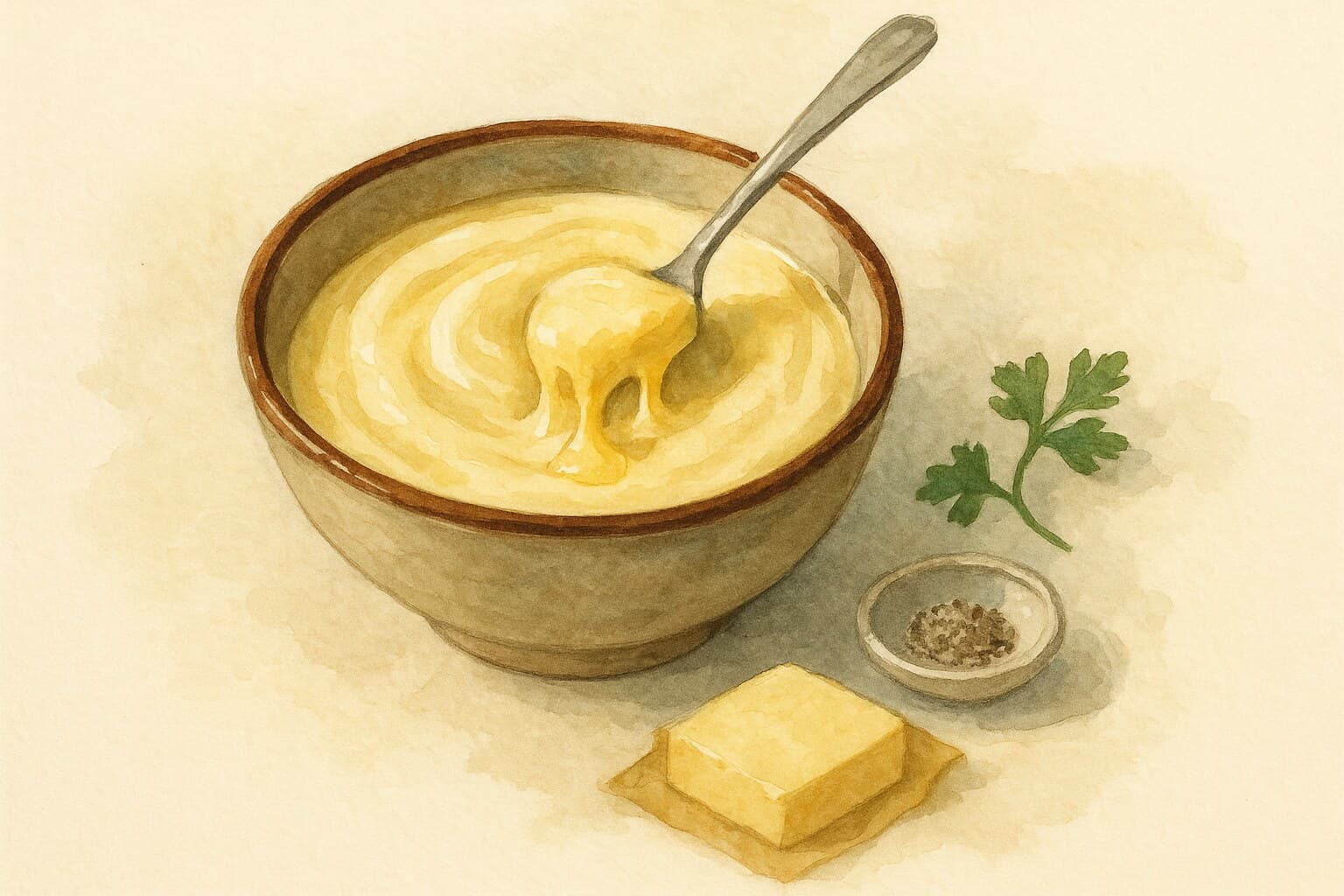
Ingredients
- 50 g unsalted butter
- 50 g all-purpose flour
- 500 ml whole milk
- 100 g Gruyère cheese, grated
- 50 g Parmesan cheese, grated
- Salt, to taste
- White pepper, to taste
- A pinch of nutmeg, freshly grated
Steps
In a saucepan, melt the butter over medium heat (about 2-3 minutes), stirring to prevent burning.
Add the flour to the melted butter and whisk continuously for about 2 minutes to create a roux; this helps eliminate the raw flour taste.
Gradually pour in the milk while whisking to avoid lumps. Continue stirring until the mixture thickens, about 5-7 minutes.
Remove from heat and stir in the Gruyère and Parmesan cheese until melted and smooth; this adds depth of flavor.
Season with salt, white pepper, and nutmeg. If the sauce is too thick, add a bit more milk to reach the desired consistency.
Why this works
Mornay sauce, a classic in French cuisine, relies on the technique of creating a roux (equal parts butter and flour cooked together as the thickening base for many classic sauces) to thicken the mixture, which ensures a smooth texture. The combination of Gruyère and Parmesan adds richness and complex flavor to the sauce. The gradual addition of milk helps prevent lumps, creating a silky finish. If the sauce breaks (when the fat splits out of the smooth mixture and leaves a grainy, oily look) or becomes too thick, simply whisk in a little extra warm milk to restore its creamy consistency. This sauce is versatile, perfect for pasta, vegetables, or as a base for gratins, showcasing the importance of technique in achieving a gourmet touch in everyday cooking.
Common mistakes
Adding cheese while the pan is still on direct heat. Target: off the heat, sauce around 70–75 °C (160–170 °F), grated cheese stirred in handful by handful. Why it matters: Gruyère and Parmesan are cheeses high in protein and fat. Push them past about 82 °C (180 °F) and the casein (milk-protein) network tightens, squeezing out fat — the sauce splits into a grainy slick and a curdled lump (a broken emulsion). The béchamel base only carries the cheese; it cannot rescue cheese cooked too hot. What to do: pull the pan off the heat the moment the béchamel coats the back of a spoon. Add cheese in small fistfuls, whisking each one in before the next. If it does break, splash in a few tablespoons of warm milk off the heat and whisk hard to re-emulsify.
Skipping the roux cook (the white-flour taste at the back of the tongue). Target: 2 full minutes of butter-and-flour cooking at medium heat before any milk goes in. Why it matters: flour starch needs heat to gelatinise and to drive off the raw cereal note. Under-cooked roux leaves a chalky, slightly bitter finish that no amount of cheese will hide. Over-cook it (brown) and you lose the thickening power because the starch chains break. What to do: keep it pale-blond, foamy, smelling like buttery shortbread — not toast. Then pour milk in three additions, whisking smooth between each.
Pouring cold milk into hot roux all at once (lump nest). Target: milk warm or room-temperature, added in three or four stages. Why it matters: cold milk shocks the roux; starch granules clump together before they can hydrate evenly, and you get the classic lump-island sauce that no whisk will fully save. What to do: warm the milk first (it does not need to simmer — a minute in the saucepan or microwave is enough). Add the first third, whisk to a thick paste, then loosen with the rest.
Reheating leftovers like a normal sauce. Target: gentle reheat to no hotter than ~70 °C (160 °F), and use within ~2 days from the fridge. Why it matters: Mornay is dairy- and protein-rich; it spoils faster than a tomato sauce and re-splits easily on a hard reheat. A scorched, separated sauce on day three is a kitchen-safety warning, not a flavour problem. What to do: refrigerate within 1 hour of cooking in a shallow container. Reheat low and slow with a splash of milk, whisking — never on a hard boil.
What to look for
- A pale-blond, faintly nutty smell rising off the roux — that is the raw-flour aroma cooking out. If the roux still smells of dry flour or paste, give it another 30 seconds before any milk.
- A coating consistency on the back of a spoon, with a slow finger-streak that holds — the classic "nappe" stage (sauce thick enough to "coat" cleanly). This is when the béchamel is ready for the cheese, not before.
- A silky surface with a glossy, almost-stretchy pull when you lift the whisk — that is intact emulsion. A dull or grainy surface, or beads of fat floating on top, means the cheese went in too hot.
- A smell that reads "warm butter and toasted cheese rind," not "boiled milk" — Mornay should smell rich but not flat. A flat boiled-milk note usually means the sauce sat over heat too long after the cheese went in.
A note on history
Despite the noble name, Mornay sauce as we know it is not a 16th-century creation. The dish first appears, by most accounts, in 19th-century Paris — likely at the famous restaurant Le Grand Véfour — long after béchamel itself had been codified, because a cheese sauce in the time of the 16th-century French diplomat Philippe de Mornay would have been built on a velouté base. The name's link to the duc de Mornay is therefore symbolic rather than literal: a 19th-century homage rather than a 16th-century recipe (Wikipedia: Mornay sauce).
Get the essays in your inbox — free
Weekly notes on flavor, fermentation, and food history — the writing behind the Atlas of Flavor. No spam; unsubscribe anytime.