
Moo Ping
Delight in the smoky, sweet, and savory flavors of Thai Moo Ping, grilled pork skewers marinated in a rich coconut milk blend.
Contents (5 sections)▾
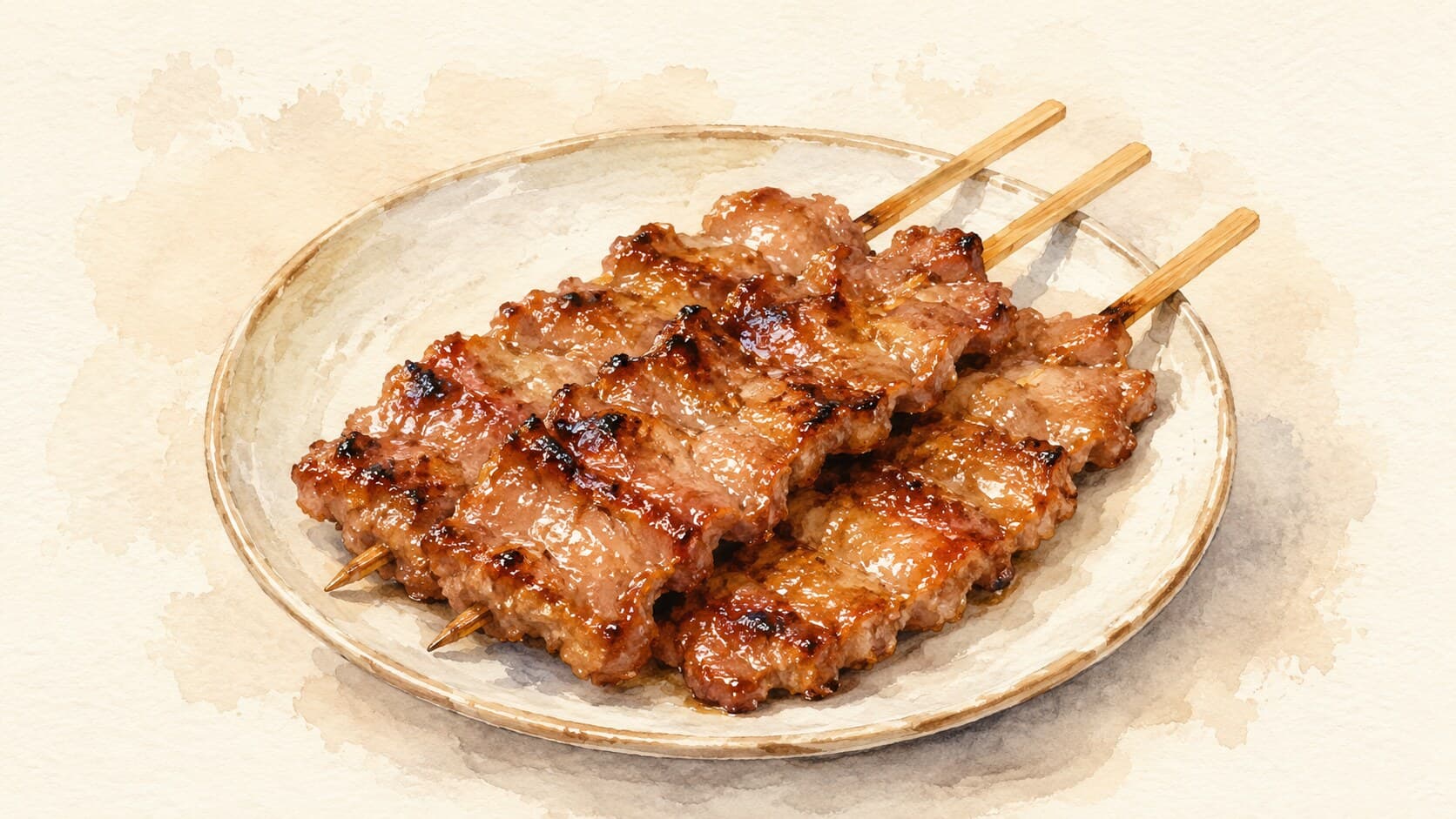
Ingredients
- 800 g pork shoulder, cut into 2 cm cubes
- 200 ml coconut milk
- 4 cloves garlic, minced
- 3 sprigs coriander root, chopped
- 50 ml fish sauce
- 50 g palm sugar
- skewers, soaked in water for 30 minutes
Steps
In a bowl, combine coconut milk, garlic, coriander root, fish sauce, and palm sugar to create a marinade. Mix well until sugar dissolves. Marinate pork cubes for at least 2 hours or overnight for better flavor.
Preheat your grill to medium heat (around 200°C). While the grill heats, thread the marinated pork onto the soaked skewers, ensuring even spacing for proper cooking.
Grill the skewers for about 10-12 minutes, turning occasionally, until the edges are caramelized and the pork is cooked through. The sugar in the marinade will help create a delicious crust.
Remove skewers from the grill and let them rest for a few minutes before serving, so they come off their peak heat before you bite in.
Why this works
Moo Ping is a classic Thai dish that showcases the art of marinating (soaking food in a seasoned liquid so it absorbs flavor and softens) and grilling. The combination of coconut milk, garlic, coriander root, fish sauce, and palm sugar creates a unique marinade that infuses the pork with flavors while also tenderizing the meat. Coconut milk adds richness, while palm sugar caramelizes (heats until its sugars turn glossy brown and sweet-bitter) during grilling, creating those enticing mahogany edges. If the pork seems too dry after grilling, it might be slightly overcooked; ensure the grill temperature is not too high, and keep an eye on the cooking time. Proper moisture retention can also be aided by allowing the skewers to rest before serving, which helps maintain juiciness. This technique ensures deliciously tender skewers and teaches the skill of caramelization, a crucial element in making many Thai dishes.
Common mistakes
Confusing char outside for cooked-through inside. Target: pork fully cooked through, no pink, internal temperature 74°C / 165°F at the thickest point, juice runs clear. Cut a thick cube to check before serving the rest. Why it matters: Moo ping is sweet from palm sugar and marinated in coconut milk — both promote fast surface browning over charcoal. The outside can darken to mahogany within 4–5 minutes while the center of a 2-cm cube is still well below safe temperature, especially if the heat is too high or the cubes were cut unevenly. Pork has to reach 74°C in the center to be safe; visual char is not the same as doneness. What to do: Cut pork into evenly-sized 2-cm cubes (not larger), grill over medium heat — not screaming-hot — and turn every 2–3 minutes so all four faces brown evenly. After 10–12 minutes, lift one skewer and cut a thick cube in half: the meat should be uniformly pale-pink-to-white throughout with clear (not pink) juice, and any thermometer reading should hit 74°C / 165°F. If the surface is darkening too fast, move the skewers to a cooler part of the grill to finish cooking through.
Skipping the marinade soak. Target: at least 2 hours, ideally overnight, refrigerated. Why it matters: The marinade is not just for flavor — the coconut milk's fat coats the muscle fibers and slows moisture loss during grilling, while the fish sauce contributes salt that draws moisture in via osmosis before pulling it back out as a flavored brine. Palm sugar provides the sugar that caramelizes (becomes the glossy mahogany crust) on the surface during cooking. A 20-minute marinade gives you skewers with bright surface color but dry, bland centers because the seasoning never penetrated. What to do: Mix the marinade until the palm sugar fully dissolves (palm sugar resists dissolving cold; warm it gently or whisk vigorously). Submerge the pork cubes completely, cover, and refrigerate at least 2 hours. Overnight is better. Never marinate at room temperature for more than 30 minutes — past that, you are in the bacterial-growth zone.
Soaking bamboo skewers for too short a time. Target: submerged in cold water 30 minutes minimum, ideally 1 hour. Why it matters: A dry bamboo skewer ignites in direct flame within 2–3 minutes. Once the wood catches fire, it splits, the meat falls off, and the splinters that fall into the coals can introduce char-flavored smoke that overwhelms the pork. Wet wood resists burning long enough for the meat to finish cooking. What to do: Start soaking skewers when you start the marinade. Weight them down so they stay fully submerged. Pat dry with a paper towel right before threading — too-wet skewers are slippery to grip.
Threading the cubes too tightly together. Target: small gap (about 5 mm) between each cube on the skewer. Why it matters: Cubes pressed flush against each other touch on their inner faces, and those faces never see the heat — you end up with cubes that are charred on the outside but the inner edges are still raw, even after the rest of the skewer is done. Spaced cubes brown evenly on every face. What to do: Slide each cube on, then push the next one to leave a 5-mm gap. Aim for 4–5 cubes per skewer rather than packing in 7–8. The longer the gap, the more juice you'll lose; the smaller the gap, the more raw inner faces.
What to look for
- A mahogany-brown crust with no black blisters. Properly grilled moo ping has a glossy, deep-brown surface from caramelized palm sugar — not the matte black of charcoal. Black blisters mean direct flame contact and burned sugar; mahogany means caramelization. If you see blisters, move the skewers further from the coals.
- Juice that runs clear when you cut. Slice a cube in half mid-grill: the juice that beads up should be clear or slightly amber, not pink. Pink juice means another 2–3 minutes are needed. Clear juice with the meat showing no pink anywhere means doneness has been reached.
- Skewers that pick up cleanly when you lift them. When done, the skewers should release from the grill grate without sticking. If they cling and tear when you try to lift them, either the grate was not hot enough at the start (a hot grate sears the surface and prevents sticking) or the marinade has dripped onto the grate and burned into glue.
- A perfumed, sweet smoke when grilling — not acrid. The smoke should smell like roasting pork and warm caramel. A sharp acrid smell means palm sugar is dripping onto the coals and burning; reduce the heat or move the skewers slightly off the direct line of the coals.
A note on history
Moo ping ("ping" = grilled, "moo" = pork) is one of Thailand's most ubiquitous street-food snacks, especially in central Thailand. The form gained nationwide popularity in the 1950s as street-vendor carts spread through Bangkok and other cities, offering a quick, cheap, hot breakfast or mid-day bite. Today it stands alongside pad thai and som tam as a national emblem of Thai street cuisine (Rachel Cooks Thai, Hungry in Thailand).
Get the essays in your inbox — free
Weekly notes on flavor, fermentation, and food history — the writing behind the Atlas of Flavor. No spam; unsubscribe anytime.