
Marillenknödel
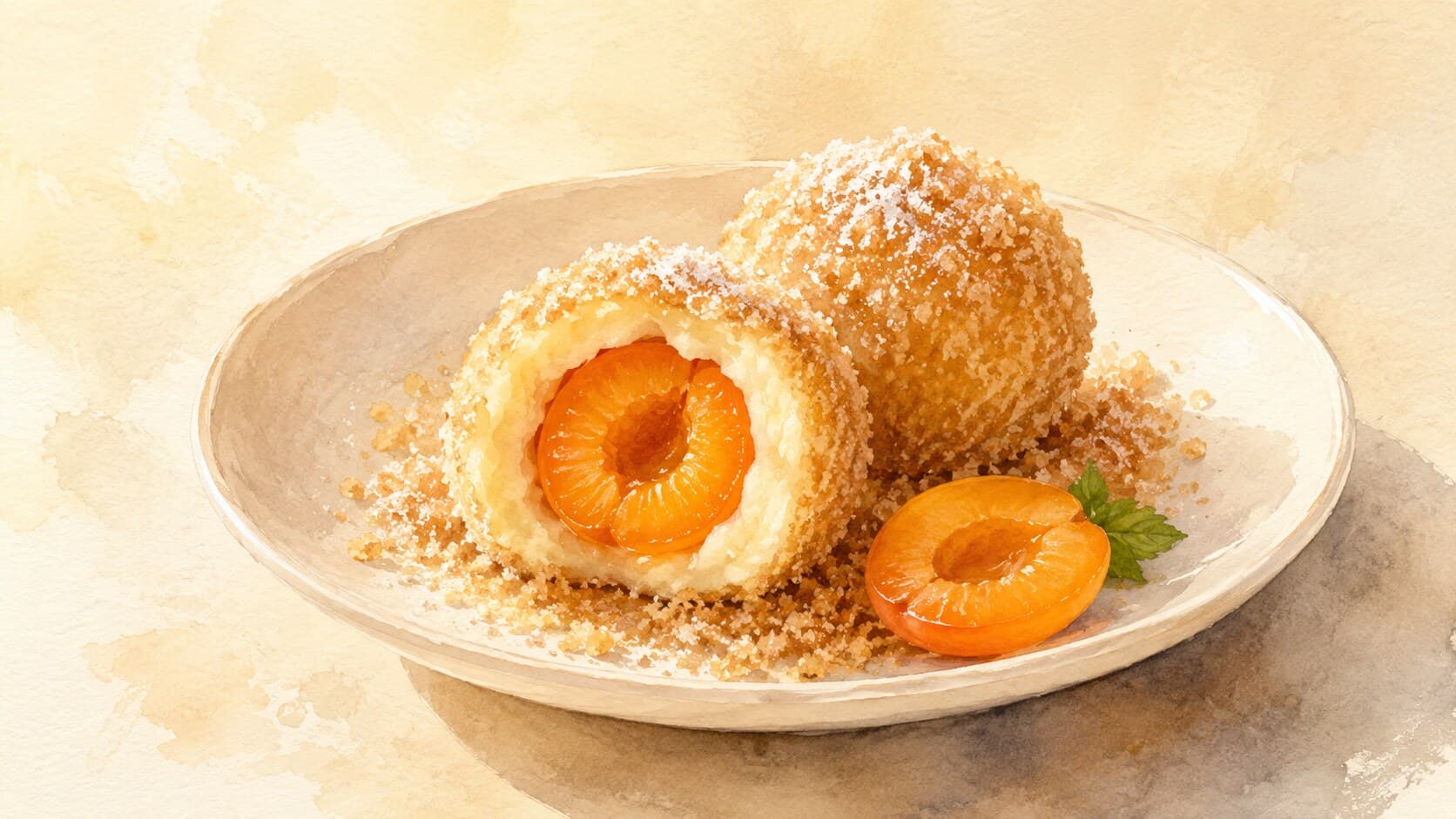
Delight in the exquisite taste of Marillenknödel, where apricots are enveloped in soft dough and finished with butter-toasted breadcrumbs.
Contents (5 sections)▾
Ingredients
- 4 whole apricots, pitted
- 4 sugar cubes
- 250 g potatoes, peeled and cubed
- 100 g all-purpose flour
- 100 g quark or ricotta cheese
- 1 large egg
- 50 g unsalted butter
- 100 g breadcrumbs
- Salt, to taste
- Powdered sugar, for dusting
Steps
Boil a pot of salted water over high heat. While waiting for it to reach a rolling boil, prepare the filling by placing a sugar cube inside each pitted apricot.
Cook the cubed potatoes in boiling water for about 15 minutes or until they are tender, checking for doneness with a fork. Drain and let cool slightly before mashing.
In a mixing bowl, combine the mashed potatoes, 200 grams of flour, 250 grams of quark (or ricotta), and 1 egg. Mix until a soft dough forms. If the dough feels too sticky, add a little more flour, about 10 grams at a time.
Divide the dough into four equal parts. Flatten each piece in your palm and wrap it around an apricot, sealing it completely. Ensure there are no cracks in the dough.
Once the water is boiling, carefully add the dumplings. Boil for about 10-12 minutes; they are ready when they float to the surface, which typically occurs around the 10-minute mark.
While the dumplings are boiling, melt 50 grams of butter in a skillet over medium heat. Add 100 grams of breadcrumbs and toast until golden brown, stirring frequently for about 3-5 minutes to prevent burning.
Remove the dumplings from the water with a slotted spoon and roll them in the toasted breadcrumbs. Dust with powdered sugar before serving.
Why this works
Marillenknödel (Austrian apricot-stuffed dumplings) combines the sweetness of apricots with the softness of dough and the richness of butter-toasted breadcrumbs, creating a delightful contrast in textures and flavors. The process starts by replacing the apricot pits with sugar cubes, which melt during cooking, infusing the fruit with sweetness and moisture. The potato or quark (a soft fresh curd cheese, similar to ricotta) dough is key: it provides a tender wrapping that allows the fruit to cook gently while maintaining its shape. If the dumplings break during boiling, it often means the dough was too wet or not sealed properly; in such cases, you can dust the outside lightly with flour or try boiling them at a slightly lower temperature of around 85°C. This technique of wrapping ensures that your dumplings remain intact while allowing the flavors to meld beautifully. The final touch of toasted breadcrumbs adds a nutty flavor and enticing crunch, enhancing the overall dessert experience. The balance of flavors and textures is what makes this dish a classic in Austrian cuisine, showcasing the simple yet profound beauty of traditional ingredients.
Common mistakes
Hot mashed potato added to the flour, so the gluten over-activates and the dough turns rubbery. The classic potato-dough trap: you mash hot potatoes and immediately mix in flour and egg. The heat partially gelatinises the starch, then the gluten over-develops as you knead — and the finished dough is tough, not tender. Target: potatoes cooked, riced or finely mashed, then fully cooled to room temperature before flour and egg go in. Mix only just long enough for the dough to come together. Why it matters: hot starch absorbs water differently — it traps the flour's gluten in an over-hydrated tight matrix. Cool starch absorbs gradually, giving you the soft "potato-pasta" feel that holds the apricot but yields gently to a fork. What to do: ideally rice the potatoes the night before and refrigerate. Or spread them on a tray to cool quickly. Mix just until no dry pockets remain — no kneading. If the dough is sticky, dust with a little flour but don't overwork it.
Dumplings cracked open during boiling — apricot juice in the water. This is the most common failure: a thin patch in the dough lets in water, the apricot inside softens, and the dumpling bursts. Hot water rushes in, sweet juice rushes out. Target: dough wrapped evenly around each apricot, sealed without any cracks. Boil at a gentle, not rolling, simmer. Why it matters: the dough is delicate by design (you want it tender to eat), so it has limited structural strength. A rolling boil mechanically batters it; a thin patch fails first. The internal apricot also releases steam as it heats, which puts the wrapping under pressure from inside. What to do: pat a circle of dough between your palms, place the apricot in the centre, lift the dough up around it, and pinch the seal closed at the top. Roll the dumpling between your palms to smooth the surface and erase any visible seam. Boil at 85–90°C — bubbles rising lazily, not a violent roll.
Dumplings undercooked — dough still doughy in the middle, apricot still firm inside. Marillenknödel must be boiled through completely. Half-cooked potato or quark dough is gummy and unsafe-feeling (raw starch + raw egg in the centre); half-cooked apricot is firm and bland. Target: dumplings boiled for 10–12 minutes total. They first sink, then float; once they float, give them another 3–4 minutes to finish through. Cut one open to check. Why it matters: the dumpling cooks from the outside in. The dough on the surface sets first, then the heat penetrates the apricot. If you pull them the second they float, the very centre may still be raw. Floating is a start signal, not a done signal. What to do: time from when they float — do not rush. Pull one out at 10 minutes total, slice it in half. The dough should be uniform and tender all the way through, the apricot soft and yielding. If either is still firm, the rest need 2 more minutes.
Breadcrumbs scorched while the butter heated — the topping tastes burnt, not nutty. The buttered breadcrumb coating is the second half of this dessert. Toast the crumbs too long or at too high a heat and you've made acrid carbon dust, not the warm nutty crunch the dish needs. Target: butter melted gently, breadcrumbs added and stirred constantly over medium-low heat until golden brown (about 3–4 minutes). Pulled off the heat the second they're done — they keep darkening in the residual heat. Why it matters: breadcrumbs are tiny — high surface area to mass ratio means they brown fast, then burn fast. The line between "toasted" and "burnt" is about 30 seconds. The milk solids in butter also burn around 150°C. What to do: keep the pan on medium-low. Stir constantly with a spatula, never leaving the pan. The crumbs go from pale → tan → gold → brown in real time. Pull at gold. If you see any speck of black, start over — burnt crumbs ruin the dish.
What to look for
- Dough that just holds together when you press a small piece between your fingers — neither sticky nor cracking. Sticky = needs a little flour. Cracking = needs a moment to rest and hydrate. Hold-its-shape-but-yielding = ready to wrap.
- Dumplings that float lazily to the surface, intact, without any apricot flesh visible. A bobbing dumpling that's gone clear-shape is sealed; a leaking dumpling will show orange streaks in the water.
- Dough inside that is tender all the way through, no gummy core when sliced. Cut one before serving all — this is the only honest doneness check. If the centre is sticky, give the rest a minute.
- Breadcrumb coating that is uniform deep gold, with no black flecks. A fine golden coating that smells of toasted nuts — not bitter, not pale. This contrast against the soft dumpling is the dish.
A note on history
Marillenknödel is the signature dessert of Austria's Wachau valley, a 33-km stretch along the Danube whose loess soils and protected basin happen to produce some of Europe's most prized apricots, the Wachauer Marille (which has a protected EU designation of origin) (TasteAtlas, Wikipedia). The dish is documented in 19th-century Austrian cookbooks — including Katharina Prato's influential 1858 Die süddeutsche Küche — as a humble peasant preparation that used the abundant summer apricot harvest. Both potato-dough and curd-cheese (Topfen) versions are traditional, with regional preference splitting roughly along Wachau / Upper Austria lines. Whichever dough you use, the dish is itself an act of regional identity: a way of saying "this is what summer here tastes like" (vienna.info).
Get the essays in your inbox — free
Weekly notes on flavor, fermentation, and food history — the writing behind the Atlas of Flavor. No spam; unsubscribe anytime.