
Mapo Nasu
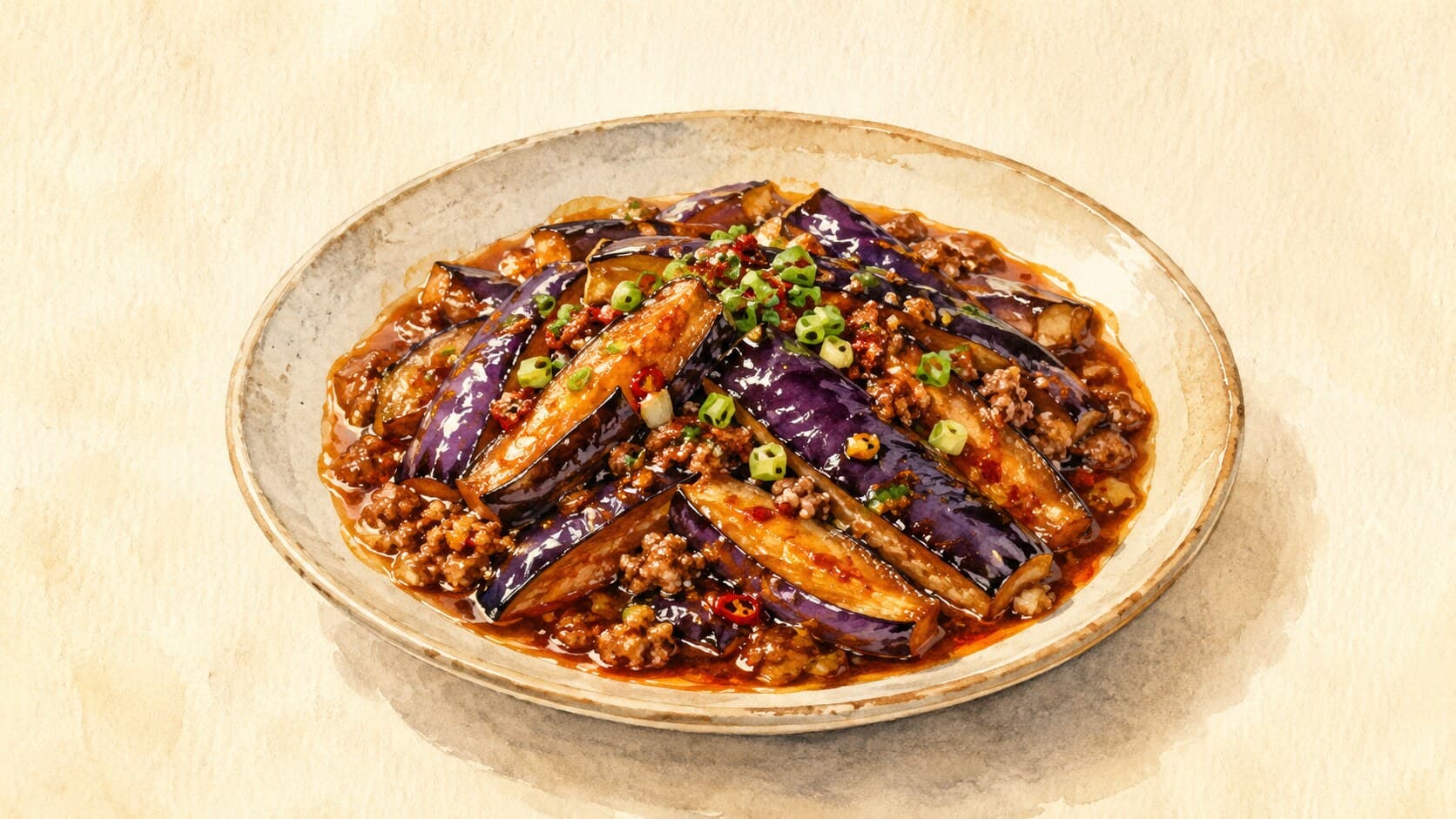
Savor the rich flavors of Mapo Nasu, a Sichuan-style dish featuring tender eggplant and ground pork in a spicy doubanjiang sauce.
Contents (5 sections)▾
Ingredients
- 500 g eggplant, cut into 2cm chunks
- 200 g ground pork
- 3 tbsp doubanjiang (spicy fermented broad bean paste)
- 3 cloves garlic, minced
- 1 inch ginger, minced
- 1 tsp Sichuan peppercorns, toasted and ground
- 3 tbsp vegetable oil
- 2 tbsp sesame oil
- 2 green onions, finely sliced for garnish
- Salt to taste
Steps
In a large pan, heat 3 tablespoons of vegetable oil over medium heat. Add the eggplant chunks and fry for about 8-10 minutes until they are tender and slightly golden. This step helps to reduce the eggplant's natural bitterness and enhances its texture.
Remove the eggplant from the pan and set aside. In the same pan, add the ground pork and cook over medium heat for about 5 minutes until browned and cooked through. Cook the ground meat until it reaches 71 °C / 160 °F on an instant-read thermometer (no longer pink throughout) — colour, float and time are guides, not the safety test.
Add the minced garlic, ginger, and ground Sichuan peppercorns to the pork. Stir-fry for 1-2 minutes until fragrant, releasing their essential oils.
Stir in the doubanjiang and cook for another 1-2 minutes, allowing the flavors to meld together. The doubanjiang is crucial as it provides the dish's signature spicy and umami profile.
Return the pre-fried eggplant to the pan and mix well to coat in the sauce. Cook for an additional 2-3 minutes to heat through.
Finish with 2 tablespoons of sesame oil for depth of flavor and adjust seasoning with salt to taste. Serve hot, garnished with finely sliced green onions.
Why this works
The technique of pre-frying the eggplant ensures that it becomes tender and absorbs the rich flavors of the doubanjiang sauce effectively. This method prevents the eggplant from becoming mushy when mixed with the meat and sauce, maintaining a pleasant texture. By toasting the Sichuan peppercorns, you release their aromatic qualities, enhancing the dish's flavor. If the sauce feels too thick, add a splash of water to loosen it up; if it's too spicy, balance the heat with a bit of sugar or additional sesame oil. The key to a successful Mapo Nasu lies in the balance of flavors and textures, making it an excellent weeknight main dish that showcases the versatility of eggplant over tofu.
Common mistakes
Eggplant added raw to the sauce, soaking up oil and going bitter. Eggplant is mostly air and water inside. Drop it raw into the sauce and it acts like a sponge — first sucking up all the oil, then releasing watery juices that thin the doubanjiang into a dull broth. Target: eggplant pre-cooked separately first — pan-fried in oil until lightly golden and just tender (about 6–8 minutes), then set aside. Brought back into the sauce only at the end. Why it matters: eggplant cells contain pectin and a lot of air. Pre-cooking collapses the cells and releases the water before the eggplant ever meets the sauce. After pre-cooking, the eggplant is no longer porous — it carries flavour on its surface instead of absorbing it greedily. Skipping this step is the single biggest reason home mapo nasu fails. What to do: cut the eggplant into 2 cm chunks, salt lightly for 10 minutes if you have time (draws out water), pat dry, then pan-fry in 2–3 tbsp of oil over medium-high heat until edges are golden and the flesh has collapsed slightly. Set aside on paper towels while you build the sauce.
Ground pork half-cooked or still pink in the middle. Mapo nasu is built on cooked ground pork. Minced meat has enormous surface area exposed to whatever bacteria were on the original cut — there's no safe "rare" for ground pork. Target: ground pork cooked until no pink remains anywhere in the pan. Centre temperature of the bulk should be at least 71°C (160°F). Why it matters: in a whole muscle cut, the inside is sterile and you can cook to a lower internal temperature. Ground meat is essentially all surface — anything on the cutting board, the grinder, or the package surface is mixed throughout the meat. It must be cooked through to be safe. What to do: break the pork up into small clumps in the wok and stir until every piece is grey-brown with no pink streaks. This takes about 4–5 minutes over medium-high heat. Then add the aromatics. If you see any pink before adding the doubanjiang, give it another minute.
Doubanjiang dumped in without blooming in oil. Doubanjiang (Sichuan fermented broad-bean chilli paste) is the flavour engine of the dish. Throw it in cold and you taste raw fermented bean — sharp, flat, one-note. It needs to bloom in hot oil first to release its colour and complexity. Target: doubanjiang stirred into the hot oil-and-pork base for 60–90 seconds before any liquid hits the pan, until the oil turns deep red-orange and the smell shifts from "raw paste" to "savoury-roasted". Why it matters: doubanjiang's colour and aroma molecules are fat-soluble. Hot oil dissolves them and carries them through the dish. The Maillard-like reactions of the soybean and chilli with the heat develop a roundness that raw paste lacks. What to do: push the cooked pork to one side of the wok, add doubanjiang to the cleared space with a little oil, and let it sizzle gently for over a minute. When the oil around it has turned a vivid red and you smell deeper roasted notes, then mix back in with the pork and add the eggplant.
Sichuan peppercorns added whole — gritty bites and uneven numbing. Whole peppercorns are wonderful, but only after toasting and grinding. Add them whole to the wet sauce and you bite into stinging gravel rather than the floating má (numbing) sensation that defines Sichuan cooking. Target: Sichuan peppercorns toasted in a dry pan for 30–60 seconds until fragrant, then ground to a coarse powder. Added near the end so the volatile aromatics don't cook away. Why it matters: Sichuan peppercorns contain hydroxy-alpha-sanshool, the compound responsible for the tingling-numbing sensation. The compound is volatile — toasting releases it, but extended boiling boils it off. Grinding releases the oils throughout the dish. What to do: toast over low heat just until you smell the citrus-pepper aroma rising. Cool, then crush with a pestle or pulse in a spice grinder. Stir most of it in at the end, off heat, and sprinkle a fresh pinch on the finished dish.
What to look for
- Eggplant chunks that hold their shape and have a glossy, sauce-coated surface — not a mushy interior, not a soaked-through interior. Pre-fried correctly, the eggplant is collapsed but distinct. Each piece reads as eggplant.
- Ground pork fully cooked through — every visible piece grey-brown, no streaks of pink. This is both a flavour and a safety check.
- Sauce that is deep red-orange and clings to a spoon, not watery. A thin sauce means the doubanjiang didn't bloom, or too much eggplant water entered the pan. Reduce briefly to fix.
- A faint citrusy tingling on the lips after the first bite — not gritty, not absent. That's the Sichuan peppercorns doing their work. Gritty = whole; absent = boiled too long or stale spice.
A note on history
Mapo nasu (mapo-style eggplant) is a 20th-century descendant of mapo tofu, the celebrated Sichuan dish whose recorded origin places it in Chengdu around 1862, during the Tongzhi reign of the Qing dynasty (Wikipedia, South China Morning Post). The name itself is striking: ma means "pockmarks" and po means "old woman", together referencing the dish's reputed inventor, Mrs Chen, an elderly cook with smallpox scars who served the dish to porters near a Chengdu bridge. The eggplant variant — mapo qiezi (麻婆茄子) — emerged later as a regional Sichuan adaptation. The Japanese-style mabo nasu sold in supermarkets today was popularised after 1984, when Japanese seasoning company Marumiya released a "Mapo Eggplant Sauce" mix, sweetened and milder than the Sichuan original (CUCH, No Recipes).
Get the essays in your inbox — free
Weekly notes on flavor, fermentation, and food history — the writing behind the Atlas of Flavor. No spam; unsubscribe anytime.