
Madeleines
Madeleines are small, shell-shaped sponge cakes made from a batter of flour, eggs, sugar, and butter, baked in a special mold.
Contents (5 sections)▾
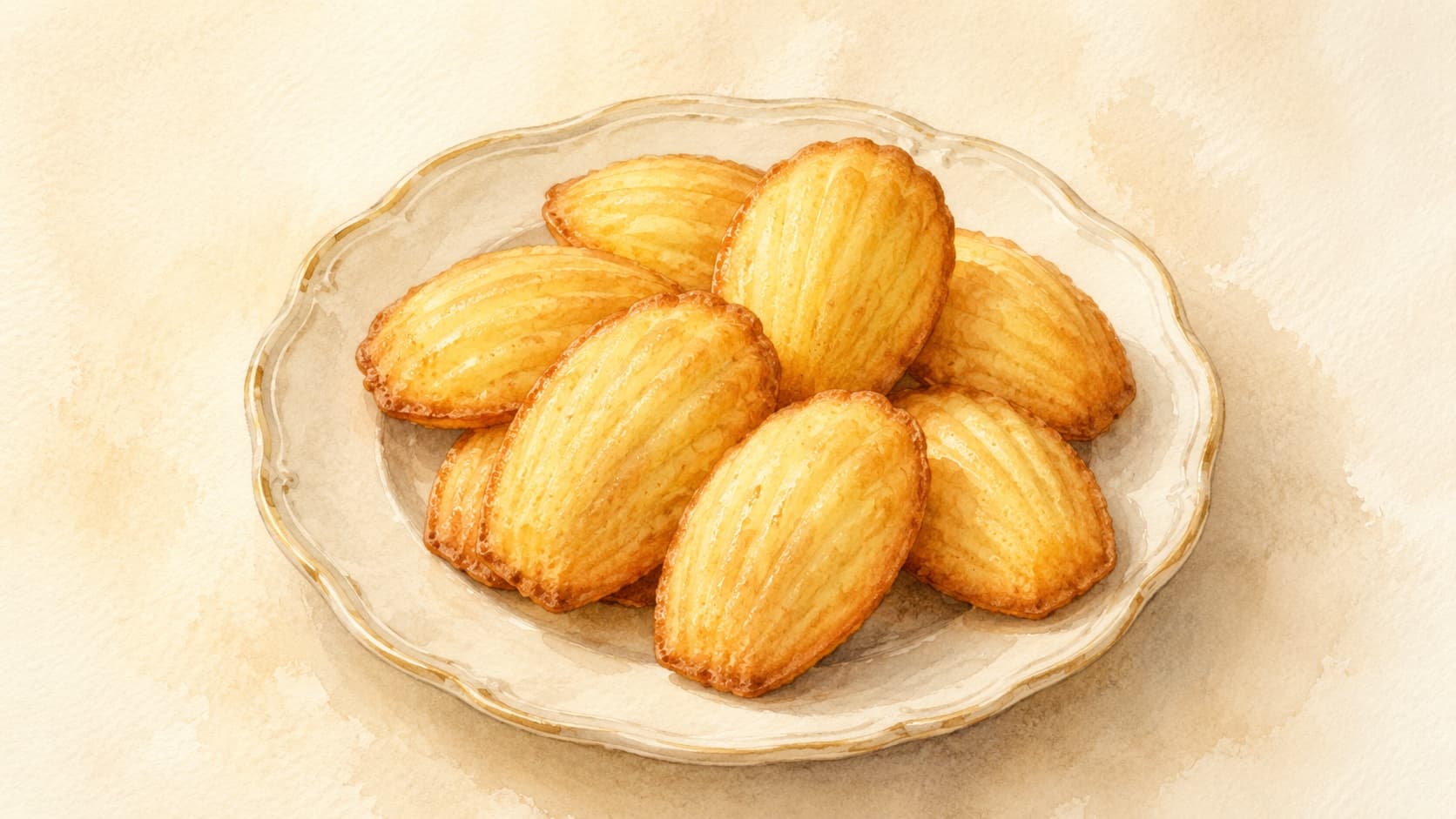
Ingredients
- 100 g unsalted butter, plus extra for greasing
- 100 g granulated sugar
- 100 g all-purpose flour
- 3 large eggs
- 1 tsp vanilla extract
- 1/2 tsp baking powder
- 1 pinch salt (approx. 1 g)
- 1 tsp lemon zest (optional)
Steps
1. Preheat your oven to 190°C (375°F). This temperature allows for the madeleines to rise beautifully and develop their characteristic shell shape.
2. In a small saucepan, melt the 100 g of butter over medium heat until it turns a nutty brown color (beurre-noisette), then set aside to cool slightly for about 5 minutes.
3. In a mixing bowl, whisk together the eggs and sugar until pale and fluffy, about 5 minutes. This aeration is crucial for the light texture.
4. Sift together the flour, baking powder, and salt. Gradually fold this into the egg mixture, being careful not to deflate the batter.
5. Gently fold in the melted butter and vanilla extract, ensuring not to overmix. If the batter seems too thick, add a teaspoon of milk to loosen it.
6. Grease the madeleine molds with butter and fill each cavity about three-quarters full with batter. Bake in the preheated oven for 10-12 minutes, until golden and springy to the touch.
7. Remove from the oven and let cool in the mold for 1 minute before transferring to a wire rack. Enjoy fresh or dusted with powdered sugar.
Why this works
Madeleines (small shell-shaped French sponge cakes baked in a scalloped mould) rely on the classic genoise technique, where the incorporation of air into the egg-sugar mixture creates a light and airy cake. The key to their distinct shape comes from the unique madeleine molds that allow the batter to rise and set in a shell form. The beurre-noisette adds a rich, nutty flavor and enhances the overall taste. If your madeleines break or do not rise well, ensure that the eggs are whipped sufficiently to incorporate enough air; if they are undercooked, then increase the baking time by 1-2 minutes, checking for a golden color and springy texture. Monitoring the baking time closely will yield perfect, golden madeleines. The baking temperature is also critical; too high can result in overly browned exteriors while the inside remains undercooked. If the batter seems too thick, it can be loosened with a splash of milk, ensuring a smooth consistency that bakes beautifully. This precise method guarantees a delightful treat that honors the tradition of French pastry-making.
Common mistakes
Skipping the cold rest, so there is no shell hump. The little belly that swells on the back of a proper madeleine — the bosse — comes from a temperature shock: cold batter hitting a hot mould. Skip the rest in the fridge and you get a flat, sad shell with no signature dome. Target: batter rested in the fridge for at least 1 hour, ideally 4–12 hours, before scooping into the moulds. Mould itself should also be cold (or at least room temperature) — not pre-warmed. Why it matters: the bosse is essentially a controlled rise. Cold batter (with chilled butter inside it solidifying) hits the 190°C mould, the surface sets quickly, then the chemical leavener (baking powder) erupts upward through the only available exit — the back of the shell. Without the cold-to-hot contrast, the rise spreads sideways instead. What to do: make the batter the night before. Pipe or scoop it into greased moulds straight from the fridge. If you want extra-pronounced humps, chill the filled moulds for 15 more minutes before they go into the oven.
Beurre-noisette poured in hot, scrambling the egg structure. The browned butter (beurre-noisette — French for "hazelnut butter", named for its nutty smell) is the soul of the flavour. But if you pour it hot into the egg-sugar foam, you cook the eggs locally and deflate the whole batter. Target: browned butter cooled to body temperature (warm but not hot to the touch) before being folded in. Why it matters: eggs start to coagulate around 62°C. Hot butter at 80°C+ poured into the foam will set patches of egg protein on contact, creating little scrambled spots and killing the air you whipped in. Air loss = no lift. What to do: after browning the butter, pour it into a wide bowl to cool faster. Wait until you can stick a finger in for a count of three without flinching. Then fold it in, gently, in a thin stream around the edge of the bowl.
Madeleines pulled out while still pale, undercooked in the middle. A madeleine that's golden on the ridges but raw in the centre is a real failure — pretty on the shell side, gummy on the inside. Target: baked through. A skewer inserted into the bosse should come out clean (no wet batter clinging). Edges should be a deep golden brown. Why it matters: the batter rises so dramatically that the outside can look done well before the centre is set. The interior needs to reach 95°C+ to be fully baked — a sticky toothpick means it's not there yet. Underbaked madeleines also collapse as they cool. What to do: at the 10-minute mark, peek. If the bosse has risen and the edges are golden, do the skewer test. If the skewer comes out with batter, give it another 1–2 minutes. Pretty colour is necessary but not sufficient — the skewer is the only honest test.
Madeleines left in the mould to cool, so they steam-stick. Pull them out too late and the trapped steam between cake and metal turns the shell side flabby; the cake also tears as you finally pry it free. Target: rested in the mould for exactly 60 seconds after coming out of the oven, then tipped onto a wire rack. Why it matters: the shell-side crust is delicate because it had direct contact with the hot mould. Leave it on a hot metal mould and you steam-cook that crust limp. A wire rack lets airflow under both sides. What to do: count to 60, then give the mould a sharp tap face-down on the rack. Properly greased moulds release immediately. Eat the same day — madeleines are at their best in the first few hours and stale by the next morning.
What to look for
- A clear shell-shape ridge pattern on top of every madeleine when you flip one over. That crisp ridge means the mould was well-greased and the batter set against the metal cleanly. A blurry ridge means greasing was uneven or the mould wasn't hot enough at first contact.
- A pronounced humped bosse on the back of each shell. This is the textbook sign of a successful madeleine — cold-batter-to-hot-mould thermal shock did its work. No bosse usually means no chilled rest.
- Edges deep golden, centre springs back when lightly pressed. Both at once — golden edge and springy centre — is the marker of fully baked. If only one is true, give it more time or check your oven temperature.
- A faint nutty, brown-butter smell when the oven door opens. That's the Maillard browning of the butter's milk solids continuing in the oven — the heart of the flavour. No smell means the butter wasn't browned deeply enough before being folded in.
A note on history
The madeleine story has two halves. The kitchen origin is a legend rather than a documented fact: a young cook named Madeleine Paulmier in Commercy, Lorraine, is said to have improvised the little shell cakes for the deposed Polish king and Duke of Lorraine, Stanislas Leszczyński, around 1755 — and he, charmed, named the cake after her (Opaleia, Connexion France). The literary half is fully documented: in Marcel Proust's À la recherche du temps perdu (1913), the narrator dips a madeleine into a cup of lime-blossom tea and is involuntarily transported back to his childhood at Combray. That single passage made the madeleine the most-cited cake in Western literature, and "a madeleine moment" became the shorthand for any sudden taste-triggered memory (Baking Like a Chef, University of Illinois).
Get the essays in your inbox — free
Weekly notes on flavor, fermentation, and food history — the writing behind the Atlas of Flavor. No spam; unsubscribe anytime.