
Lentilles Vinaigrette
Lentilles Vinaigrette is a French side dish featuring cooked lentils mixed with a tangy vinaigrette, highlighting emulsification and flavor balance.
Contents (5 sections)▾
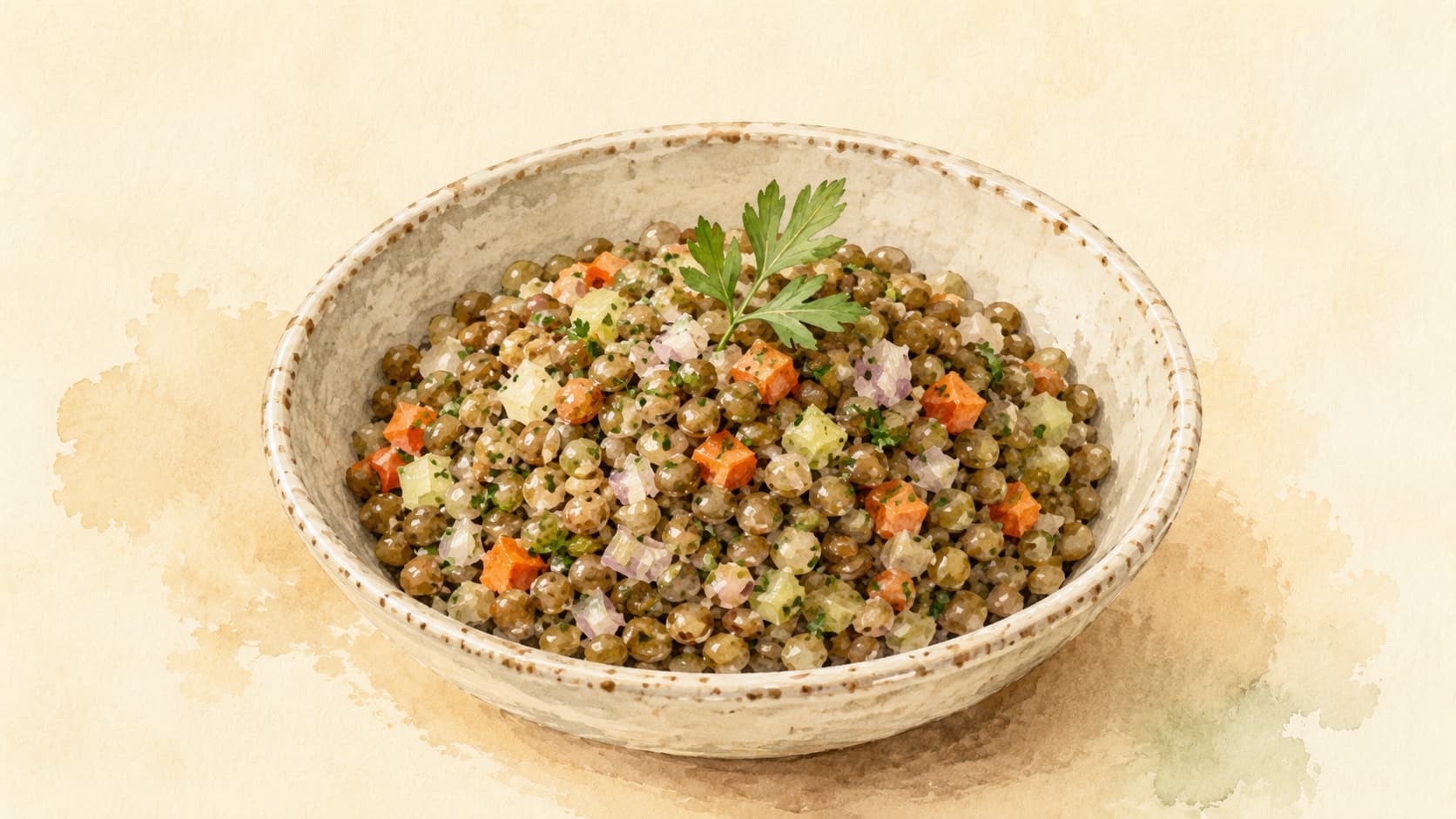
Ingredients
- 200 g French green lentils
- 1 small shallot, finely chopped
- 3 tbsp red wine vinegar
- 4 tbsp olive oil
- 1 tsp Dijon mustard
- Salt, to taste
- Freshly ground black pepper, to taste
- Chopped fresh parsley, for garnish
Steps
Rinse the lentils under cold water, then place them in a pot with 1 liter of water. Bring to a boil over medium-high heat, then reduce to a simmer for about 15 minutes until tender.
While lentils are cooking, in a small bowl, whisk together the red wine vinegar, Dijon mustard, salt, and pepper. Gradually whisk in the olive oil until emulsified.
Once the lentils are cooked, drain any excess water and let them cool slightly. Combine the warm lentils with the vinaigrette and shallots in a large bowl, tossing to coat.
Allow the lentils to sit for at least 10 minutes to absorb the vinaigrette flavors before serving. Garnish with fresh parsley.
Why this works
The combination of warm lentils with a tangy vinaigrette is a classic technique that enhances their earthy flavor while adding brightness. The key is to use French green lentils, which hold their shape well and have a nutty taste. The acid from the vinegar brightens and boosts their natural flavors. If the vinaigrette seems too sharp, adjusting with additional olive oil can mellow it out. Conversely, if your vinaigrette is too thick, whisking in a teaspoon of water can help achieve the desired consistency. This dish is a versatile accompaniment to many mains or can be enjoyed simply on its own as a salad. The rested time allows the flavors to meld beautifully, creating a cohesive dish that feels both rustic and refined.
Common mistakes
Lentils undercooked, chalky at the centre (BLOCK-level safety). Target: A lentil that crushes cleanly between thumb and finger, with no resistant core; tender but holding its shape. Why it matters: Undercooked legumes contain residual lectins and antinutrients (proteins that resist digestion and can upset the stomach) which require the lentils to be fully soft to be fully denatured. French green (Puy or Puy-style) lentils are prized because they hold their shape — but that virtue tempts you to undercook them. Shape ≠ done. Bite tells the truth. What to do: Simmer in plenty of unsalted water at a gentle bubble (not a hard boil — that breaks them) for 15–20 minutes. Test 2–3 lentils. Drain when uniformly tender; if some still resist, give five more minutes. Don't add vinegar to the cooking water — acid keeps the cell walls intact and slows softening.
Lentils boiled too hard, turning to mush. Target: Lentils with individually distinct, intact shells; some give underfoot but no broken purée. Why it matters: A rolling boil agitates the lentils against each other, breaking the seed coats; what should be a salad reads as a thick paste. The starch released also clouds the cooking water and clings to the lentils. What to do: Bring to a boil, then immediately reduce to a gentle simmer — the surface should ripple, not churn. Stir gently if at all. Once tender, drain at once; sitting in hot water continues cooking even off the heat.
Vinaigrette poured onto cold lentils — flavour stays on the surface. Target: Lentils carrying the vinaigrette's perfume through to the centre — not just glossed on the outside. Why it matters: Warm lentils' starch matrix is more porous; they drink the vinaigrette as they cool, carrying mustard, vinegar, and shallot deep into each pulse. Cold lentils have set; the dressing slides off into the bottom of the bowl, and you taste oil-on-lentil rather than seasoned lentil. What to do: Drain the lentils warm — still steaming — and toss with vinaigrette immediately. Then let the salad sit at room temperature 10–20 minutes for flavours to develop before serving. Adjust seasoning at the end; cooled lentils need more salt than they did when hot.
Vinaigrette broken or flat. Target: A creamy, opaque emulsion (oil and vinegar bound together) that clings to each lentil; bright at first taste, mellow at the back. Why it matters: A vinaigrette is held together by mustard, which contains natural emulsifiers (molecules that bridge oil and water). Without that, the oil and acid slick separately, the oil pools on top, and the salad tastes either flat or harsh depending on which the bite hits. Salt added late doesn't dissolve properly into the oil either. What to do: Whisk the vinegar, mustard, shallot, salt, and pepper first until the salt dissolves; then drizzle the oil in slowly while whisking. Taste before tossing — adjust acid if flat, oil if too sharp. Re-whisk just before pouring if it has rested.
What to look for
- A lentil that breaks open neatly between your teeth, no chalky white centre: the tender-but-intact signal that the salad is safe and digestible.
- Cooking water still mostly clear, not heavily clouded: the simmer was gentle enough; lentils kept their skins.
- Vinaigrette opaque and creamy when whisked, holding its colour for 30 seconds before any separation: the mustard emulsion is stable; toss now.
- A faint warm steam rising as you mix lentils with vinaigrette: the temperature is right for absorption — warm, not hot enough to dull the acid.
A note on history
Lentilles vinaigrette sits in the classic French bistro repertoire — a cold or just-warm salad of cooked lentils tossed with mustard vinaigrette and shallot — and is closely associated with lentilles du Puy, the small green-blue lentils grown around Le Puy in the volcanic Auvergne region of central France. Puy lentils have been cultivated in the region since at least the 17th century and were the first foodstuff awarded an Appellation d'Origine Contrôlée (AOC) for a vegetable, in 1996. The salad pairs naturally with classic French sausage dishes; petit salé aux lentilles and saucisson aux lentilles du Puy are bistro mainstays that use the same lentil base under richer toppings. Sources: French Lentils (French-American Cultural Foundation), Puy Lentils (Eat and Geek).
Get the essays in your inbox — free
Weekly notes on flavor, fermentation, and food history — the writing behind the Atlas of Flavor. No spam; unsubscribe anytime.