
Lentil Soup
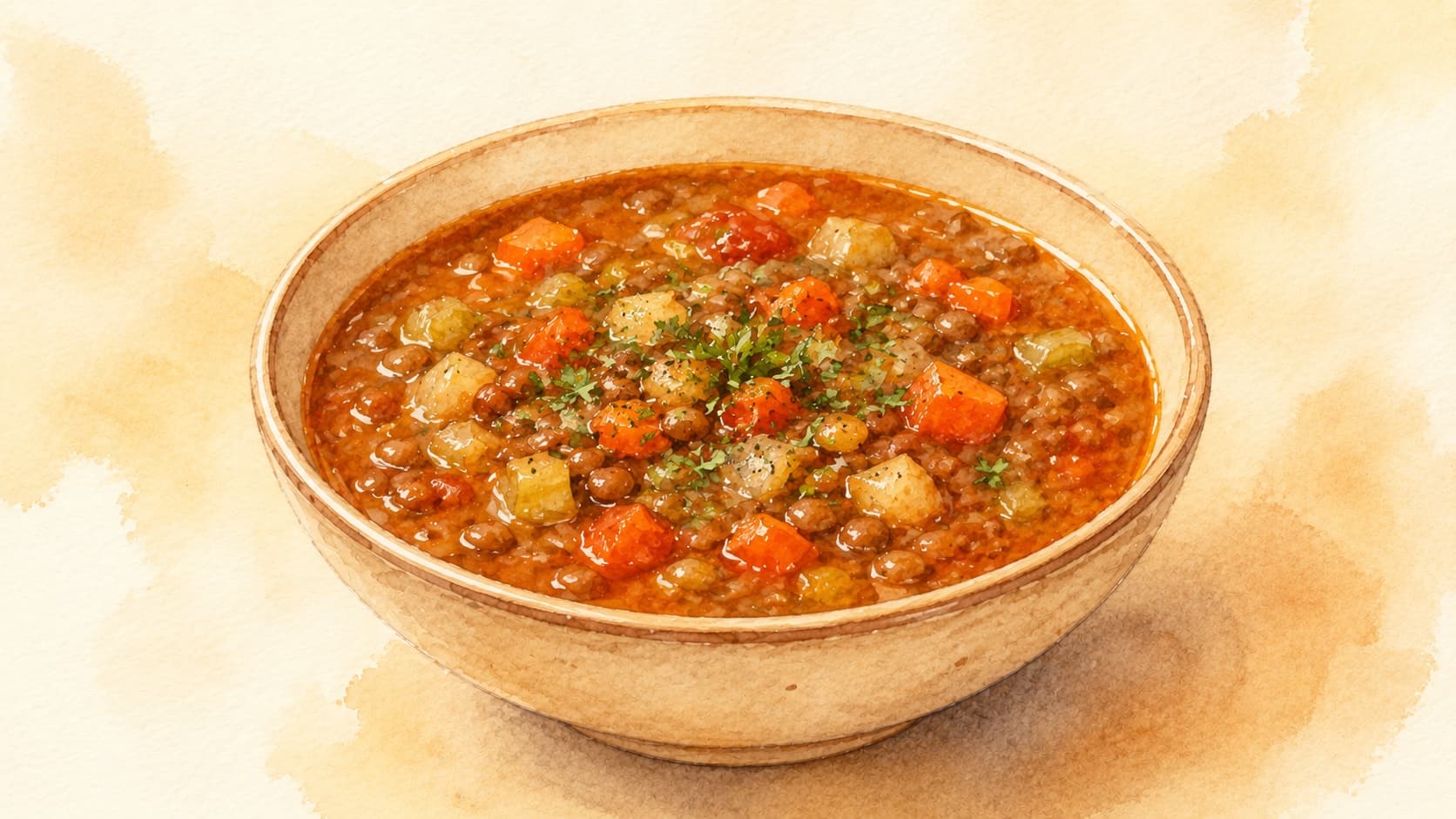
Lentil soup combines lentils, vegetables, and spices, simmered to develop flavors and achieve a balanced texture.
Contents (5 sections)▾
Ingredients
- 200 g lentils, rinsed
- 1 tbsp olive oil
- 1 onion, diced
- 2 carrots, diced
- 2 celery stalks, diced
- 3 cloves garlic, minced
- 1 tsp ground cumin
- 1 tsp smoked paprika
- 1.5 L vegetable stock
- Salt to taste
- Pepper to taste
- Fresh parsley, for garnish
Steps
In a large pot, heat the olive oil over medium heat. Add the onion, carrots, and celery; sauté for about 5 minutes until softened.
Stir in the garlic, cumin, and smoked paprika, cooking for an additional 1-2 minutes until fragrant.
Add the rinsed lentils and vegetable stock to the pot. Bring to a boil, then reduce heat and simmer for 20 minutes, or until lentils are tender.
Season with salt and pepper to taste. If the soup seems too thick, add a bit more stock or water to reach your desired consistency.
Serve hot, garnished with fresh parsley.
Tools you'll want
Why this works
Lentil soup is hearty and packed with flavors from aromatic vegetables and spices. The key to achieving a well-balanced soup lies in the layering of flavors, starting with the sautéed onions, carrots, and celery, known as mirepoix, which forms the aromatic base. Cooking the lentils in a flavorful stock enhances their natural taste and provides a rich, comforting profile. If the soup seems too thick, adding more stock or water will help achieve the desired consistency without compromising the taste. This flexibility allows for adjustments based on preference or available ingredients. Proper seasoning at the end is crucial; taste before serving to ensure the perfect balance. If it breaks, overcooking the lentils can lead to a mushy texture. To rescue a mushy soup, consider pureeing part of it for a creamy consistency while leaving some lentils whole for texture.
Common mistakes
Lentils not cooked fully tender (BLOCK-level safety). Target: Each lentil yields completely between thumb and finger; no chalky core when you taste one. The soup simmers until lentils are uniformly soft, typically 20–25 minutes for brown/green and longer for older lentils. Why it matters: Undercooked lentils, like other legumes, contain lectins and antinutrient compounds (proteins that resist digestion and can cause stomach upset) which heat denatures fully only when the lentils are properly soft. A chalky core means the centre never reached the temperature long enough. Beyond comfort: properly cooked lentils are digestible; undercooked ones are not. What to do: After bringing to a boil, simmer (small lazy bubbles, not a rolling boil) for at least 20 minutes. Taste two or three lentils — if any feel hard at the centre, give 5–10 more minutes. Old lentils from the back of the cupboard can take 40+ minutes; don't fight them, just cook longer.
Salt added too early, lentils stay tough. Target: Lentils softening evenly through cooking, taking on stock flavour. Why it matters: A common belief is that salt prevents lentils from softening; the modern consensus is that very heavy salting early can slow it slightly (the salt competes with water at the cell surface), and acidic ingredients (tomatoes, vinegar, lemon) definitely slow softening because acid stabilises the pectin (the natural glue holding cell walls together). Lentils added to an acidic broth from the start can stay firm for an hour. What to do: Salt lightly at the start to season the aromatics; reserve the bulk of salt for the end. Add tomatoes, vinegar, or lemon juice only after the lentils are tender — otherwise they hold their shape too aggressively.
Aromatic spices added raw without blooming. Target: A deeply spiced soup with rounded, integrated flavour, not gritty or harsh. Why it matters: Cumin and paprika contain fat-soluble aromatic compounds (the ones that smell warm and earthy). Adding them to the stockpot without first toasting in oil leaves the flavour raw and superficial. Heat in fat releases those compounds — a process called blooming — and turns dusty spice into a fragrant base. What to do: Add the spices to the sautéed mirepoix (the diced onion-carrot-celery base) 1–2 minutes before the lentils and stock. Stir until fragrant — about 30 seconds — but watch carefully; spices burn at the same temperature they bloom at, and burnt spices taste bitter.
Soup served thin and flat — no body, no finish. Target: A soup that coats the spoon lightly, with a brightening note (acid or fresh herb) that lifts the heavier flavours. Why it matters: Long-simmered legume soups can read as monotone — heavy and brown — without a final brightening. Acid (a squeeze of lemon, a splash of vinegar) wakes up the palate and resets it between bites; fresh herbs add aromatic top notes that long-cooked herbs cannot match. What to do: Just before serving, taste and add salt; finish with a squeeze of lemon or a half-teaspoon of red wine vinegar per bowl, plus chopped parsley. If too thin, mash a ladleful of lentils against the side of the pot and stir back in — instant body, no extra ingredient.
What to look for
- A lentil that yields cleanly between thumb and finger, no chalky core: the sign that they are tender enough to serve safely and digestibly.
- Mirepoix turning soft, sweet, and just slightly golden at the edges: this is the flavour foundation — flat, raw vegetables under the broth mean the base never built.
- Spices smelling toasty and warm rather than dusty as you stir them in: blooming is happening; pour in the stock the moment you smell them, before they burn.
- Steam smelling slightly sweet from the carrot's sugars and earthy from the lentil: the soup is alive; if it smells only of broth, the lentils haven't broken down enough — keep going.
A note on history
Lentils are among the very first cultivated crops, with archaeological remains dating to roughly 9,000 years ago in the Levant and the Fertile Crescent, and lentil soups appear in ancient Mesopotamian, Egyptian, and Greek diets. The most famous early reference is in Genesis 25, where Esau trades his birthright to Jacob for a bowl of red lentil pottage — evidence that simmered lentils were a staple in ancient Israel as early as the period the text records. Lentils sustained whole communities through the ancient world because they cooked relatively quickly compared to other legumes and dried well for long storage. Sources: Lentil soup (Wikipedia), Ancient Israelite Cuisine: Jacob's Lentil Stew (Tori Avey).
Get the essays in your inbox — free
Weekly notes on flavor, fermentation, and food history — the writing behind the Atlas of Flavor. No spam; unsubscribe anytime.